• Skip to primary navigation
  • Skip to main content
  • Skip to primary sidebar
  • Skip to footer

Pro Blog Service

  • Business Blogging
    • Blogging and Content Marketing for Search Engine Optimization (SEO)
    • Social Media Strategy and Consulting
    • Blogging Services
    • Content Factory
    • Need a Law Blog or Legal Blog?
    • Download Our White Paper: Business Blogging: The Cost of Corporate DIY Blogs vs. Ghost Blogger
    • Pro Blog Service Books
  • Blog
  • Speaking
  • About Pro Blog Service
    • Erik Deckers
    • 4 Simple Rules for Guest Posting on Our Blog
  • Get Ghost Blogging Quote
  • Link Sharing/Contributed Articles
You are here: Home / Archives for All Posts / Marketing

Marketing

February 13, 2014 By Erik Deckers

The Legend of John Henry Versus the Steam-Powered Content Machine

John Henry was a steel drivin’ man, digging tunnels in the mountains in West Virginia. He was the best there was. He would rear back with his hammer until it touched his heels, and drive steel spikes into the rock with one mighty blow, so the holes could be filled with dynamite, and the tunnels could be dug out. No one could work as fast or as well as John Henry.

One day, the big bad bossman told John Henry that he was going to be replaced by a steam driver, a monster machine that could outwork any man. John Henry told the boss that no machine could beat him, and he would die with a hammer in his hand.

The John Henry statue in Talcott, WV.

A race was set up between the two, man versus machine. The steam driver drilling holes into the rock, and John Henry hammer-slamming spikes home. The two combatants went at it so hard and so long, no one knew who was going to win that day.

Once the whistle blew and the time ended, not only had John Henry won the battle, the machine overheated and exploded from all the effort. A few seconds later, John Henry’s heart gave out, and he died, still gripping his mighty hammer.

While John Henry proved he was the better man, progress never stops. The machine was fixed, and the workers were still replaced in the end.

The Machines Are Still Coming

A couple years ago, I wrote about how the content shock will flood the Internet with cheap, poorly-written content, which will make it harder for good content marketers to get their stuff actually read.

Except now it’s worse.

While writers have only had to worry about competition from other humans, now it’s computers that are able to write. And if anyone is going to be creating the content shock, it’s going to be machines that can turn out articles in seconds and minutes, not hours.

This is what worries me. Not the poor writers who blob together a few sentences that would barely pass high school English. But the machines that can actually do an acceptable job of it.

I worry about companies like Automated Insights or Narrative Science, creators of software programs that can automate writing. Automated stories like Narrative Science’s stories for Forbes about earnings previews of publicly traded companies. Or Automated Insight’s mechanically generated stories for fantasy sports leagues. All output is based on algorithms and formulas, and is built on the principles that made Mail Merge so cool in the 1990s.

Just dump in the data, hit the button, and the algorithms will select language from a vast dictionary of phrases based on differences in scores. Once you’re done, you have a fact-based article about how one team fared against the other, how this quarter’s results are better than last quarter’s, or what your web analytics actually mean month over month.

Now, a new piece of software, Articoolo, can take a few keywords, scour the Internet for other articles about that topic, and create one that gives you the gist of what else is being said on the Internet. It’s not great writing, but it’s “good enough.”

Not only is it mechanical and soulless, it still falls into that “mediocre” category that people have come to accept. They accept it because we’ve been conditioned to by all the crappy writing that’s come before it from people who don’t give a shit about the quality of their work.

The Machines Are Improving

The content created by computers now is much better than what was being plopped out just a few years ago. And it’s getting better, which is worse for human writers. In 2012, Kris Hammond, CTO and co-founder of Narrative Science, told The Atlantic that it’s “theoretically possible for the platform to author short stories,” although The Atlantic author believes it will never match the soul and emotion of a human-generated story.

(Does it matter? By all accounts, 50 Shades of Grey was poorly-written, but still earned nearly $100 million in 2013. So much for the soul and emotion of human writing.)

Combining a slackening of acceptable standards with an improvement in robot writing, and this is where most of the content flood will come from in the next five years. Hammond once told Wired magazine that 90% of the content on the Internet will be generated by automated writers by 2027.

While I worry that it means fewer humans will be writing content, Hammond says that’s not the case. Instead, it will be because the machines are generating more and more articles than ever before.

And that’s where Schaefer’s content shock is going to come from.

The John Henrys of the written word are facing the new-fangled steam drivers, and it’s about to get ugly. As decision makers lower their expectations about what’s good writing, that means they’re more willing to accept bad writing, or not-quite-human writing. It means that people will blindly accept writing that wouldn’t have passed muster 50 years ago, but is considered “good enough for who it’s for.”

I hope it doesn’t mean we’re going to die with a pen in our hands.

Photo credit: Gene1138 (Flickr, Creative Commons)

Filed Under: Blogging, Blogging Services, Content Marketing, Writing, Writing Skills Tagged With: blog writing, content marketing, writing

January 23, 2014 By Erik Deckers

Will You Survive The Content Shock?

We’re about to be deluged with a flood of content of Noah-esque proportions that could get so bad, we may have to actually pay people just to read our work.

At least that’s what Mark Schaefer is saying.

He says we’re about to enter a period of content shock, which is going to render content marketing unsustainable as a marketing channel.

Of course the volume of free content is exploding at a ridiculous rate. Depending on what study you read, the amount of available web-based content (the supply) is doubling every 9 to 24 months. Unimaginable, really.

However, our ability to consume that content (the demand) is finite. There are only so many hours in a day and even if we consume content while we eat, work and drive, there is a theoretical and inviolable limit to consumption, which we are now approaching.

This intersection of finite content consumption and rising content availability will create a tremor I call The Content Shock. In a situation where content supply is exponentially exploding while content demand is flat, we would predict that individuals, companies, and brands would have to “pay” consumers more and more just to get them to see the same amount of content.

I won’t lie. This scares me a bit. Basically, small content marketers who produce good work are going to be buried by Sturgeon’s Law.

(Scifi author Theodore Sturgeon once said “95% of everything is crap.” Actually, he said “crud,” but I like “crap” better.)

Still, in an age of the Walmartization of everything, there are experts and artisans who have survived the onslaught of cheap plastic crap cheapening their work.

If you want to survive the content shock, here are a couple things you need to remember.

You have to write better than everyone else

As much as it pains me to say it, you have to “write good content.” (Even though I still say it’s a stupid strategy.) But it can’t just be “good,” it has to be awesome.

Because most of the content that’s being put out by content marketers around the world is at best, just awful.

The Internet is already one example of Sturgeon’s Law, and we’ve managed to survive that so far. All this means is that there’s going to be more crap, and we just have to figure out a way to stay in the 5%, or even 1%.

The written word has been commoditized over the last few decades. Excellent writing was cheapened by pretty good writing, as publishing got cheaper. Pretty good writing was diluted by good writing, as people started blogging. And good writing is now being weakened by mediocre writing, as more businesses jump on the content train, and marketers will accept content from anyone and everyone who has a basic grasp of the English language.

If you want to outperform the flood, you need to be better than the mediocre crap that’s being passed off as “content.” You need to be better than the hacks and flacks who are calling themselves writers, just because they can construct a grammatical sentence.

You have to start “social media marketing” again

Plenty of social media veterans have stopped talking about “social media marketing” in favor of the new flavor of the day as being — inbound marketing, digital marketing, mobile marketing, blah blah blah — but businesses are only just now recognizing “social media marketing” is a thing.

But the content flood means that building relationships and being seen as an influencer is going to become important, even as it becomes more difficult. If nothing else, people will read your work because they trust you and know that you give them valuable insights.

If people buy from people they like, they’re certainly going to read stuff from people they like.

Lately I’ve been seeing a number of people inflating their Twitter and LinkedIn followings as a way to fake influence. They’re chasing numbers and growing their counts, but they’re not actually doing anything important or valuable.

That’s not influential, that’s just stupid.

I will never follow anyone with 20,000 followers and only 1,000 tweets. I can’t believe those 1,000 tweets are so awesome that 20,000 people shrieked “I have to be a part of this!”

High followers + low tweets = you cheated. It doesn’t mean influence.

There’s no secret to being influential. You need to start building it three, four, five years ago. If you didn’t, don’t scam your way to the top. Slog it out like the real influencers.

The content shock may be inevitable, but that doesn’t mean you can’t survive it. It means you have to work harder, write better, and be more trustworthy than everyone else. It means adding followers one and two at a time, by building genuine relationships with them.

Let all the hacks and fakers flail away at an ever growing mountain of utter crap. Stick with your own little patch and grow it by by bit. It may not be huge, but it will certainly be more effective and appreciated than those who muddled their way through and never actually contributed anything.

Photo credit: Luke Zeme Photography (Flickr, Creative Commons)

Filed Under: Blogging, Content Marketing, Marketing, Social Media, Social Media Marketing Tagged With: content marketing, personal branding, social media marketing, writing

December 23, 2013 By Erik Deckers

My Social Media and Content Marketing Predictions for 2014

It’s the annual end-of-year-what’s-happening-next-year prediction time, something I have proved to be very bad at ever since 1997, when I got pissed at the Indianapolis Colts for cutting quarterback Jim Harbaugh and bringing in some hick rookie from Tennessee to take over a playoff contending team.

This guy. It was this guy.

But I’m going to keep trying, because as my fantasy football record shows, there are people who are even worse at making predictions and they still get to keep their high-paying TV jobs. Apparently a 3-for-10 success rate is good enough in baseball and sports predictions, so if those idiots can make it, I’m certainly not giving up.

Here are my three social media and content marketing predictions for 2014.

1. Facebook’s and Twitter’s replacements will be born in 2014

I’m not saying Facebook and Twitter are going to die, but I think people are getting sick enough of their shenanigans that the networks that come after the two giants will be born in 2014. We just won’t realize what they are until a couple years later, when there’s a frog-in-slowly-boiling-water migration to the two newcomers. Keep your eyes peeled for Twitter alternatives next year and claim your favorite username while you still have time.

Part of me still hopes App.net could be Twitter’s successor — I even put $50 into their Kickstarter campaign in 2012 — but I haven’t used it enough to know how well it’s doing.

2. SEO professionals are going to continue to suffer

Google is never as happy as when they’re messing with search engine optimization professionals. The last three years of SEO changes have seen the end of many strategies that the cheaters and spammers employed to trick Google. The latest nail in the SEO’s coffin iteration of Google’s algorithm, Hummingbird, not only made high quality content a requirement, they also stopped reporting keywords, making it harder for SEOs to know why people came to their site in the first place.

These changes are going to continue until the only thing an SEO professional is good for is reading the analytics reports (and there are software packages that can make pretty dashboards with the click of a button). 2014 isn’t going to let up on them either. Look for another major shift in Google’s algorithm, and the continued closing of SEO companies that refuse to make the switch from code chaser to writer/video producer/audio engineer.

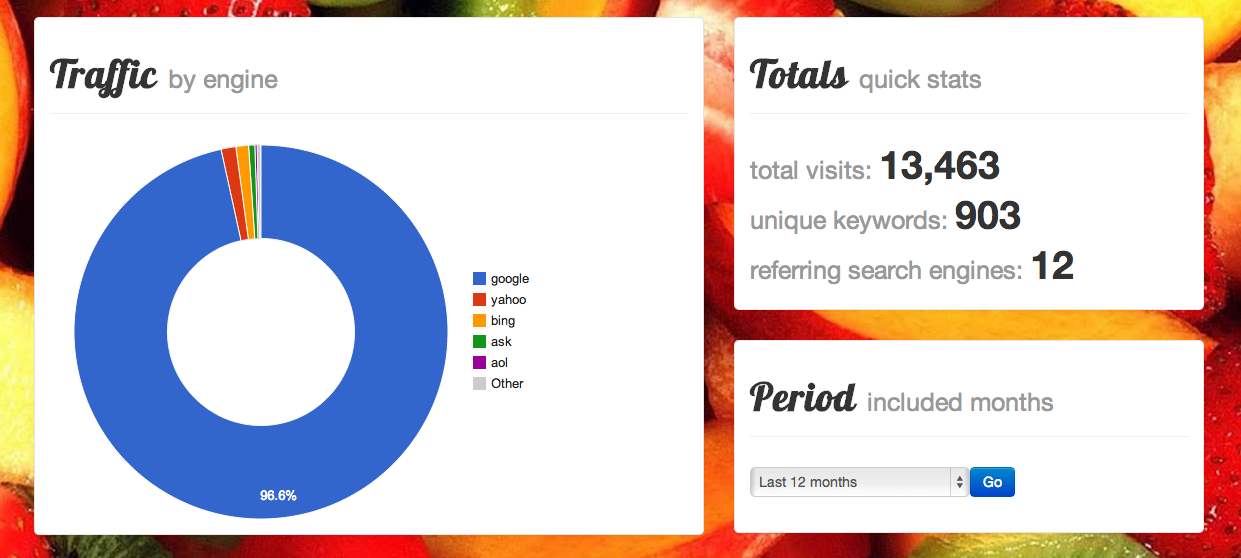
This is a screenshot of SERPFruit’s analytics dashboard. Just connect it to your Google Analytics and get simple charts for your organic traffic.

3. Content marketing will become the new trend

Remember when everyone was clamoring for social media? Ah, those were the heady days. When a 26 year old could get hired as the VP of social media at a fast food chain, and when interns and recent college grads were handed the keys to the most public-facing communication channel a company had. Media had not been that much of a Wild West frontier since the very early days of radio when anyone with a transmitter could call themselves a radio station.

Now that everyone has calmed down about social media, and it’s becoming just another marketing channel, it looks like content marketing is becoming the Next Big Thing. There are companies, websites, and entire conferences dedicated to content marketing, and we’re starting to see predictions like three Fortune 500 companies will hire chief content officers. That does seem a little specific — what’s next, chief video officers? Chief analytics officers? Remember, a Chief ____ Officer is one of the most senior executives in a company. A Content Marketing Director seems more likely — but it does illustrate how important companies will realize content is to their marketing efforts.

It also means there’s potential work for all the professional journalists who have been losing their jobs at the newspapers and magazines. My only hope is that the same people who were hiring the college kids to run their social media marketing will actually take the time to find the best writers, and not assume that everyone who was born with a computer on their lap knows how to write.

Look to see an increase of content marketing production hires, as well as an increase of content marketing spending by CMOs, not only to the detriment of traditional marketing, but maybe even social media and (hopefully) SEO as well.

Okay, maybe “predictions” is a strong word, but based on the trends of 2013, I can only assume that numbers 2 and 3 are going to continue in the new year. Pay close attention to history, kids, because that’s where you’re going to learn your most valuable lessons.

By my count, I’m 6 for 10 in my social media predictions over the past three years, which is twice as good as the football pundits who rumble about their picks every Sunday morning. I’m hoping this year’s predictions can boost my total, thus helping me forget my Peyton Manning flub 16 years ago.

Filed Under: Content Marketing, Marketing, Social Media, Social Media Marketing, Social Networks Tagged With: App.net, content marketing, Facebook, social media marketing, Twitter

December 4, 2013 By Erik Deckers

Bad Content Is Worse Than No Content

Yes, that’s right. You’re actually better off to have no content whatsoever on your blog than to put up bad, or even mediocre, content. That’s because bad content will drive people away forever.

Jake Athey’s recent post on The Next Web, Bad content is worse than no content: How to create stuff that doesn’t stink argues that customers will judge you and your website based on the content they find.

Visiting a website with filler content is a lot like walking into a living room and finding a coffee table book like “Extraordinary Chickens” or “United States Coinage: A Study By Type.” As a visitor, you’re under no obligation to read either book, but you have to question the judgment of the person who chose them.

You can see the original French version of this billboard here.
As Kyle Lacy and I said in Branding Yourself, you’re better off not being on a social network than only being on it sporadically, because it shows you’re not committed. A complete absence, while not desirable, is understandable.

So how much worse is it that your bad content, even regularly-posted content, is worse than not being on there at all, or even on it sporadically? How bad does it have to be that “no content” is preferable?

In his post, Athey offers three tips to creating good content:

  1. Set a measurable goal.
  2. Give your visitors what they want.
  3. What can we offer that nobody else can?

The underlying idea of Athey’s article is that everything needs to be well-written or well-produced. As he said, “anyone can produce Web copy, infographics, videos, slideshows, white papers, blog posts, cartoons and interactive gizmos – but not everyone can do it well.”

Doing it well is going to give visitors a reason to show up. Being “good enough” is no longer good enough. Good enough gets you the bronze. Winners do it well.

Content First, Design Second

Remember, content is not filler. It’s not the stuff you drop in once you’ve got your beautiful design all finished. Content is the whole reason people come to your website. They want to read, see, and hear what you have to say about your product or service. They’re not there to see your color scheme, font choice, or layout.

If you put content first, and design second, everything will fall into place.

Your content has to:

  1. Be well-written. This above all else: to thine own words be true. You can’t just write like a high school student. Don’t use too many words, or needlessly big words. Use proper spelling and grammar. Writing is not one of those “good enough” activities. Your content needs to be awesome. Don’t trust your content creation to someone who doesn’t have a passion for words. You may even want to hire a professional, because mediocre content can actually lose you money. (Consider it an investment.)
  2. Be interesting. I can take the most boring, tedious idea and write it perfectly, but it will still be boring. Boring content is usually overloaded with stats, overly technical, or uses enough qualifiers and jargon to make a scientist squeal like a 12-year-old girl meeting Justin Bieber. Unless you’re writing an academic paper or journal article where that kind of writing is actively encouraged, focus on writing to a general audience. Make your writing accessible.
  3. Use stories. You’ve heard it over and over in content marketing articles, but it bears repeating. Stories make points better than stats and concepts. As the holidays are coming up, pay attention to the nonprofit fundraising letters that come to your house. Every single piece will tell a story about a single adult/child/organization that needs your help. The story is the hook that gets you interested. Convey your information with stories first.

(Yes, I realize I’ve completely left out the infographic designers and video and audio producers from this list. I’m a writer, I do words. If you want something on infographics, videos, or podcasts, read back through the list and anywhere you see “writing,” put in your favorite medium.)

The Internet is so saturated that we’re at the point where bad content is toxic, and mediocre content is enough to drive people away. That means stop worrying about publishing every day, because you’re not giving us great or new ideas, you’re recycling the old ones. Publish when you have something interesting to say instead, and people will stick around to see what bit of awesomeness you’re sharing.

Focus on creating only the best content you can be proud of, something that you’d be willing to share if someone else had written it. If you can’t be proud of it, don’t publish it.

Photo credit: Urban Artefakte (Flickr, Creative Commons)

Filed Under: Blog Writing, Blogging, Content Marketing, Marketing Tagged With: blog writing, content marketing

November 20, 2013 By Erik Deckers

Ain’t No Party Like a PERQ Launch Party

If you’re involved in the Indianapolis tech startup scene, you already know about Verge, the startup community made up of entrepreneurs, programmers, and investors. We come together once a month, hear a few pitches from some exciting new startups, drink beer, eat pizza, and network with new people (and old friends).

Tonight was an especially huge night for Verge, because we were being hosted by PERQ, the new company formerly known as CIK Enterprises. They were hosting us because they were launching their new corporate identity and look. This was a mega launch party, the size of which I have not seen in Indianapolis in my nearly six years of doing social media and tech stuff.

PERQ was created when CIK consolidated several different companies they owned, and created this new enterprise. The previous three companies served clients in the newspaper, automotive, and retail industries. Because of this consolidation, they’re combining all forces to create a new marketing technology solution — FATWIN — to offer “business-branded games, contests, and sweepstakes with direct mail, email and advertising campaigns to attract in-store and online traffic.”

I first became acquainted with CIK and one of their companies, Tri-Auto Enterprises, when I worked at a local direct mail company years ago. In fact, I bumped into my old boss on the shuttle ride over from the parking lot, who was there for the PERQ launch. He hadn’t heard of Verge, so I was able to fill him in on what it was all about.

See? At first glance, you probably thought it was a real bookshelf too.
Not only were they launching a new company with new branding, they had a new look to their office. Everyone who attended got the grand tour of the office, including the conference rooms (complete with Legos for brainstorming, or at least looking creative), the open concept desks, the giant warehouse space turned meeting and collaboration space, the gym and weight room, and even the video broadcast booth. The whole building is so big, they even have Razor scooters for people to ride, like some sort of inter-office scooter share program. TKO Graphics created several of the wall decorations, including a gigantic bookshelf wall that I kept mistaking for a real bookshelf when I saw it from the corner of my eye.

All in all, it’s a gorgeous new space, and I kept wishing I worked there just because it looked so awesome. I might even be able to, because according to their press release, the company plans on hiring 30 new employees to deal with all their new growth and to help promote their new FATWIN technology.

FATWIN is an interesting new product that lets people enter promotional contests held by different companies using the service. From what I can tell, I can either join a company’s FATWIN promotion, or I can join FATWIN and join different companies’ promotions from there. My data is used only by the companies whose promotions I join, and they don’t sell it to third parties. From a data privacy standpoint, I appreciate this approach, because I can give my data only to the companies of my choosing, and not have to worry that some fly-by-night company is going to start spamming me two weeks later.

According to the FATWIN website:

FATWIN is a resource for people who love to win. It’s for people who love to play games, love to enter promotions, and hate to sign up for free stuff over and over again. Our goal is to be as transparent as possible — and for you to have a great experience while winning great prizes and discounts from your favorite brands.

For more information on PERQ, you can visit the website at . You can also follow them on Twitter at @perqmarketing.

Photo credit: PERQ

Filed Under: Marketing, News, Reviews Tagged With: Indianapolis, marketing

November 13, 2013 By Erik Deckers

Content Marketing the Kurt Vonnegut Way

One of the things I love about Kurt Vonnegut, and the reason I mention him in my writing talks, is his ability to create visual imagery in his writing.

I’ve been on a metaphors are better than similes kick lately — I’ll save that topic for another time — so I’ve been paying more attention to this in my reading. I saw an excerpt of a Kurt Vonnegut interview on a Paris Review blog post that reminded me of what makes him such an important writer.

In this particular segment, he’s talking about a 240 millimeter Howitzer he had done basic training on, the largest weapon in the US military at that time (WWII). The interviewer said, “It must have been a thrill to fire such a weapon.”

Vonnegut said:

Not really. We would put the shell in there, and then we would throw in bags of very slow and patient explosives. They were damp dog biscuits, I think. We would close the breech, and then trip a hammer which hit a fulminate of mercury percussion cap, which spit fire at the damp dog biscuits. The main idea, I think, was to generate steam. After a while, we could hear these cooking sounds. It was a lot like cooking a turkey. In utter safety, I think, we could have opened the breechblock from time to time, and basted the shell. Eventually, though, the howitzer always got restless. And finally it would heave back on its recoil mechanism, and it would have to expectorate the shell. The shell would come floating out like the Goodyear blimp. If we had had a stepladder, we could have painted “Fuck Hitler” on the shell as it left the gun. Helicopters could have taken after it and shot it down.

What caught my eye about Vonnegut’s answer is the way he describes how slow and inefficient the firing system was. He didn’t just say “it was slow” or fire off some witty simile about molasses and icebergs. Instead he took 13 sentences — using 15 metaphors and 2 similes — to explain how slow the gun was.

  • He referred to the “slow and patient explosives” as damp dog biscuits. That gives me an idea of the consistency and feel of the explosives, as well as their effectiveness. It also made me laugh, because I like the hard consonant sounds of the D’s, P’s, and K (in biscuit).
  • He said the sound was like “cooking a turkey,” and then followed it up with imagery of “basted the shell.” The fact that he said they could have done that in utter safety also shows how slow the process was.
  • The word “expectorate” means more than just “spit out.” It’s that thing old men do when they make that deep snk-k-k-k-k in the back of their throat and then spit. His term makes me think of old men retching up a gob of spit, which speaks to the thickness and fullness of what the gun was firing.
  • The idea of the floating shell is reinforced by the idea of them painting the shell as it left the gun.

This is also how good stand-up comics work. They take a single idea, a single incident, or even a single conversation, and expand on it. Vonnegut took “the gun was slow to fire” and turned it into a 165 word epic description of just how slow the firing process actually was.

As bloggers and content marketers, you can use the same techniques to convey ideas in your own writing. Rather than a detailed, lengthy, and technically accurate description, try using metaphors and similes to make your writing more easily understood. And interesting.

Filed Under: Blog Writing, Blogging, Content Marketing, Language, Writing, Writing Skills Tagged With: blog writing, content marketing, Kurt Vonnegut, metaphors, writing skills

  • « Go to Previous Page
  • Page 1
  • Interim pages omitted …
  • Page 10
  • Page 11
  • Page 12
  • Page 13
  • Page 14
  • Interim pages omitted …
  • Page 29
  • Go to Next Page »

Primary Sidebar

Subscribe via RSS

Categories

Tags

advice bloggers blogging blog writing books book writing business blogging citizen journalism content marketing copywriting crisis communication digital marketing Ernest Hemingway Facebook freelance writing ghost blogging ghostwriting Google grammar Jason Falls journalism language Linkedin marketing media networking newspapers No Bullshit Social Media personal branding public relations public speaking punctuation ROI SEO Social Media social media experts social media marketing social networking storytelling traditional media Twitter video writers writing writing skills

Archives

Recent Posts

  • The Enshittification of Evernote and Why I Quit Them
  • 11 Tips for New Digital Nomads
  • 13 Things to Do or Not to Do When Connecting With Me for the First Time
  • Why You Need to Write Your Memoir
  • How to Give a 6-Minute Presentation at 1 Million Cups

Footer

BUY ERIK DECKERS’ LATEST BOOK

Erik Deckers' and Kyle Lacy's book - Branding Yourself now available at Amazon

Request a Quote – It’s easy

We write blog posts, manage social media campaigns, write online press releases, write monthly news letters and can write your website content.

Let's figure out the right package for you.

FREE 17 Advanced Secrets to Improve Your Writing ebook

Download our new ebook, 17 Advanced Secrets to Improve Your Writing

Erik recently presented at the Blogging For Business webinar, and shared his presentation "12 Content Marketing Secrets from the Giants of Fiction.

If you attended the event (or even if you didn't!), you can get a free copy of his new ebook on professional-level secrets to make your writing better than the competition.

You can download a copy of free ebook here.

© Copyright 2020 Professional Blog Service, LLC.

All rights reserved. Use of this site indicates your consent to our Privacy Policy and Terms of Use.

1485 Oviedo Mall Boulevard Oviedo, FL 32765
Call us at (317) 674-3745 Contact Us About