Using The Irony Mark or Sarcasm Mark

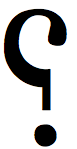
The reverse question mark, or irony mark, is used to denote irony and sarcasm.

The discussion and desire for an irony/sarcasm mark is one that has been making the Twitter rounds lately, and I may have accidentally stumbled upon the answer.

It seems the backward question mark, also called the rhetorical question mark or percontation point, has been the historic favorite, having been proposed by English printer Henry Denham back in 1580.

The reverse question mark, or irony mark, is used to denote irony and sarcasm.

The reverse question mark, or irony mark, is used to denote irony and sarcasm.

It’s an odd coincidence — but NOT ironic — that a 430-year-old mark may just find its usage in the 21st century, thanks to modern technology.

The problem is that twitterers and emailers have had a hard time denoting sarcasm, irony, and eye rollable statements. We’ve tried the :-| and the </sarcasm> marks, but every extra character takes up valuable space in a 140 character tweet.

So in our quest to show that we’re being snarky and sarcastic, social media people have been looking for a way to show their sarcasm in as few keystrokes as possible, which is why the irony mark can solve a lot of problems.

Unfortunately, it’s not that easy to get to at the moment.

If you’re a Mac user, there’s no easy way to do it. The best way to get it is to open up the Characters box (usually command-option-T). Then search for character 061f. When it comes up, insert it or copy and paste it.

If you’re a Windows user, I believe you can type the mark this way:

  1. Press and hold down the Alt key.
  2. Press the + (plus) key on the numeric keypad.
  3. Type one of these:
    • 2E2E
    • 61F
    • 061F

(Windows users, if this doesn’t work, please let me know. I haven’t done Windows for about 4 years, and I don’t remember how to enter Unicode.)

If you’re a Linux user, I didn’t think you guys got humor, so I don’t know if it’s even available to you. (Kidding! Just kidding! Some of my best friends are Linux users.)

Or you can just copy it here and save it somewhere else, like an Evernote document.

؟

I understand that the SarcMark is making its way into use, but unfortunately, as a Mac user, I can’t use it. Right now, it’s a Windows-only app that lets you use the SarcMark with a few keystrokes. The SarcMark looks sort of like the @ symbol, but with a period instead of the letter ‘a’ inside.

I also prefer Denham’s backward question mark because it’s historic. It’s over 430 years old, even though it was never widely used. Because of its longevity, it’s the one that many “we need an irony mark” proponents are already suggesting.

This may help people understand what irony truly is. It’s not an “odd coincidence” or “misfortune.” And it’s certainly not rain on my f—ing wedding day! Irony is when a statement conveys the opposite meaning of what you said.

So — according to Dictionary.com — if I say “that’s nice” when you tell me you got a flat tire, that’s irony. It’s not irony when you got a flat tire going to lunch.

And now, thanks to the irony mark, when I tweet you and say “that’s nice؟” you’ll know what I really meant.

Author :  •  Content Location : Indianapolis, IN  •  Copyright Year : 2011  •  Headline : Using The Irony Mark or Sarcasm Mark  •  Keywords : irony mark, backward question mark, rhetorical question mark, irony, punctuation  • 

Four Language Errors That Make You Sound Pretentious

There are some grammar errors people insist on perpetuating (not you, you’re awesome!). Some are just common errors that we all make. But others are errors people make in the hopes of sounding smarter or somehow official. (Think government talk or cop talk.)

I heard the first error — “an historic” — on NPR the other day, and thought of all media outlets, this one should know better. And it actually annoyed me so much, I not only shouted at the radio — “A historic, dammit! A historic!” — I wrote this post.

So here are four language errors people make that sound a little pretentious.A unicorn rearing back atop the Falcon Square Mercat Cross in Inverness, Scotland.

1) It’s Not An Historic

Just because you heard them say it on the BBC doesn’t make it true. The reason you say “an” anything is if the next word starts with a vowel sound. Not even a vowel — a vowel sound.

An apple. An MBA. An honorable profession.
A unicorn. A universal truth.

Say “historic” out loud. What sound does it start with? “H.” That’s not a vowel sound. Unless you’ve got a cockney accent, you didn’t just say ‘istoric. The only reason you’d say “an historic” is if you dropped the H sound in front of the word.

And since you’re not an 18th century bootblack, you’re going to keep the H and say “a historic.”

2) Bemused is not Amused

This is a tricky one, because “-mused” is the root word. People seem to think bemused is a form of amused, like it made you chuckle or smile slightly.

It isn’t.

Amused means you think something is funny. It means you found it slightly humorous. Bemused means confused or bewildered. It means you’re cocking your head like a puppy hearing a weird noise.

Bemused is not one step above amused. It’s not “more amused.” There certainly will never be “cemused.”

Just remember, bemused = bewildered.

3) You Don’t End Your Sentences With a Preposition EVER

Regular readers know that I hate and despise the “don’t end your sentences with a preposition” rule, because it’s wrong. However, not everyone got the memo, and some people are just mentally locked in to this idea. So I don’t begrudge the people who write this way, because they were bullied into thinking this is correct.

But if you speak that way, it’s like fingernails on a chalkboard.

It makes you sound like you’re trying too hard to be grammatically correct. But even most die-hard word nerds don’t speak like they write. They end their sentences with prepositions. They use slang. They have weird accents. But they don’t try to speak correctly all the time like an overenthusiastic school marm.

The most famous example is Winston Churchill telling an aide who misapplied the preposition rule to a speech, “this is utter nonsense up with which I shall not put.”

If you contort your brain and vocal cords to speak like this, you sound stilted and overly formal.

When you talk, end your sentences with a preposition, if that’s the way you would normally talk. If you’re not comfortable doing it, try to figure out a different way of saying what you wanted to say.

Like adding, “you know?” at the end.

4. Stop Saying “Myself” When You Mean “Me”

A lot of people say “myself,” when they mean “me.”

“Please email your questions to Bob or myself.”

I heard this a lot during my state government days. I think people did this to sound smarter or more official, but it’s wrong, so it negated any effect they were going for.

Using “myself” in most cases is almost certainly the incorrect usage. There are a few times you can use it — as a reflexive pronoun or an intensive pronoun — like “I see myself in the mirror” (reflexive) or “I built the workbench myself” (intensive) but that’s it. You would never use “myself” as the object or subject of a sentence.

Wrong: Give the cookies to myself.
Wrong: Myself baked some cookies.

The best way to see whether or not to use “myself” is to remove the other person — Bob — and see if the sentence makes sense: “Please email your questions to me.”

In this case, “email your questions to myself” just sounds wrong, so you know to use “me” instead.

We’re starting to learn that a lot of our hard-and-fast grammar rules are changing, either because common usage is rendering them unnecessary, or because they were never right to begin with (see #4 above). If you can avoid these, you can feel morally superior to people who make these mistakes in an attempt to sound smarter than everyone else.

I feel that way myself.

Photo credit: ranil (Flickr)

Author :  •  Content Location : Indianapolis, IN  •  Copyright Year : 2011  •  Headline : Four Language Errors That Make You Sound Pretentious  •  Keywords : language, writing, grammar, punctuation, speaking  • 

Five Writing Rules You’re Allowed to Break

Chances are, you’re repeating some grammar and writing rules as gospel, not knowing they’re completely wrong. Or that they changed. Or that they were never really rules to begin with.

Whatever the reason, you can stop doing them. In fact, you should stop doing them.

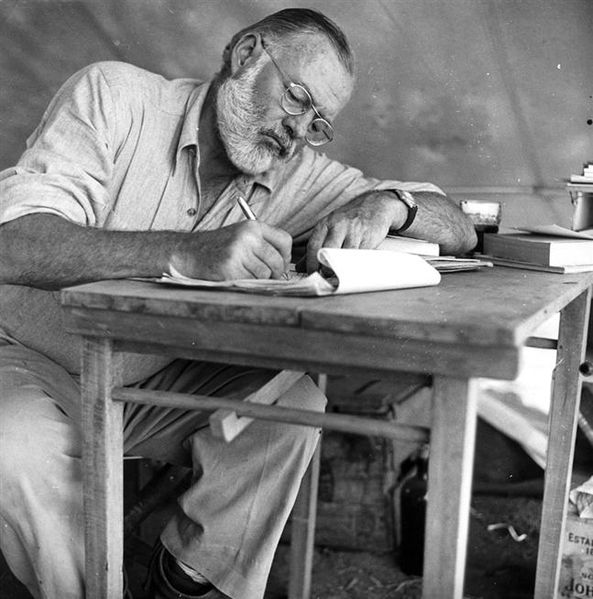
Ernest Hemingway

Ernest Hemingway - This guy knew a few things about writing and breaking rules.

I’m trying to undo the writing rules my daughter’s 8th grade teacher has been foisting upon her, showing her that they’re not really legitimate, but some arbitrary rule that someone made up to make our language fit a preconceived structure. The English language is an ever-changing organic system that defies most rules. The ones that were created hundreds of years ago — like “don’t end your sentences in a preposition” — was never correct. Other ones like “don’t use incomplete sentences” have changed.

1. You CAN end your sentences with a preposition.

This one doesn’t always work, but for a good bit of the time it’s true. The rule was created by a scholar, Robert Lowth, who wanted English to bend to the same rules as Latin. In the Latin sentence structure, it’s not possible to have a sentence end with a preposition. Ergo, said Lowth, English shouldn’t either.

But it’s wrong. There are times you have to end your sentences in a preposition. For example, let’s say you stepped in something that stinks, and your friend says to you, “In what did you step?”

Wouldn’t you look at her like she lost her mind?

In that instance, it’s perfectly okay to say “what did you step in?” It’s proper English, it’s grammatically correct, and it doesn’t sound completely idiotic.

On the other hand, “where’s it at?” is wrong.

The basic rule is that if you can remove a preposition and the sentence still works, you shouldn’t use the preposition. But if you remove it, and the sentence changes, you should leave the preposition at the end.

Okay: What did you step in?
Not Okay: Where is it at?

2. You CAN start a sentence with And, But, or Or.

This may have been a real English class rule at one point, but no longer. Common usage has rendered it obsolete. People talk this way. People write this way. It may not be completely accepted in business writing, but I can foresee that hurdle breaking down in the next ten years as more business people speak that way.

Besides, it looks pretty cool. And dramatic. And punchy. And intense.

And it turns out the practice has been around since the 10th century. It’s just some arbitrary rule our English teachers liked to enforce without ever knowing why.

3. You don’t have to start with the dependent clause first

A dependent clause is that sentence clause that can’t exist on its own. “Before the trial even ended” is a dependent clause (also called a subordinate clause). And we were told that you needed to start sentences with a dependent clause.

“Before the trial even ended, the real killer had been arrested and the defendant was set free.” not “The real killer had been arrested and the defendant was set free, before the trial even ended.” Even though you might want the important information at the front of the sentence, our teachers told us to put the dependent clause first.

You don’t have to do that anymore. For one thing, it sounds clunky. For another, there are times where the dependent clause will get in the way. Third, there are times a dependent clause needs to be set apart in a different way.
“The real killer was arrested — before the trial even ended — and the defendant was freed.”

It doesn’t always fit at the end, but it doesn’t always have to go first either.

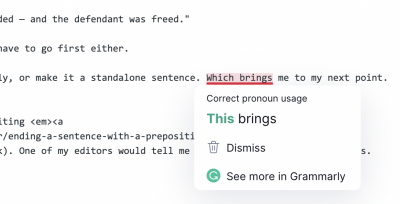
Your better bet? Eliminate the dependent clause completely, or make it a standalone sentence. Which brings me to my next point.

4. You CAN use incomplete sentences.

This was a very minor point of contention while I was writing Branding Yourself (affiliate link). One of my editors would tell me not to use incomplete sentences.

Like this.

“But it’s a style choice,” I would say. “Not a grammar issue.”

And while you don’t want to make that a regular habit, stylistically, it doesn’t hurt to do it once in a while. It’s another common usage issue, where enough people have begun doing this that the grammar sticklers have to bow to majority rules and allow the change in the accepted use. (They don’t have to like it, and they’ll talk about it at dinner parties, but they’ll generally leave you alone about it.)

They also add some punch and drama to your writing, whether it’s fiction or nonfiction. Pepper them occasionally throughout your writing and see what it does for you.

5. A sentence does not always contain a subject, a verb, and an object. A paragraph does not always contain 3 – 5 sentences.

Journalists violate this rule all the time.

Because it’s a dumb rule. And untrue.

For one thing, people read differently than they did 30 years ago. We’re so impatient that we don’t want to read a lot of text. We need white space to break up the monotony of the Tolstoy-esque blocks of text we find in some books, tech manuals, and magazines. If you’ve ever looked at a page with a lot of tiny text and no breaks at all, you know what I’m talking about.

Newspaper publishers learned a long time ago that people won’t read long paragraphs and über-long sentences. So they encouraged writers to use short punchy words, short sentences, and short paragraphs.

Even one sentence paragraphs.

My daughter has been told her paragraphs all need to be 3 – 5 sentences long, and I keep telling her it’s not only unnecessary, but it leads to bad writing. If you try to fill up every paragraph with 3 – 5 sentences, you start writing filler just to get there.

But if you keep some extra white space in your writing — by using short paragraphs — people are more likely to continue reading long beyond when they thought they would quit.

How about you? What writing rules do you gladly (or unwittingly) violate? Are there rules you wish you could break? Leave a comment and let me know.

Author :  •  Content Location : Indianapolis, IN  •  Headline : Five Writing Rules You're Allowed to Break  •  Keywords : writing, writing rules, grammar, punctuation  • 

Did Merle Haggard Marry Two Men? Another Reason to Use the Oxford Comma

Photo from newspaper about Merle Haggard

Did Merle Haggard marry Kris Kristoferson and Robert Duvall?

Of course not! Don’t be stupid!

But you might not know it if you look at a newspaper clipping from an unnamed newspaper (which was originally posted on James Joyner’s Outside the Beltway blog, “Merle Haggard and the Gay Serial Comma“). The clipping features a photo of the country music star with the caption, “The documentary was filmed over three years. Among those interviewed were his two ex-wives, Kris Kristofferson and Robert Duvall.”

Photo from newspaper about Merle Haggard

Look very carefully at the last 9 words — “his two ex-wives, Kris Kristofferson and Robert Duvall.” The sentence, as it’s written, looks like Rural Merle was married to Kristofferson and Duvall.

That’s because the newspaper forgot to put the Oxford comma after “Kristofferson.” If they had, it would look like the documentary interviewed four people: two ex-wives, Kristofferson, and Duvall.

But the Associated Press typically does not use this device, and as a result, most newspaper writers and editors have taken it to mean “There will be NO Oxford Commas EVER!” What they forget is that the Oxford comma may be used if it will clarify a confusing sentence. And the sentence about Merle Haggard’s marriage partners is about as confusing as it can get.

Adding the Oxford comma would have told us that Kristofferson and Duvall were not part of the previous group, “his two ex-wives,” but rather, were two additional people. It’s exactly like the book author who dedicated his book “To my parents, the Pope and Mother Teresa.”

I may have the occasional argument with an editor or punctuation stickler about the use of my beloved Oxford comma, but I have never seen an instance where using the Oxford comma caused confusion. On the other hand, there are occasions where blindly adhering to the “no Oxford comma” rule can cause all kinds of confusion. Or at least raise some interesting questions.

Author :  •  Content Location : Indianapolis, IN  •  Headline : Did Merle Haggard Marry Two Men? Another Reason to Use the Oxford Comma  •  Keywords : Associated Press, grammar, newspapers, Oxford comma, punctuation, writing  • 

Why You Should Put One Space After a Period, not Two

This post was originally published on March 5, 2009 at DeckersMarketing.com, which has been retired.

I raised a bit of a Twitter ruckus this morning, when I posted the following tweet:

# Attention Unfrozen Caveman Lawyer: Here in the 21st century, we put 1 space after a period, not 2. That’s a typewriter thing.

It was just a random thought. Nothing sparked it, nothing set it off. I just like to post little pithy commenth every tho often.

I started getting replies from people I had never met, so I ran over to Twitterfallto see what was going on. Apparently, my little off-the-cuff random comment was sparking some serious conversation in Oregon, Texas, Massachusetts, and even England and Australia.

Typewriter keyboard

If you're not using one of these, you only need 1 space after a period.

Oopsie. People really like their two spaces after a period. That’s fine. It’s not wrong to do it, it’s just not necessary.

The rule came from our old typing classes, where we were told to use two spaces after a period. Younger people (i.e. punks and whippersnappers who never had to use a real typewriter) learned the two space rule from people who. . . learned to type on typewriters. (I learned from Mr. Carey, Typing 1 teacher, Muncie Central H.S., in 1983.)

According to Wikipedia, this double-spacing is sometimes called English spacing, although since the mid-1990s, it’s been called French spacing. (Insert your own joke about the French, cheese, and surrendering here.)

The reason for the two spaces is because typewriters use a fixed width font. That is, all letters were the same fixed width. The letters ‘i’ and ‘l’ take up the same space as the letter ‘m.’ To set the sentences apart from each other and make them easier to read, we used two spaces. This practice actually hearkens back to the typesetting days, when typesetters had to hand place each character and punctuation mark. They just stuck in a double space and the habit carried forward.

But unless you use Courier on your computer, today’s software programs use a variable width font like Arial and Times New Roman, which means the letter ‘i’ and ‘l’ take up a minimum amount of space, while the ‘m’ uses more. In fact, an ‘l’ is almost one-third the size of an ‘m.’ Take a look:

m
lll

In addition to this, the computer jams the period in tight against the last letter in a sentence, which creates a little extra space on the other side. If you could measure it, it would be microns of a difference, but the space looks bigger because of how the period is placed against that last letter.

The world is ignoring that second space

If you create websites, you’ll find that html will ignore any space after the first space. (And I know, I know, there’s a whole other controversy about whether it’s website, web site, or even Web site. That’s for a different post.)

Plus, there are some cases, like using Twitter or other micro-blogging services, when every character counts, you don’t want to waste a character on an extra space.

The net result of this variable width is that sentences are easier to read, which means the extra space is not necessary. Again, not wrong, just not necessary. (Okay, maybe a little wrong.)

This issue is not without its passionate controversy.

There were plenty of Twitterers who said I could have their extra space when I pried it from their cold, dead fingers. They learned to type on a typewriter, and are trying to break 30 – 40+ years of habit (it took me two weeks to quit doing it, and I had only been typing for 15 years at the time).

On the other hand, Luke Maciak at Terminally Incoherent said clients would count spaces in Word documents and send them back for revision if he didn’t use two spaces. Needless to say, he hated these clients.

So who’s wrong, and who’s right? Nobody, although I’m claiming moral superiority in this matter. I salute the traditionalists who want to stick with two spaces after a period. I love tradition and doing things old school (I still listen to radio theater). But I also see the need for ease of use, and eliminating extra keystrokes. And really, that’s what it’s all about.

(I’d be interested to see if someone has ever figure out what the saved spaces translates into for saved disk space.)

So what about you? Are you a single spacer or a double spacer? Why? If you’re a double, would you ever consider switching to single? Why not?

———-
A little more about it from the Chicago Manual of Style:

The view at CMOS is that there is no reason for two spaces after a period in published work. Some people, however—my colleagues included—prefer it, relegating this preference to their personal correspondence and notes. I’ve noticed in old American books printed in the few decades before and after the turn of the last century (ca. 1870–1930 at least) that there seemed to be a trend in publishing to use extra space (sometimes quite a bit of it) after periods. And many people were taught to use that extra space in typing class (I was). But introducing two spaces after the period causes problems: (1) it is inefficient, requiring an extra keystroke for every sentence; (2) even if a program is set to automatically put an extra space after a period, such automation is never foolproof; (3) there is no proof that an extra space actually improves readability—as your comment suggests, it’s probably just a matter of familiarity (Who knows? perhaps it’s actually more efficient to read with less regard for sentences as individual units of thought—many centuries ago, for example in ancient Greece, there were no spaces even between words, and no punctuation); (4) two spaces are harder to control for than one in electronic documents (I find that the earmark of a document that imposes a two-space rule is a smattering of instances of both three spaces and one space after a period, and two spaces in the middle of sentences); and (5) two spaces can cause problems with line breaks in certain programs.

Five Punctuation Errors Exploded

We had such great success with our Five Grammar Myths Exploded post, and I’m such an attention whore, that I wanted to follow up with Five Punctuation Errors Exploded. Plus, I’m a bit of a Word Nerd and Punctuation Prude (but not a Grammar Granny), that I wanted to talk about a few of the punctuation errors I see people make over and over.

Unfortunately, a lot of these errors are perpetuated by Microsoft Word’s Grammar Checker. Others are perpetuated by English and writing teachers who are still teaching the same errors they learned when they were writing their lessons on slate tablets. And still others are inexplicable. No one knows why they do it, but they do it.

Here are the five most common ones I’ve seen.

1. Don’t use apostrophes for anything but possessive pluralization: This one sets my teeth on edge, more than any other. An apostrophe is absolutely, positively, without exception used to show possessive or contractions. It is never, ever, ever used to show plurals.

With one exception. (More on that in a minute.)

First, don’t write things like DVD’s, CDs, CEO’s, 1990′s, or any abbreviation or acronym. The proper pluralization is DVDs, CDs, CEOs, and 1990s. No question.

The one exception is if you are pluralizing a single letter. The Oakland A’s, five Model T’s.

So the rule for apostrophes is just to leave it out for plurals, unless you’re pluralizing a single letter.

(Update: More than a few people pointed out that apostrophes are also used for contractions, which I knew, but forgot to mention. Thanks for the reminder, everyone.)

2. I give a f— about the Oxford comma: This one is actually optional, but I love the Oxford Comma. So if you were to ask me the first line of the Oxford Comma song by Vampire Weekend, the answer is “I do!”

The Oxford comma — also called the Harvard comma or Serial comma — is the comma that appears before “and” in a list. Red, white, and blue. Moe, Larry, and Curly. That comma there before “and” is the Oxford comma.

There are some writing styles that forbid it, like AP Style. Others allow it, like MLA and APA.

The problem is some Oxford comma-haters will remove it as a knee jerk reaction. See an Oxford comma, yank it out. That leads to problems, like the famous example of the book author who wrote in his dedication, “To my parents, the Pope and Mother Teresa.” Or the gay church in Dallas that has “3,500 members, a full choir, a violinist and long-stemmed roses in the bathroom.”

Punctuation is designed to make language more readable and understandable. And sometimes removing a comma just because you’re “supposed to” can make the problem worse.

Bottom line: Using the Oxford comma isn’t wrong. It’s strictly a style issue.

3. Hyphens are dying: Some people say the hyphen is old-fashioned. Others would say it’s old fashioned. Either way, the hyphen is falling out of favor with most grammarians and editors. In fact, the sixth edition of the Shorter Oxford English Dictionary, editors removed hyphens from 16,000 entries. An article in the BBC said words like fig-leaf, pot-belly, and pigeon-hole are now fig leaf, pot belly, and pigeonhole.

The Online Writing Lab (OWL) at Purdue is very thorough on the subject of hyphens. They have eight examples of when it should be used. The three most important are:

  • Use a hyphen to join two or more words serving as a single adjective before a noun:

a one-way street
chocolate-covered peanuts
well-known author

  • However, when compound modifiers come after a noun, they are not hyphenated:

The peanuts were chocolate covered.
The author was well known.

  • Use a hyphen to avoid confusion or an awkward combination of letters:

re-sign a petition (vs. resign from a job)
semi-independent (but semiconscious)
shell-like (but childlike)

Unfortunately, there’s no one rule that will explain all hyphens. If you’re not sure what to do, check Purdue’s OWL.

4. Proper use of the en (–) and em (—) dash: I love dashes. More powerful than commas, but not as sentence-stopping as a period. An em dash — which is the really long dash; so called because it’s the approximate width of the letter m — is used to separate parenthetical thoughts in your writing.

The en dash — it’s the approximate width of the letter n — is used to show a range between numbers.

I will be in Orlando, Florida from January 21 – 28.
Admission is $3 for ages 4 – 12.

Create the em dash with SHIFT+OPT+hyphen (Mac)/CTRL+ALT+hyphen (Windows). Create the en dash with OPT+hyphen (Mac)/ALT+hyphen (Windows). You can also turn on “Create em dash” in Word; anytime you type a double dash (–), Word will replace it with an em dash.

The other question I see a lot is whether to put a space between the em dash and a word. There doesn’t seem to be any consensus on whether to do it or not. The Chicago Manual of Style says there shouldn’t be any spaces—like this—between dashes and text. But the AP Stylebook — which is correct in all things except my beloved Oxford comma — says it’s okay to have a space between dashes and text (like I just did there).

The basic rule is the em dash is used in text, the en dash is used to show a range between numbers.

5. Punctuation always goes inside quotation marks: This is a simple one, but one that people don’t always understand. Basically, all punctuation goes inside quotation marks when you’re writing a quote.

“Where are you going?” she asked.
“None of your business!” he said.
“Jeez, you’re always such a jerk,” she said.

The punctuation in the last example is the one that usually trips people up. The entire sentence actually ends with “she said,” which is why the period goes at the very end. The actual quote — Jeez, you’re always such a jerk — ends with a comma, which goes inside the quote.

Now, if she says something else afterward, that’s actually a separate sentence, and doesn’t need a “she said” to go with it.

“Jeez, you’re always such a jerk,” she said. “I don’t know why I married you in the first place.”

Even other quotation marks will go inside the final quotation mark.

“And then I said, ‘that sounds like a load of BS!’” he shouted over the music.

Notice the use of the single quotation mark around ‘that sounds like a load of BS!’ That’s how you show you’re quoting something within another quote. But then if you look very closely at the end of the example, you’ll see the single quote and the double quote mashed together. It’s a little sloppy and hard to see, but that’s just how it is.

Bottom line: All punctuation goes inside a quotation mark, including other quotation marks.

(Special thanks to Bil Browning of the Bilerico Project for recommending this final item for the list.)

What about you? What are some of your punctuation pet peeves? What bugs you, or what do you struggle with? Leave a comment, and we’ll do a followup post.

Apostrophe photo: Melita Dennett
Comma photo: Leo Reynolds

Author :  •  Content Location : Indianapolis, IN  •  Headline : Five Punctuation Errors Exploded  •  Keywords : copywriting, grammar, punctuation, writing  • 

Five Grammar Myths Exploded

I love language, and I’m a stickler for grammar and punctuation. I don’t always know the names of the rules, or how to diagram a sentence, but I know what’s right, and what’s not.

So as a professional wordsmith, and self-confessed know-it-all, I want to explode five common grammar myths I hear rather frequently.

  1. You can’t end your sentences with a preposition: According to Grant Barrett and Martha Barnette, hosts of at A Way With Words, an NPR radio show for Word Nerds, this is a tired old proscriptiondating back from the 17th century.Grammar Girl Mignon Fogarty said it best in her podcast:

    A key point, you might say the Quick and Dirty Tip, is that the sentence doesn’t work if you leave off the preposition. You can’t say, “What did you step?” You need to say, “What did you step on?” to make a grammatical sentence.

    I can hear some of you gnashing your teeth right now, while you think, “What about saying, ‘On what did you step?’”

    But really, have you ever heard anyone talk that way? I’ve read long, contorted arguments from noted grammarians about why it’s OK to end sentences with prepositions when the preposition isn’t extraneous (1), but the driving point still seems to be, “Nobody in their right mind talks this way.” Yes, you could say, “On what did you step?” but not even grammarians think you should.

    Or in the famous words of Winston Churchill, “this is utter nonsense, up with which I shall not put.

  2. Don’t split infinitives: Patricia O’Connor, author of Woe Is I, says this is a bunch of hooey. She lays the blame at the feet of Henry Alford, a Latinist and Dean of Canterbury in the 1800s, for foisting this crap on us.Alford published a grammar book in 1864, A Plea for the Queen’s English, where he used several Latin rules to create English rules, like the idea that the word “to” is part of an infinitive, and thus should be inseparable. O’Connor’s book is much bigger and more popular, and she says Alford is dead wrong.

    Part of the problem is that infinitives in Latin are single words, while they’re two words in English: to go, to run, to lift, to look. Alford figured if they can’t be split in his dead language of choice, they shouldn’t be split in the language everyone else was using.

    Look, English isn’t Latin, so we shouldn’t be bound by rules that guys with funny beards tried to impose on us, especially when they had no foundation to begin with. (This same kind of Latin = English is the reason for the “don’t end your sentences with a preposition” myth too.)

  3. It’s an historic occasion: Use “an” when a word starts with a vowel sound, like “an NBA referee.” Bottom line: does “historic” start with a vowel sound? No. So stop saying “an historic.” The reason some people do it is because the British do it. Why do the British do it? Because in some regions of the country, and with a Cockney accent, they sometimes drop the H sound from words like her, he, or his. (And yet they stick it on words like herbal. Go figure) A dropped H means a word starts with a vowel sound, and hence the “an” in front of it. So people who want to sound like they’re educated in England will do the whole “an historic” thing.
  4. Alright isn’t all right:Turns out it is, much to my relief. I have been using “alright” for years, and was told recently it was wrong. It was a dark day.However, Gabe Doyle, a 4th year computational psycholinguistics graduate student at UC-San Diego (i.e. he’s smarter than you) and owner of the Motivated Grammar blog, says you can. “Alright is a common, 100-year-old alternate spelling of all right, presumably created on analogy to already and although.” So if a 4th year computational psycholinguist on the Internet says it’s true, that’s good enough for me.
  5. Don’t start sentences with And, But, or Or: That might have been true once, but not anymore. It’s a modern invention of writing and language, and there’s nothing wrong with it. Patricia O’Connor says we’ve been starting sentences with And and other conjunctions since the 10th century. She says that other than a bunch of high school English teachers driving themselves to hysterics, there’s no proof we can’t do this.

Explosion photo: Veo

Reblog this post [with Zemanta]
Author :  •  Content Location : Indianapolis, IN  •  Headline : Five Grammar Myths Exploded  •  Keywords : grammar, language, linguistics, punctuation, writing  •