Five Universal Truths of Social Media for Business

Plato from Raphael's School of Athens

Despite what we may think about the power of social media, there are still plenty of business owners and corporate executives who dismiss it with a wave of their hands, and pooh-pooh it as nothing more than people who want to talk about what they had for breakfast.

Nothing is more annoying to me than for someone to dismiss an idea or tool without ever having even looked at it, let alone used it. People who repeat their dislike of that idea, just because they heard other non-users say it is about as accurate as thinking you understand fraternity life because you saw “Revenge of the Nerds.”

So I can’t help but feel a little schadenfreude when those same people who dismissed social media as a passing fad of food-sharers and and parents’ basement dwellers find themselves in a panic when a social media mob comes after their company with virtual pitchforks and torches.

Plato from Raphael's School of Athens

If anyone knows about Universal Truths, it's Plato.

Nothing has disrupted marketing more in the last 90 years than social media. Everything in marketing that came after the advent of radio has all been one-way broadcasting — the advertisers talk, we listen. There’s no way to talk back. But social media has changed all of that. Now we have a channel that lets us talk back to advertisers and lets us talk to each other. And it has helped drastically change what is happening in the business world.

After writing No Bullshit Social Media with Jason Falls, we started to hear from more businesses about how they were using (and not using) social media for marketing, customer service, and PR. After hearing from these people, I began to figure out these five universal truths about social media in the business world.

Five Universal Truths of Social Media for Business

  1. People are no longer listening to marketers, they’re listening to each other. Gone are the days of people listening to the trained marketing professionals. Now they’re reading customer reviews and making their decisions based on what their friends, and sometimes complete strangers, are telling them. This is why review sites like Yelp.com are so popular, and why people stand in Best Buy reading reviews on the store’s site before buying a piece of electronic equipment. (I once bought a digital camera based strictly on user reviews, and didn’t read a single pixel of marketing copy.)
  2.  

  3. Your brand is no longer what you say it is. Now, thanks to people telling each other what is good and bad about a brand, your ability to define yours is nearly gone. That has been lost to your customers. They are the voice of your brand. Sure, you can put out brochures, commercials, and any other marketing piece, but as people’s voices get louder, you’re fighting to be heard in an increasingly-crowded room. What are people finding on the search engines? What’s being said about you on Facebook and Twitter? What are people saying about you on their blog that reaches thousands of readers? That’s where your true brand lies.
  4.  

  5. People want to be heard, not shouted at. Consumers are going out of their way to avoid being advertised to. We record TV shows on our DVRs just so we can skip the commercials. We watch Netflix and Hulu because they’re (mostly) commercial free. We listen to iPods and commercial-free Internet radio stations. We block ads from our web browsers.

    So when we do interact with companies online, we want to communicate with real live people. We don’t want marketing speak. We don’t want canned responses. We want help, information, answers. We want to know how your product or service will solve our particular problem. That means someone needs to be monitoring social media for our queries. And given Universal Truth #2, someone needs to be monitoring for unhappy customers as well.

  6.  

  7. It doesn’t matter how stupid you think social media is. Your customers love it. Why do you advertise on TV, because you love a particular program, or because your customers watch it? Why do you advertise in a particular magazine, because you love the stories, or because your customers read it? What about going to trade shows? Because you love being away from your family, or because it’s the best place to reach your target clients in one location?

    You may hate a particular TV show, think a particular magazine is shallow and pedantic, and despise a particular trade show. But you go because your customers are there. It’s the same thing with social media. With more than half of all Americans on some sort of social network, you’re missing a big piece of your audience just because you think it’s stupid. Know who doesn’t think it’s stupid? Your competitors, who are stealing your customers.

  8.  

  9. You have to play in it personally before you understand it from a business perspective. The best business accounts are those that are led by people personally. If you’ve been on social media for a while, you already know, and have a few favorite, people and brands that you like to interact with. But if you haven’t, you need to join it, use it, and understand how it really works.

    If you can get a feel for what works and doesn’t work for you as user, you’ll start to understand how you want your favorite brands and people to interact with you. And you’ll want to interact with your own customers and clients that same way. But if you’re not using it regularly yourself, you won’t understand how you want people to react to you.

    (h/t to Chuck Gose for #5. He said, “The people you see who are doing dumb things socially with their business are not the people you see using social media themselves.” Well said, Chuck!)

 
It’s easy to tell you what social media tools you need to use — how to use Twitter, what to do on Facebook, whether blogging is a smart marketing strategy for your business (hint: it is). But if you want to truly understand what you need to do with social media for your business, you need to understand these important truths about what’s happening to your business, how your customers are using it, and what they expect from you.


Author :  •  Content Location : Indianapolis, IN  •  Headline : Five Universal Truths of Social Media for Business  •  Keywords : social media marketing, traditional marketing, No Bullshit Social Media, disruption  • 

How to Write, for the 21st Century

David Ogilvy was a master advertiser. He was a big proponent of “give away the good stuff,” writing an entire monograph on how to do automobile advertising, and then giving it away to all the automakers in the United States.

He was also an ardent proponent of quality writing. So I was very interested to stumble upon Shaun Usher’s Lists of Note blog, with Ogilvy’s list of How to Write.

David Ogilvy

David Ogilvy

Woolly minded people write woolly memos, woolly letters and woolly speeches. Good writing is not a natural gift. You have to learn to write well. Here are 10 hints:

1. Read the Roman-Raphaelson book on writing*. Read it three times.
2. Write the way you talk. Naturally.
3. Use short words, short sentences and short paragraphs.
4. Never use jargon words like reconceptualize, demassification, attitudinally, judgmentally. They are hallmarks of a pretentious ass.
5. Never write more than two pages on any subject.
6. Check your quotations.
7. Never send a letter or a memo on the day you write it. Read it aloud the next morning—and then edit it.
8. If it is something important, get a colleague to improve it.
9. Before you send your letter or your memo, make sure it is crystal clear what you want the recipient to do.
10. If you want ACTION, don’t write. Go and tell the guy what you want.

Writing for the 21st Century

Having never seen Ogilvy’s list before, I was very excited to see that some of the same writing rules I’ve been teaching are the ones that he espoused. Like a confirmation that I was doing it right. It also made me rethink some of what I’ve been telling people, and forced me to crystallize my thoughts on the matter.

So, if I may be permitted to stand on the shoulders of giants, here are my 10 hints for writers and bloggers in the 21st century.

  1. Read Stephen King’s book On Writing. Also Bird by Bird
    by Annie Lamott and The War of Art by Steven Pressfield.
  2. Avoid adverbs. Use descriptive verbs, don’t describe the verbs.
  3. Still use short words, short sentences, short paragraphs. Big words don’t make you sound smart. Being accessible to many readers makes you sound smart.
  4. Write visually. Use metaphors, and if you have to, similes.
  5. Write intentionally. Practice your writing whenever you can, whether it’s a new blog post or an email.
  6. Never write more than 1,000 words on any subject. No one wants to read that much, unless they’re following the #longreads hashtag.
  7. Read more than you write. Don’t just read books in your industry, read fiction, history, and biographies. Especially fiction.
  8. Never publish anything important the day you write it. Let it sit for at least 24 hours before you edit it again.
  9. Agonize over word choice. Don’t just spit out the first words that come into your head. Choose the best ones for maximum impact.
  10. Don’t wait for inspiration. If you only wait until the “right moment,” you’re not going to have many of them. The right moment will come when you’re already busy, or when you’ve got the time, you won’t be inspired. Schedule a regular writing time, either every day or a few times a week.
Author :  •  Content Location : Indianapolis, IN  •  Headline : How to Write, for the 21st Century  •  Keywords : write, writing, David Ogilvy  • 

Why I Don’t Like Pinterest

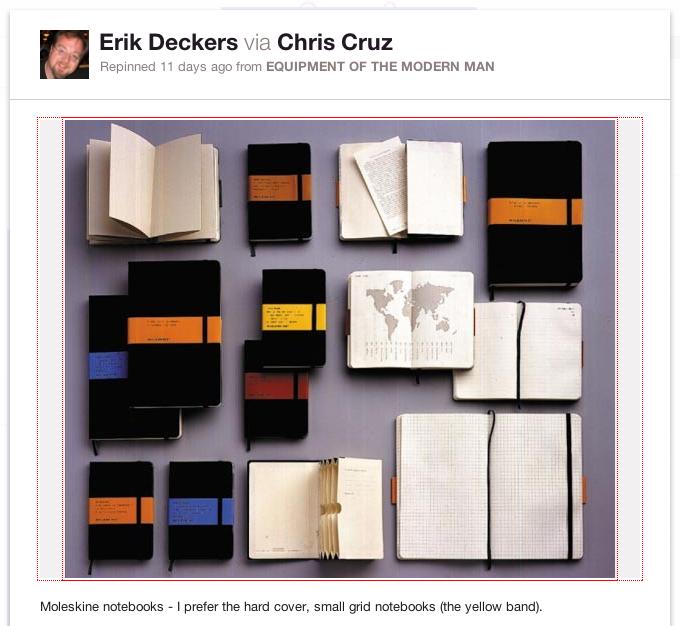
Moleskine pin

I don’t like Pinterest.

Don’t get me wrong. I think it’s a cool site, and I like the community it’s building, and the sharing that’s going on. I also like the back end SEO that’s happening, and what it’s doing for web traffic.

But I just don’t like it.

I’m a words guy. You know, these things you’re reading right now. They give me context. I get meaning from words that I don’t get from pictures. They express ideas and educate me. Pictures can’t do that nearly as well as words. And Pinterest, as a collection of photos, doesn’t always give me the context and meaning that I need in order to understand why you thought that particular photo was important.

As I’ve said before, a word is worth a thousand pictures. A picture of a baby has a different context and meaning for me than it does for you. Pin a picture of a baby on your board, and there could be any number of reasons why you did it. It’s your child, it’s your niece or nephew, it’s you as a baby. Whatever. Right now, it’s a picture of a baby, and I have no idea why you think it’s interesting.

“But you can read the description and board title to figure out the context,” you’re saying.

That’s right, I can read the description and title — made up of words — to figure out the context. Without your words, that’s just a picture of a baby.

Why did you think this was interesting? Where did you see this? What’s the story behind it? Is that you when you were 14 months old? Is that your nephew about to dump a bowl of cereal on the floor?

You have 500 characters to explain this all to me, but most comments I read are usually “too funny,” “WANT!”, or “that’s a deal breaker, ladies!” so I have no idea what was so interesting about the chicken sleeping in the kayak converted into a hammock.

Basically, if you’re not putting words with your photos, I have no idea what’s so important about what you just pinned, so I don’t click it, follow it, look at it, or pay a lick of attention to it.

It would be nice if Pinterest could include the websites where the photos were pinned from, or let you highlight important text to include with your pin. It would be great if people would put more than one or two words describing the photo. It’s not that hard, is it? Answer the question, “I like this because it _________” and tell everyone why that particular item caught your eye.

(For the record, writing “grapes” under a picture of grapes is not helpful. I can see they’re grapes.)

Like I said, it’s not that I think Pinterest is a bad thing. It’s a cool site, and I use it occasionally to share pictures of stuff I want (making it the most expensive Christmas list manager ever created), interesting ideas I’ve found, or funny photos and captions that made me laugh.

But as someone who thinks in words more than pictures, I need Pinterest and its users to give me a little context about what I’m seeing. Otherwise it’s just a bunch of pictures of food, clothes, and last night’s Oscars fashion.

Author :  •  Content Location : Indianapolis, IN  •  Headline : Why I Don't Like Pinterest  •  Keywords : Pinterest, sharing, social network, social media, SEO  • 

5 Ways to Deal With Jerky Comments on Your Blog

Sometimes you get jerky comments on your blog. Not just people disagreeing with you, but people who are being out and out A-holes. These are the people who leave snide, snarky, and mean-spirited comments on your blog, often cowering behind an anonymous handle.

How do you deal with those, especially if you’re a new blogger or have a corporate blog, and you’re just not used to seeing this kind of stuff?

1) Take it personally.

Yes, I know we’re not SUPPOSED to take it personally, and everyone who tells you this has either never had it happen to them, has grown immune to it, or is lying to you about sobbing uncontrollably in the bathroom after someone pointed out a grammatical error in their post last week.

You will feel bad. You will get your feelings hurt. I completely understand it, so give yourself time to feel that. Afterward, remind yourself you’re better than they are, and the other person is just envious of your life, because hanging out in their mom’s basement in their Star Trek uniform doesn’t seem as glamorous as it did 10 years ago when they first started working at Burger King.

2) See if you can you learn anything from it.

Sometimes a mean or abrupt comment may have something to teach you. Maybe they said you can’t spell. Maybe they said you were being short-sighted about your ideas. Maybe they said your work was derivative and sounded an awful lot like someone else’s work. It may hurt, but it may also be a small hint that maybe you should work more on your spelling, think out your ideas better, or develop your own style or voice.

If you can learn something, great. Keep going through these steps. If there’s nothing useful in it whatsoever — and that includes printing it out and using it to soak up where your dog just puked on the rug — then, keep going through these steps.

3) Don’t respond.

There are trolls on the Internet. They get their jollies from saying mean and spiteful things to people because their lives are so pitiful and joyless that this is the only way they feel better about themselves. They’re still just bitter that they didn’t get that promotion to assistant night manager after 10 hard years, and they want to bring people down to their own level.

They figure if they can get you to respond, they’re somehow accomplishing something, and they feel better about themselves in a way that only trolls can. So don’t respond, don’t give them the satisfaction, and keep telling yourself you’re better than that.

4) Delete the comment.

There is no rule that says you have to leave a comment up on the blog, especially if the other person is being an A-hole. This is your blog to do with what you want. There are no blog comment rules other than your own, and no expectations that you leave up something you don’t want to. It’s not censorship to delete negative comments — it’s only censorship if the government deletes it — it’s you keeping your house looking the way you want to. You wouldn’t let an obnoxious jerk come to your house and sully up your living room. So you don’t need to let them come in and stink up your blog either.

If people want to be A-holes, let them continue to clog the comments section of their local newspaper. You only want people who can be supportive, or at least constructively critical. Delete away and don’t feel bad about it at all. If necessary, block the users from leaving comments.

5) Read all your good comments.

Sometimes, after you’ve been hammered, you need a pick me up. (Just please don’t go to Facebook or Twitter and ask for prayers and hugs.) Go look at your past comments where people have said some great stuff about you. You should be able to access your comments page from your blog’s admin dashboard. When you get slimed by an A-troll, after you delete their muck, go read all the awesome stuff people have said about you to cheer yourself up. Or go read your LinkedIn recommendations. Or, if you don’t have many of those yet, go to Facebook and Twitter and ask for prayers and hugs.

Yes, there are people who like being jerks and trolls. They do it on purpose, just so they can be hurtful to someone else. They want to be mean, and don’t have anything better to do, so they leave nasty comments on other people’s blogs. But occasionally, you’ll get a comment from someone with poor tact, but who actually means well. Learn to separate the people with communication issues from the actual trolls, and deal with them as you see fit.

It’s your blog, and you’re free to keep whatever content and comments on there you would like. Save yourself the headache and the heartache, and delete anything from anyone who pisses you off.

Author :  •  Content Location : Indianapolis, IN  •  Headline : 5 Ways to Deal With Jerky Comments on Your Blog  •  Keywords : blogging, comments, trolls  • 

Should Social Media Marketers Give Away the Good Stuff or Get Ripped Off?

No Burglars sign

I’ve gotten burned by being a little too optimistic and open at times, especially now that I’ve been in the social media marketing business. I share the good stuff with people, and while for the most part, it pays me back in the end, there have been a couple times where I got ripped off.

Not just taken advantage of. I’ve had revenue-generating ideas stolen because I shared them too early in a negotiation process.

When I first moved to Indianapolis, I was working with a friend, Darrin, at his marketing company, and we were pitching a possible new client. As part of our pitch, I suggested that the owner start a new off-shoot company to hire entry-level employees and train them in his methods. This would end up being a feeder company for experienced employees, rather than have to scramble around at hiring time. Sort of like a minor league baseball team feeding into a major league one.No Burglars sign

It was a pretty good idea, even if I do say so myself. And I was proud of the suggestion, because the owner also seemed to like the idea, and I thought it was going to help us get the marketing contract.

Unfortunately, he never hired us. He never gave us a reason. He just took our proposal, and never returned our call, and was always “busy” when we called him. (My business partner, Paul, calls this the “Indiana No.”)

Fast forward to four years later, when I see the business owner in the newspaper for the brilliant idea “he had” for starting a smaller company for entry-level employees who later moved up to his company. It ended up being very successful company for him too.

How much did Darrin and I get for our idea?

$0.00

Not having learned our lesson that time, a few weeks later, we made another pitch to a local restaurant, including six ideas we wanted to execute for them, and one idea for a radio commercial. After submitting our official proposal, they said they weren’t interested, and kept the proposal.

A few months later when I went in to the restaurant, I saw that they were using five of our six ideas, and had used our radio commercial idea for a guest appearance on a local radio station.

How much did Darrin and I get for these ideas?

$0.00

Painful Lessons Learned

The lesson my friend and I learned in all of this? Give away the good stuff, but don’t give away the secret sauce.

It’s a shame too, because I fully believe in the Chris Brogan model of give away the good stuff. I don’t want to give away a nickel’s worth of free stuff to sell $100 worth of ideas. I want to give away hundreds of dollars of ideas to sell thousands.

Pile of $100 billsOur point was to give away some interesting ideas in the hopes that we would get hired to actually do them and get paid for it.

Did we get hired? No. Should we have gotten the contract just because we rattled off a few good ideas? Probably not.

But it seems to me that when someone pitches you an idea, and you don’t hire that person, you also should not be allowed to steal their ideas, especially when you didn’t hire anyone else to do it either. At the very least, it’s unethical, and the people who do it are skeevy.

So I’m torn. What should I do in the future?

Should I selfishly hold on to my “secret sauce” and only share the information that anyone can find in a book? I do that now when people want to “pick my brain” in exchange for buying me lunch.

Or should I give away any idea that I come up with for a potential new client in the hopes of signing them?

On the one hand, demonstrating some of our ideas could help us win a contract. On the other hand, the people we work with are smart enough to execute an idea just based on a basic two sentence explanation. If we tell them they need milk, they’ll figure out where to find a cow.

If you’re an entrepreneur, marketer, or salesperson, what do you do? Do you trust people and “share hundreds to earn thousands?” Or do you play things close to the vest and give those ideas away only when you’ve got a signed contract in hand? How would you play it?

Photo credit:

Author :  •  Content Location : Indianapolis, IN  •  Headline : Should You Give Away the Good Stuff or Will People Rip You Off?  •  Keywords : Chris Brogan, consulting, social media marketing  • 

Sick of the Same Old Social Media Case Studies? Too Bad.

Tweet from the Siouxland Chamber about who had heard of the United Breaks Guitars case study

Are you tired of the same old social media case studies? The United Breaks Guitars, the Dell Hells, the @ComcastCares?

It’s a common complaint I hear from other social media marketers. We’re sick of people talking about these case studies all the time. We can recite them by heart, we’ve heard them so many times.

Siouxland Chamber of Commerce Social Media Luncheon 2011

Siouxland Chamber of Commerce Social Media Luncheon, November 2011

The social media mavens raise their voices to the rafters: “We’ve heard them over and over! Show me something new!”

Too bad. Do you know who hasn’t heard them?

Everyone else.

I remember when Jason Falls and I were writing No Bullshit Social Media, the question came up about whether we should include Dell Hell, United Breaks Guitars, and @ComcastCares.

“They’re old. Everyone has heard them,” was the objection.

“Our target readers haven’t heard them,” was the counter-argument. So we decided to leave them in.

A few months later, when I was speaking to a group in Sioux City, Iowa, I asked the 150 people in the room, “How many of you have heard of the United Breaks Guitars incident?” Out of the 150, fewer than 10 people raised their hands.

Chris Brogan and Josh Brolin

This is not the same dude.

We as social media marketers need to remember, not everyone uses social media. Not everyone follows it like we do. Not everyone has heard about the latest case study. Most people still confuse Chris Brogan and Josh Brolin.

While we may be tired of the same old case studies, sick to the teeth of list posts, and still roll our eyes (me included) at every “social media marketing secrets” post that tells us to use Twitter and completely fill out our LinkedIn profile, there’s a very important group of people who have never heard of this before.

Our potential clients.

Remember, while there may be over 383 million people around the world on Twitter, only 27% of them actively use Twitter. In the US, there are 107 million Twitter accounts — accounts, not active users — which is a little more than 1/3 of the country. Hypothetically, if only 27% are using Twitter actively, we’re looking at only 28.9 million people in the US using Twitter, or approximately 9.2% of the country.

In other words, nearly 90% of the country is not using Twitter. Not everyone uses YouTube. Only 40% of the US adult population has a smartphone. And only a small percentage of people are blogging. (Note: Twitter is NOT blogging.)

So while you may be sick to death of the same old case studies, the same old list posts, and the same old “social media secrets for beginners” articles, we’re still fighting an uphill battle. There are still plenty of people who still only think social media is for kids and is all about playing Farmville and Angry Birds. There are still people who don’t get “the Tweeter” and would never “want to hear about someone’s bathroom habits on FaceSpace.” There are still people who don’t understand that social media can be good for business, and that left unchecked, it can hammer your business like the fist of an angry god.

As long as there are clients who are still trying to understand why social media is important, it’s equally important that you be ready to share the stale, 7-year-old case studies with your clients. Bring out the new ones too, but don’t forget that if people feel like they share common knowledge (i.e. when two non-users get together and start talking about “that ‘United Breaks Guitars’ video”), it helps them feel smarter and more empowered to try it themselves. It may also scare the bejeezus out of them, and get them to start using it.

Arm your clients with the body of common knowledge. Go back to the same old case studies, keep using list posts (they always get the highest web traffic for me), and don’t assume everyone is carrying the latest mobile phone. It may feel remedial, but if you’re a social media professional, you need to fish where the fish are.

Author :  •  Content Location : Indianapolis, IN  •  Headline : Sick of the Same Old Social Media Case Studies? Too Bad  •  Keywords : social media marketing, social media case studies, list posts, smart phones  • 

Three Social Media Marketing Secrets to Promoting Food

Being a B2C brand on Twitter can be hard, because the B2B world seems better suited for it.

A potential client in your niche has a question, you answer it. You identified that client because she used particular keywords, which you searched for. Or you identified her through her Twitter bio or LinkedIn profile, and found that she was in your industry. Since there are only thousands of people in that niche — and not millions, like in the B2C world — they’re easier to find, connect with, and keep up with.

But what if you’re managing the social media account for a major food brand?

The traditional reaction is to view this as another advertising channel. Maybe you think it’s an even better advertising channel, because it’s free.

However, advertising on Twitter is just like a commercial-only TV station — no one will want to watch, since no one is producing anything useful or interesting. So, telling people over and over that they can get your product “for 20% off this Friday only!” doesn’t do a thing for them. That’s not effective social media marketing. It’s shouting. No one likes being shouted at. People are either going to unfollow you, or worse, spam block you. (Get enough of those, and Twitter will suspend your account.)

Roast Duck from Great British Chefs on Flickr

Roast Duck

So what can you do? You could try posting recipe suggestions and links to recipes on your blog, but after a while that gets a little repetitive, and people will start to tune you out. You can also do a search for your food item, and retweet the people who are mentioning your product or item, but that’s not really a conversation. (Remember, social media marketing is about interacting with customers and building relationships, not about broadcasting.)

Here are three other social media marketing tactics to try:

1. Create Buyer Profiles, and Find People Who Fit Them

Maple Leaf Farms in Milford, Indiana is the largest duck producer in North America (and a former consulting client from a long time ago). And as a food producer, their market is, well, everyone. Everyone eats food, therefore, they should market to everyone, right?

Wrong.

Not everyone buys food, and not everyone eats meat. So right there we already have groups of people we can eliminate — vegans, children, and teenagers.

If I were running Maple Leaf’s account, I would start focusing on the following types of people, because they are the people most likely to buy duck:

  • Professional Chefs — This has always been a target market for Maple Leaf Farms.
  • Amateur Chefs and Foodies – They lo-o-o-o-o-ove unusual food. And as big as the world’s duck consumption is, it’s still considered a gourmet item by a lot of people in this country, so foodies will love this.
  • Moms, but especially stay-at-home moms — Duck is nutritious and healthy (most of the fat is in the skin, not the meat). And since women make most of the food buying decisions in this country, they’re the natural target to reach. I also specified stay-at-home moms, because many of them self-identify as such on Twitter, often with the #SAHM hashtag in the bio. While you’re at it, look for single dads. They’re a smaller market, but they also make all their buying decisions at home.
  • Organic Food Enthusiasts — There are no hormones in duck or poultry of any kind, so organic foodies may be a little more interested in duck for that reason.

In most cases, most of these people will have something about these interest, vocations/avocations in their Twitter bio. Go to Twellow.com and do a search for each of these groups via the keyword search tool, then follow those folks.

2. Create Lists of Profiles, Interact Directly with Those People

Twitter lets you create lists of people and you can drop people in any of those lists. Maple Leaf can create those lists, and then monitor them on TweetDeck or HootSuite. I still recommend TweetDeck, because those columns automatically update on my desktop, rather than having to refresh my screen whenever new tweets pop up.

Then, start talking to these people about the issues that they care about, especially — but not solely — if they relate to food. If you’re a parent, and they’re talking about parenting, talk with them. If they’re talking about marathon running, and you’re a marathoner, talk with them. If they have a question about where to go for dinner when they’re visiting a new city, and you’ve been there, make the recommendation. Build relationships with these people and get to know them. As they get to know you, they’ll be more willing to try the products you sell (without you ever pimping the products to them).

3. Reach out to influential bloggers

There are outstanding foodie bloggers, chef bloggers, mommy bloggers, dad bloggers, organic food bloggers who all have hundreds of thousands of readers among them. Give them a proper email pitch, not a mass email sent to hundreds of bloggers at once.

Ask the most influential of them to review your product, whether it’s through a free sample plus an extra coupon to give away to readers, or a free dinner at a local restaurant that serves duck, or whatever seems to be the most cost effective. Whatever you choose, the most important thing is that you treat the bloggers as individuals, and don’t mass email them. That will backfire, and get them talking about you, but not in the way you want them to.

These are the first steps I would take if I were in charge of the social media marketing program at a food manufacturer. Don’t try to be something to everyone; identify a few niches and appeal to them first. As you gain success, expand your reach to more people within the niches, as well as any other likely target markets.


My book, No Bullshit Social Media: The All-Business, No-Hype Guide to Social Media Marketing (affiliate link), which I wrote with Jason Falls, is available at Amazon.com, as well as at Barnes & Noble and Books-A-Million. It’s also available for Nook, Kindle, and other e-readers.

Photo credit: Great British Chefs (Flickr)

Author :  •  Content Location : Indianapolis, IN  •  Headline : Three Social Media Marketing Secrets to Promoting Food  •  Keywords : social media marketing, blogging, Twitter, food, B2B, B2C  • 

Attorneys Should Have Their Own Blog Content, Not Syndicated Content

Attorneys need to approach the use of syndicated blog content with care. Many times, syndicated posts are written as a one-size-fits-all approach, and you can make tweaks and changes as needed. But what if you don’t have time, or don’t know how, to make the changes? What problems could you see if you relied on syndicated content?

Here are three reasons we think attorneys should have their own blogs with their own content, instead of relying on syndicated content.

1. Syndicated content does not perform well in search.

If you buy a copy-and-paste content service, chances are it’s not going to be picked up by the search engines. That’s because Google has a “no duplicate content” rule they follow, meaning they don’t want to see a lot of websites using the same content over and over.

You may hear this described as the duplicate content penalty, but it’s not a penalty. Rather, Google just does not index the content. The Google bots see it and say, “we already saw this back at another website, so we’ll ignore this one.”

One of the primary reasons to have a blog is to rank high on the search engines, and it doesn’t make sense to pay for syndicated content if it’s not going to help you rank in the first place.

(That’s not to say that all content syndicates do this. The better ones don’t. The cheaper ones, not so much.)

2. You can localize your content.

Google is paying a lot more attention to local search, because they’re delivering local search results to their users. Check it out. Go to Google, and do a search for “Italian restaurant.” The results you’ll see will be for the city where you perform the search. That’s because Google can see where you are, and it wants to deliver the results you’ll be most interested in. If you’re in St. Louis, Google assumes you don’t care about Italian restaurants in Jacksonville, Florida, so they deliver the results you’re most likely to be interested in.

To that end, it’s more helpful to write localized articles about your areas of specialty and include your city or geographic practice area in things like the headline and body copy, so Google will know where they should have you listed.

  • Five Things to Look For In An Indianapolis Personal Injury Attorney
  • When Does a Startup Need a Chicago Intellectual Property Attorney?
  • Should I Hire a Florida Attorney to Plan My Estate?

You need to do this so when a potential client does a search online for an attorney, they find your page. Google is not going to return the best-optimized pages around the country. It’s going to show them the results from the pages in their city and/or state. If your site is properly optimized, clients will find you, not your competition.

3. Your Content Can Fit Your Readers’ Style

Syndicated blog content is written one way, and it may not be your style. But, you paid for it, so you might as well use it, right?

Wrong.

If you’re paying for it, you’re presenting your image in a style that doesn’t quite fit with you, or more importantly, may not appeal to your readers.

It’s important that you communicate with your readers in the way they want to be communicated with. And since you know your clients the best, you can best dictate the kinds of topics they want to read, the style, language, and even readability of the posts. You should even be able to decide the best keywords to write about that week or month.

Since you know your readers best, you need to create content that they will find and read, which will ultimately lead to them calling you when they need you.

Whether you write your own blog posts 2 – 3 times a week, or work with a ghost blogging service (which we recommend, given your hourly billing rates; otherwise, blogging will end up being your lowest priority), you need to have content that is geared toward your style, your geographic region, your clients, and can help you win search for your niche and your keywords.

Author :  •  Content Location : Indianapolis, IN  •  Copyright Year : 2012  •  Headline : Why Attorneys Should Have Their Own Blog Content Instead of Syndicated Content  •  Keywords : blog content, business blogging, corporate blogging, legal blogging, attorney, lawyer  • 

Three Ways New Fiction Writers Can Promote Their Work With Social Media

How can a writer promote their own work, especially if they are just releasing their first published work? Thanks to ebooks and ereaders, as well as print-on-demand and self-publication, any fledgling writer can publish their work and make it available to the general public.

But how can they get readers before they have even established their writing career? Here are three ways new writers can promote their newly published works to a wider audience than their moms.

1. Find readers on Twellow and Facebook.

Twellow is a Twitter directory that lets you search people’s Twitter bios. Look for anyone who would fit your target readership. If you write sci-fi, look to see if anyone has science fiction or sci-fi in their bio. Chances are they’re fellow writers, but you’ll find a lot of sci-fi fans too.

Check out the Facebook pages and groups too, and start friending and connecting with people in those groups. As you follow the other two steps, they’ll be the people you want to reach out to.

2. Pre-release the book in blog form.

As you’re writing your book, try publishing sections of it on a blog. Invite reader comment and ask them to give you feedback, ask questions, and make any suggestions. Make your changes from the blog and incorporate them into the final manuscript.

You’ll also get readers who start to follow along because they get drawn into the serial nature of the story. Plus, don’t worry about people not wanting buy the book because it’s on the web. There are plenty of people who have written books that were originally posted online first, and went on to great success. They’ll be willing to pick up your book too.

3. Create an audio version of your book.

Seth Harwood released the self-published Jack Wakes Up book as an audio podcast. He would read approximately 45 minutes of the book each week and upload it as a podcast. While that seemed to fly in the face of conventional publishing wisdom, the Jack Wakes Up ended up garnering enough attention that it was then picked up by Three Rivers Press and published.

It’s possible with some publishers that you can keep the audio rights to your book. If you’re self-publishing it, you own all versions, including audio and ebooks. So take advantage of that. Get a decent microphone (I prefer the Blue Snowball USB mic), and start reading it. Don’t launch until you get at least half the book recorded though. It builds in some extra time in case you run into a production delay.

Author :  •  Content Location : Indianapolis, IN  •  Copyright Year : 2012  •  Headline : Three Ways New Fiction Writers Can Promote Their Work With Social Media  •  Keywords : social media, writing, social media marketing, publishing, Seth Harwood  • 

Ten Steps to Blogging Every Day

I’m always amazed — and irritated — at my colleagues who are blogging every day. I’ve tried that. I did it for a whole year once on my humor blog. By month four, I was regretting my choice. By month seven, I hated my blog. And by month 10, I longed for the sweet, sweet release of a sledgehammer to my monitor.

But I stuck it out. I made it the whole 12 months. And I saw a great increase in traffic. So much so that it is now about 80% less than what it once was, now that I’m publishing once a week. But I gained enough regular readers that publishing day (Friday) is the same level it was when I was doing the daily thing. That is, my regulars keep showing up and they keep reading. They just don’t keep coming back every day.

Tired marathon runner

Yeah, you'll feel like this around the 9th month

But if you want to blog on a daily basis, here are the 10 steps I took to make sure I made it all 365 days. (And remember, “daily” means “every day,” including Sundays. Be sure to take that into account.)

  1. Write certain evergreen posts that can be used anytime. Plug those in when you just can’t write that day from sickness, vacation, other plans.
  2. Write all posts the day before. That gives you an extra 24 hours cushion for that time you missed a post.
  3. Be prepared to use videos and photos. YouTube is a veritable cornucopia of blogging topics. Do a quick search, embed the video (when it’s permitted of course), write a few sentences of commentary, and voila!
    • Do the same thing with photos.
    • Depending on your blog platform, you may be able to email your posts in. Snap an interesting picture with your smartphone, attach it to an email, tap in a few sentences, and email it to your blog. You can always go back in later and expand it and clean it up, but at least you have the beginnings of the post.
    • (Note: Most blog platforms publish the emailed content as soon as you send it, so that won’t work to save ideas for later. Use Evernote for that.)
  4. Carry around a notebook and write down ideas as you get them. Nothing is worse than an escaped idea. And if you can start sketching out notes at the same time, do it. Even go so far as to make an outline. Think about the outline on your way to and from work. Then, when you sit down at your computer, the thing is already written. You just need to type it out.
  5. Go for brevity. Remember, a blog post is not a 750 word column. A post can be 400, 300, even 200 words. You don’t want to make a regular habit of writing short pithy 100 word posts, but you can slip them in once in a while.
  6. Break up longer posts. Got a top 10 list of something? Turn it into two top fives. A couple months later, take each item from that top 10 list and expand on it for an additional post.
  7. Set a regularly scheduled topic for certain days of the week. For example, on my humor blog Sundays were always videos, Wednesdays were always reprints of old humor columns.
  8. Find other outlets in your industry that are about your chosen topic. Pull from them for inspiration. Since I wrote about some of the stuff that stupid people did, I got a lot of inspiration and ideas from Fark.com. (And let me just say, the British Town Councils are ripe for the picking for a satirical humorist.)
  9. Schedule your blogging time. Make it the same time every day. If you don’t, you’ll have to…
  10. …get up earlier or stay up later. This is like pro athlete training. You have to do it every day and you have to make sacrifices. That means missing sleep on one end of the day or the other, especially if you were screwing around and didn’t get it done when you should have. A few days like this, and you’ll learn to stay on schedule.

Your daily blogging goal will not succeed unless and until you commit to doing it. I don’t mean, “yeah, it sounds like a good idea,” but then it’s broken like a New Year’s resolution, by late morning on the second day. I mean, you absolutely say you’re going to do it, come hell or high water. (And then the theme to Rocky starts playing, and you find yourself dancing around at the top of your courthouse steps with a bunch of computer nerds yelling and cheering around you.)

When I made that commitment, it meant a lot of bleary-eyed posts that were written at 1:30 am and had to be polished up the following morning. It meant a lot of scrambling around to find new post ideas, and rehashing a lot of old topics. And sometimes it meant putting up some less-than-worthy posts and ideas just so I could keep going.

All in all, I’m glad I did it. I had a sense of accomplishment when I was done. It got me noticed by a lot of people, and got my name out to some new people. And I find myself being drawn back to it. This blog post marks the third business day in a row that I’ve written something on this particular blog, after being sporadic from time to time.

Will I keep it up? I don’t know. Do I have enough to say that I can keep up the momentum? Definitely. Do I have the time? That’s a tough one. I have clients to take care of.

I do know that I’m skipping weekends.

Photo credit: Kit Oates (Flickr)

Author :  •  Content Location : Indianapolis, IN  •  Headline : Ten Steps to Blogging Every Day  •  Keywords : blogging, daily blogging, video, photo, blogger, blog writing  •