• Skip to primary navigation
  • Skip to main content
  • Skip to primary sidebar
  • Skip to footer

Pro Blog Service

  • Business Blogging
    • Blogging and Content Marketing for Search Engine Optimization (SEO)
    • Social Media Strategy and Consulting
    • Blogging Services
    • Content Factory
    • Need a Law Blog or Legal Blog?
    • Download Our White Paper: Business Blogging: The Cost of Corporate DIY Blogs vs. Ghost Blogger
    • Pro Blog Service Books
  • Blog
  • Speaking
  • About Pro Blog Service
    • Erik Deckers
    • 4 Simple Rules for Guest Posting on Our Blog
  • Get Ghost Blogging Quote
  • Link Sharing/Contributed Articles

Blog

January 25, 2010 By Erik Deckers

Defining Two Types of Crisis Communication

Crisis communication has two different, distinct meanings. They require different approaches, different ideas, and completely different types of plans. And not knowing the differences between the two can create some problems if you try to use one approach in the wrong place.

There’s corporate crisis communication (CCC), and there’s CERC.

CERC — Crisis and Emergency Risk Communication — is what the government calls communication during a massive emergency, such as swine flu, a terrorist attack, or large-scale natural disaster. (And you can tell the government came up with it, since it’s so much longer and has more words than are truly necessary.)

Both are often called “oh shit PR,” but the difference is that in a CERC situation, a lot of people could die. With CCC, a lot of money could be lost. One type of emergency gives emergency first responders sharp chest pains and indigestion, the other makes the corporate lawyers pull out their hair. But they both say the same two words when something goes down.

Although these two forms have a lot of similarities, there are some important differences. And if you’re talking about social media for crisis communication, you need to know them, because they affect your strategy.

Corporate crisis communication

I’d like to say that it’s important to always tell the truth and to be as open and honest as possible. But the sad truth is that being completely open and honest can ruin a company. I’ve hassled corporate legal departments over their “wrecking” crisis communications, but they’re a necessary part of any response. They just shouldn’t control it. In CCC:

  • Transparency tends to go out the window. The emergency is usually something that will make the corporation (or individual) look bad, so the first instinct is to hunker down and contain the bad news. This often means trying to keep it under wraps. This hardly ever works.
  • The negative end result of a corporate crisis is a loss of money. It could be a hit to their reputation, credibility, or branding, but those will all effect the bottom line. And since that can be in the millions or billions, crisis communication is not something that should be taken lightly. Entire companies, like Chi-Chi’s restaurants, have been lost to bad communications. But it’s the attempt to avoid losing money that leads to bad communications.
  • Communication is about containment. Many corporate crisis PR professionals are focused on keeping their client from being found guilty or negligent. They’re not worried about whether people like them, they just want to win the pending lawsuits. So they’ll put out information that, while is not a lie,
  • The message is the biggest part of the response. There’s other stuff going on behind the scenes — product recall, legal preparations, brand managment — but the communication is what’s going to affect the public’s perception, and thus, their reaction, lawsuits, vendor relationships, etc. Information may be easy to get if you’re in crisis communication, but it’s not always easy to share.

Social media strategy: Guarded, but present. Correct misinformation, use Tweets and Facebook to communicate with customers in a brand management manner. Put on your best face, but don’t lie. Monitor the gossip sites, but don’t engage.

Crisis and Emergency Risk Communication

This is the area I came from. We wanted as much open communication as we could get. More was better, and there was no such thing as too honest. Our goal was to “prevent panic,” and make sure everyone knew what was going on. With CERC:

  • Transparency is crucial. This is information people need to know. Information about where to go for safety, supplies, or medication.
  • The negative end result of a public crisis is a loss of life. When I was at the Indiana State Department of Health, we trained for things like medication distribution during an anthrax attack. The goal was to tell as many people as possible where medication was available. Information has to be gotten out quickly and to as many people as possible.
  • Communication is widespread. The point of CERC is to get as much information out as possible, and to correct misinformation. There is nothing that should be contained or covered up.
  • The message supports the rest of the response. It’s the other stuff that’s going on — law enforcement, public health response, rescue/recovery, clean-up — that’s going to affect the public, and communication lets the public know what’s going on. If there’s medicine to be distributed, communication will tell the public where to get it, but it’s the Point of Distribution that will give it out. The problem with this approach is that the public information officers (PIOs) are trying to get information from the busiest people, which means it’s not always readily available or being put out as quickly as possible. This is one reason the PIOs have direct access to the Incident Commander, the person in charge.

Social media strategy: Strong social media strategy. More people are getting their news on Twitter and Facebook than they are in their regular media. Put information out on social media at the same time you give it to the mainstream media. Correct misinformation directly, rather than through mainstream media. Monitor the citizen journalists, and engage when it’s appropriate.

Photo: Slworking2

Filed Under: Communication, crisis communication, Public Relations, Social Media, Social Networks Tagged With: CERC, crisis communication, public health, Social Media

January 5, 2010 By Erik Deckers

Be an Entre-Commuter With Just a Latte and a Laptop

I’m the mayor of my office and my church.

At least that’s what Foursquare tells me. I’ve checked in enough times at both places that I’ve been declared the mayor.

Foursquare is a location-based social networking site that lets you tell people where you are via Twitter and Facebook.

Think: 50% friend-finder, 30% social city guide, 20% nightlife game. We wanted to build something that not only helps you keep up with your friends, but exposes you to new things in and challenges you to explore cities in different ways.

You check in at different places around a city, give tips and recommendations, and in general get to know your city better.

I’ve been using FourSquare a lot lately, especially after I got my new Droid phone a few weeks ago.

I’m starting to earn the reputation for being out and about all the time. I check in everywhere I go: the office, the coffee shop, the library, the grocery store. I’m not out any more than usual. I’m just telling people about it.

But it’s become a whole lot easier now for me to be out and about too, thanks to my laptop and the proliferation of free wifi around the city. I’ve become a real entre-commuter.

(Entre-commuter: entrepreneurial commuter who works out of a coffee shop, cafe, restaurant, library, or any other place with free wifi. Term coined by Erik Deckers and Paul Lorinczi to justify why they don’t sit in the office all day, every day.)

We came up with the term entre-commuter for those people who own their own business and have the ability to do it anywhere. They can do it from home, the local library, or their local coffee shop. We happen to favor Hubbard & Cravens in Broad Ripple, although I’ll travel just about anywhere around Central Indiana for good coffee.

The great thing about being an entre-commuter is that you get to network with other people, and collaborate with them on occasion. I can’t tell you the number of people I’ve met with, helped, provided connections for, and done business with, just because we both happened to be out at the same time in the same place. And meeting some of the same people in the same place several times has blossomed my network beyond the typical Chamber and other networking events.

Where do entre-commuters gather?

I prefer to patronize local coffee shops and restaurants, although I’ll hit the occasional chain once in a while. We need to support our local establishments more than the chains — the chains don’t support our local economies. The locals do.

Is there entre-commuters etiquette?

There are a few rules for entre-commuters. They’re fairly common sense, but I still see people violate them from time to time.

  • Don’t camp out. They have to turn tables during peak times. If you’re sitting with a computer and a bottled water over lunch, they’re losing money on you.
  • Only occupy tables during low times. Don’t take up a 4-top all by yourself if you can help it, and don’t be afraid to share a table with a stranger either.
  • Buy something. Spend money, and more than just a little. Don’t buy a $2 coffee and then sit for 8 hours.
  • Be respectful. This is someone else’s business, not your office. Don’t treat it like it’s your place. You’re a guest.
  • Keep your voices down. Other people are there too, so don’t have loud conversations. You’re not at the club, you’re at a quiet little shop.

Entre-commuters just need to be somewhere we can find free wifi and good coffee. Somewhere we can connect online and offline. Find your local shops and spend some time there. See if you can create some business, as well as giving the local shops some business as well.

Photo: Nina Turns 40 blog

Filed Under: Communication, Networking, Social Media, Social Networks Tagged With: coffee shops, entre-commuters, Indianapolis, social networking

December 29, 2009 By Erik Deckers

Rules for Being a Media Blogger

This was originally posted at the DeckersMarketing.com blog on May 28, 2009.

I was really honored to be selected as a media blogger for the Indianapolis 500 this year (I’m covering it at my Laughing Stalk humor blog). I’m sitting up here with a lot of local talent, although there are a lot of empty seats right now (I’m in Dennis Neal’s seat from WLW radio in Cincinnati).

I learned a long time ago that there are a couple of unwritten (and written) rules for media people. And if you’re interested in being a guest blogger for a sports team or major event, you need to follow these rules. They’re the same ones the big-J Journalists follow every day. (“Big-J Journalist” implies that these people are serious journalists who make their living writing and producing important work. These guys look down on bloggers, because we’re not serious or well accepted in journalistic circles.)

  1. Never geek out. You were probably invited because you’ve got a passion for writing and for the team you’re covering. However, you’re the media now. You’re not a fanboy who bumped into your favorite player at a McDonald’s. Play it cool, be mature, and don’t try to be their buddy. You’re there to get a story, just like the real Journalists (see, I even used a big J), so act your age and get it done.
  2. Never ask for autographs or photos. My friend Amanda, who writes Red Hot Mama, the Cincinnati Reds/National League Central fan blog, said she once tried to get some media credentials for a Reds game, and was told it would never happen. It seems the year before, they allowed a blogger into the locker room, but the guy geeked out and asked for autographs and photos with the players. The guy turned into a total fanboy and gave the PR staff the only reason they would ever need to not invite bloggers to cover the team again. Now, we can argue the Reds are missing some great PR and coverage, but until that PR director leaves, he’s willing to give it up to avoid the hassles and headaches.
  3. Blogging is not big-J Journalism. And it never will be if you don’t act like it. Sure there are writers like Chris Brogan, Jason Falls, and even political writers like Matt Drudge and the Daily Kos are all professional bloggers and speakers. They take their reputations and brands seriously, and work hard to make blogging an accepted form of media. If you’re going to be a serious blogger — and maybe we should start calling ourselves big-B Bloggers — write your blog as if you have a serious brand to promote.
  4. On the other hand, you’re not there to write fluff either. Don’t feel like you have to be the company yes man on anything. I was eating lunch today with a reporter who had also been a blogger for his newspaper. He wrote a not-so-nice post about one of the racers and his wife last year, and was griped at by the racer’s staff via email. While he is no longer blogging for his paper, he is still employed by them. He still writes critical pieces if he needs to, and realizes he’s not there to be the PR mouthpiece of the racers or their teams. The takeaway: if you find or see something that could be seen as negative, write about it anyway. Do it respectfully, and treat it like a big-J Journalist would. Write the facts, keep your opinion out of it, and be a professional.

Bloggers are still getting a bad rap from most of the mainstream media as being an unreliable source of news. And it will be, until we change our reputation and quality of work. That, and when the newspapers all go out of business, and network news is replaced by cable news and, well, blogs.

Until that time, as you grow your reputation and reach as a quality Big-B Blogger, practice journalistic techniques. Read books on newspaper writing (it’s still the gold standard of writing quality and ability), use Associated Press writing style, and study as many newspaper writers as you can.

But most importantly, for the love of God, don’t geek out.

Filed Under: Blog Writing, Blogging, Citizen Journalism, Communication, Marketing, Social Media, Traditional Media, Writing Tagged With: blog writing, bloggers, citizen journalism, journalism, media

December 10, 2009 By Erik Deckers

9 Books That Will Improve Your Writing

Demian Farnworth over at CopyBlogger came up with a list of the 10 Books That Will Transform Your Writing. Ten books, that if you read them, will help improve your writing just by reading some examples of what is good, and then modeling them

A few of Farnworth’s 10 transforming books:

  • King James Bible
  • Barbarians at the Gate – Bryan Burrough and John Helyar
  • Complete Odes and Epodes of Horace
  • Outliers – Malcolm Gladwell

While I’ve only read a couple of Farnworth’s recommendations, I have a few recommendations of my own. These are my own favorite books and the ones I read more than once just to get an idea of how I want my writing to look.

    1. On Writing – Stephen King. I’m not a big fan of writing books and try to avoid them whenever possible. But more than a few writing friends recommended this one. Stephen King talks more about the desires and itch to write, and how he pursued his love of writing, even when he was first starting out. His story is inspiring and makes believe I can be successful.
    2. Fool – Christopher Moore. Really, any Christopher Moore book will do. The guy is a comic genius and knows how to write humor that catches you off-guard and makes you laugh out loud. Moore writes off-the-wall, exaggerated characters who seem so natural in their setting, and their descriptions and his jokes seem so effortless. He doesn’t crowbar anything into his stories, they just flow.
    3. My Beautiful Idol – Pete Gall. Pete is a writer here in Indianapolis, and has such tight writing that, after I read the first chapter, I started working to tighten up my own writing. I typically don’t notice the quality of writing unless it leaps out at me, good or bad. I’m more carried away by the story. But Pete’s writing just grabbed my attention, and made me pay attention to the quality of the words.
    4. My Other Life – Paul Theroux. I read this novella in an issue of Granta, and became a fan of Theroux. I’m not a big fan of creative writing and the emotional angst anyone with an MFA feels compelled to flog, but Theroux is one of the few I actually enjoy. He’s got a mastery of the language that I wish I could reach.
    5. Breakfast of Champions – Kurt Vonnegut. Indianapolis’ son is a world-famous wordsmith whose mastery of the language shines through, even when he’s writing some of the weirdest stuff. While most of his novels are fairly weird, Breakfast of Champions turns the Weirdness amp up to 11 . But even in this opus of oddity, the brilliance of his writing is obvious.
    6. Leaves of Grass – Walt Whitman. The Romantic poet sure knew how to turn a phrase. He and a few other of the Romantic poets are great inspiration when you want to capture the flavor of language, and tap into its rhythm and energy, read someone like Whitman, Burns, or Lord Byron to get the creative juices flowing.
    7. Kitchen Confidential – Anthony Bourdain. I worked in a restaurant for a few months when I first moved here to Indianapolis, and while I didn’t spend much time in the kitchen, I can tell you it’s hot, sweaty, unpleasant work. But Bourdain is able to make it sound glamorous, cool, and even enjoyable. If he can make kitchen grunt work sound fun and exciting, what can you do with your blog with his influence?
    8. The Naming of the Dead – Ian Rankin. You can actually pick any Inspector Rebus novel by this Scottish writer to get a look at what good dialog looks (he’s written 20 Rebus novels alone; he’s written 12 others) like. The dialog is tight, believable, and sounds like real people. I figure Rankin knows what he’s doing, because according to literary legend, Rankin lives on the same street as J.K. Rowling, who lives in a damn castle. If he made enough money to be her neighbor, he must be doing something right.
    9. Fear and Loathing in Las Vegas – Hunter S. Thompson. The man’s crazed drug and alcohol addictions notwithstanding, HST was a brilliant writer in his early days. His writing suffered as he slipped deeper into his addictions, but his earlier stuff was brilliant. It packed all the punch of a Chuck Norris movie, and was as tight as a drum. That’s because Hunter would write a series of ledes (newspaper talk for “lead,” or the opening sentence of a story), and string them together. Rather than having only one punchy attention-grabbing sentence, he had a dozen of them. If you want to add power to your writing, get the early Thompson works. (Fear and Loathing on the Campaign Trail is another recommended read.)

Other writers I could have included, but didn’t — for no particular reason include — Douglas Adams, Dave Barry, Dick Francis. These writers are also great, and worth studying. I like them for their humor (Adams and Barry), and their ability to tell a good story (Adams, Francis). Plus, they all have a large body of work to draw from. Check any and all of these writers out and start learning from them as a fun way to improve your writing.

Filed Under: All Posts, Blogging Services, Communication, Networking, Writing Tagged With: writing

December 1, 2009 By Erik Deckers

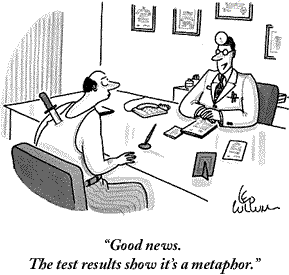
Want to Make Your Writing More Vivid? Use Metaphors

If you want to add some life to your writing, to give it breath and a heartbeat, use metaphors. They’re the lifeblood of any vibrant, vivid writing, whether it’s fiction or nonfiction.

I’ve been using metaphors in my writing with great success over the last several years. It marks a significant improvement in the quality of my writing, and I’ve garnered more and better opportunities. Whether there’s a connection between the two, I don’t know.

I’m a big fan of metaphors, and I like them better than similes. From the Greek, metaphora means to transfer or to carry over. It basically carries a comparison from one idea or item to another.

There is one difference between metaphors and similes: similes use the words like or as in them, metaphors do not.

Similes

  • Life is like a box of chocolates. (Forrest Gump
  • There was a great shout like the roaring of an airplane.
  • Similes are like metaphors, but only weaker.

Metaphors

  • All the world’s a stage. (Shakespeare)
  • Strength and dignity are her clothing. And she smiles at the future. (Proverbs 31:25)
  • “Men’s words are bullets, that their enemies take up and make use of against them.” (George Savile, Maxims of State)

I don’t like similes. They’re weak. They’re the pencil-necked milksop of literary devices. They say things are similar, but not quite that item. Life is like a box of chocolates, but not really.

Take a look at the last metaphor example: “Men’s words are bullets.” That’s a powerful phrase. It doesn’t say they’re like bullets, that they remind people of bullets, or “words can hurt people sort of like bullets can hurt people.” That’s just smarmy, wishy-washy pap.

“Men’s words are bullets,” on the other hand, makes you feel the the emotional damage that can be done by words, feeling the piercing, crashing power of a bullet fired from a large gun.

If you want to make your writing more powerful and add more life to your words, sprinkle some metaphors into your articles and watch what they’ll do for you.

Filed Under: Blogging Services, Communication, Writing Tagged With: Communication, metaphors, writing

November 19, 2009 By Erik Deckers

Bloggers Are Citizen Journalists

A common complaint I hear from big-J Journalists about bloggers is that we’re not “real” journalists. That we’re somehow beneath their contempt and notice.

Bullshit. We’re citizen journalists!

I first saw this attitude when I worked at the Indiana State Department of Health, and a few of my colleagues said we would never deal with bloggers because they only wanted to put out bad information. And in dealing with other Journalists, they almost seemed to say “blogger” with a sneer. As if “blogger” was something they stepped in on their way to the office.

Bloggers are citizen journalists, like it or not.
As a result, many Journalists don’t believe things like Reporter Shield Laws should apply to us citizen journalists. For example, if an environmental blog were to uncover environmental violations by a large corporation, that citizen journalist could be forced to reveal who his or her sources were. But if a newspaper wrote the same story, the reporter would not.

The biggest question comes down to who is a real journalist and who is only a blogger/citizen journalists. In the Branzburg v. Hayes case, Justice Byron White said

“Freedom of the press is a ‘fundamental personal right’ which ‘is not confined to newspapers and periodicals. It necessarily embraces pamphlets and leaflets. … The press in its historic connotation comprehends every sort of publication which affords a vehicle of information and opinion.’ … The informative function asserted by representatives of the organized press in the present cases is also performed by lecturers, political pollsters, novelists, academic researchers, and dramatists.”

— Quote from an article by David Hudson of FirstAmendmentCenter.org

Even back in 1973, when Justice White threw open “The Press” to anyone who produced the printed word, technology has widened the definition to anyone who writes for blogs, the 21st century’s electronic pamphlet.

In his article, Hudson also cited Kurt Opsahl, the staff attorney for the Electronic Frontier Foundation, who mentioned a couple examples where bloggers outperformed the big-J Journalists

“Bloggers hammered on the Trent Lott story (Lott’s comments about Strom Thurmond) until mainstream media was forced to pick it up again,” he said. “Three amateur journalists at the Powerline.com blog were primarily responsible for discrediting the documents used in CBS’s rush-to-air story on President George Bush’s National Guard service. And the list goes on.”

Cox lists several other national-headline stories affected greatly by reporting from blogs, including: Dan Rather and the Texas Air National Guard memos, the White House giving press credentials to James Guckert/Jeff Gannon, the resignation of CNN news executive Eason Jordan after publicity surrounding his remarks at the World Economic Forum and the John Kerry-Swift Boat Veterans for Truth controversy.

Or to put it another way, the big political scoops in the last 5 years have not been by the media, but by bloggers. Also called little-J journalists.

So, other than an overwhelming sense of elitism by the men and women of the dead-tree media, what really separates us from being real Journalists?

Is it the medium? Many former newspaper reporters and columnists have left the printed word, and gone on to start their own blogging career:

  1. Ruth Holladay who is serving brilliantly as a cheerleader for traditional media and a thorn in the side of her former employer, Gannett
  2. Lori Borgman the former arts columnist for the Indianapolis Star
  3. Columnist Saul Friedman who retired from Newsday rather than let his column go up behind a paywall

(I’m curious what their colleagues think? Have these writers somehow fallen from grace, and are no longer “good enough” to be considered Journalists? Are they now mentioned with the same sneer I heard three years ago?)

Maybe the pay is the issue. The fact that bloggers don’t get paid as much as newspaper writers (who, frankly, are not known for their lavish pay and glamorous lifestyle) may be the deciding factor. However, there are some online writers who make a lot more money than most successful businesspeople, let alone Journalists. So that argument doesn’t seem to hold weight.

Maybe it’s the training. The aforementioned paper-turned-pixel writers notwithstanding, Journalists seem to think they have the super-secret training that makes them a font of reliability and trustworthiness. Yet I know a lot of journalists who can’t spell, don’t know grammar, and in some cases, just plain can’t write. I took several journalism classes in college, and I can tell you they don’t teach anything extra special that someone with a penchant for the written word couldn’t pick up.

Even the Washington Post isn’t immune from bad writers. Meanwhile, there are several outstanding bloggers who produce some outstanding prose that would make any big-J Journalist green with envy.

Maybe it’s because the media is trustworthy and bloggers aren’t? You know, trustworthy. People like Jayson Blair, Stephen Glass, and Ruth Shalit. Of course, Shalit is back in journalism, Blair is a life coach in Virginia, and Glass is now a multi-millionaire, thanks to the book and movie deals he has gotten.

Admittedly, these three are the exception to the rule, and not the rule themselves. But my point is there are bad apples in blogging and bad apples in Journalism. Still if you’re going to accuse bloggers of not telling the truth, you need to look at the journalists who make stuff up too.

I just don’t see what the big difference is, other than bloggers don’t kill a lot of trees to get their message out through a dying medium. Yes, there are bad bloggers, but there are bad journalists. Yes, there are bloggers who lie, but there are lying journalists as well. (Some people might say that term is redundant.) Yes, journalists are trained as writers, but there are a lot of trained writers who use the electronic medium instead of newsprint.

If the U.S. Supreme Court opened up the definition of Citizen Journalists to pamphleteers and leaflet-writers, then they can certainly open it up to bloggers. And as bloggers, we need to make sure we can meet that expectation. We need to take on the mantle of Citizen Journalist ourselves, and then make sure we live up to that standard. (I’ll discuss that more in the future.)

So what do you think? Are bloggers journalists? Or are we a bunch of cranks sitting in our parents’ basement under bare light bulbs, writing about conspiracy theories and Paris Hilton sightings?

Stacks of newspapers photo: John Thurm
Ann Arbor News photo: mfophoto

Filed Under: Blogging Services, Communication, Writing Tagged With: journalism, media, newspapers, writers, writing

  • « Go to Previous Page
  • Page 1
  • Interim pages omitted …
  • Page 68
  • Page 69
  • Page 70
  • Page 71
  • Go to Next Page »

Primary Sidebar

Subscribe via RSS

Categories

Tags

advice bloggers blogging blog writing books book writing business blogging citizen journalism content marketing copywriting crisis communication digital marketing Ernest Hemingway Facebook freelance writing ghost blogging ghostwriting Google grammar Jason Falls journalism language Linkedin marketing media networking newspapers No Bullshit Social Media personal branding public relations public speaking punctuation ROI SEO Social Media social media experts social media marketing social networking storytelling traditional media Twitter video writers writing writing skills

Archives

Recent Posts

  • The Enshittification of Evernote and Why I Quit Them
  • 11 Tips for New Digital Nomads
  • 13 Things to Do or Not to Do When Connecting With Me for the First Time
  • Why You Need to Write Your Memoir
  • How to Give a 6-Minute Presentation at 1 Million Cups

Footer

BUY ERIK DECKERS’ LATEST BOOK

Erik Deckers' and Kyle Lacy's book - Branding Yourself now available at Amazon

Request a Quote – It’s easy

We write blog posts, manage social media campaigns, write online press releases, write monthly news letters and can write your website content.

Let's figure out the right package for you.

FREE 17 Advanced Secrets to Improve Your Writing ebook

Download our new ebook, 17 Advanced Secrets to Improve Your Writing

Erik recently presented at the Blogging For Business webinar, and shared his presentation "12 Content Marketing Secrets from the Giants of Fiction.

If you attended the event (or even if you didn't!), you can get a free copy of his new ebook on professional-level secrets to make your writing better than the competition.

You can download a copy of free ebook here.

© Copyright 2020 Professional Blog Service, LLC.

All rights reserved. Use of this site indicates your consent to our Privacy Policy and Terms of Use.

1485 Oviedo Mall Boulevard Oviedo, FL 32765
Call us at (317) 674-3745 Contact Us About