Posts Tagged: Indianapolis

5 Types of Presentations You’ll Find at Blog Indiana 2010

I’ve been Blog Indiana 2010 and attended several of the presentations here. Our sessions tend to be the same kind of presentation, although they cover a wide variety of topics. Whether it’s at a conference, a seminar, or a corporate presentation, presentations tend to follow the same formula.

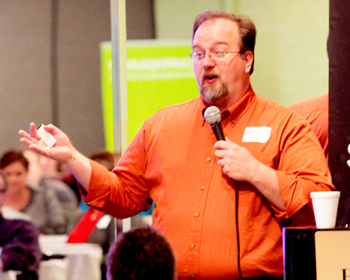
Erik Deckers at his presentation at Blog Indiana 2010

Me at my presentation at Blog Indiana

If you’re interested in becoming a public speaker, there are five basic types of presentations you could give.

  1. How to: Basic tips, how-to, suggestions, and strategies. These are great for sharing information, and to establish your expertise. Title your talk something 7 NEW Secrets To Promoting Your Blog Through Social Media. People who are interested in sessions like this are looking for concrete, nuts-and-bolts ideas. This is the kind of talk I gave this year.
  2. Case Study: These historic talks show how you got from point A to point B, and the lessons you learned on the way. They can be inspirational or a cautionary tale, and if they’re done well, people can get both types of information from them. If you’re a great story teller, then I suggest you give this a try. Do a case study of a single client, or tell a part of your story (Note: We didn’t ask for your life story), or even 3 -4 short stories that are all centered around a single point. This is also a good place to ask for discussion from the audience. Paul Poteet gave this as a keynote presentation this year.
  3. Futurecasting: This is where the futurists and 30,000-foot-view thinkers can really shine. You can talk about what you think the future of your industry will be. If you make enough accurate predictions, you’ll be one of the hot properties on your industry’s speaking circuit. This presentation may look back historically to make its point, but a futurecasting talk is going to discuss what they believe will be happening over the next few years.
  4. Educational: Educate your listeners about a topic, idea, or tool. It may not be as in-depth as the how-to, but it’s great for teaching beginners about a particular concept. An informative session will teach people about Twitter — why use it, how it works, who uses it — while a how to session will cover the specifics of using it — signing up, following people, sending tweets. Doug Karr told listeners why their site sucks, with his Why Your Site Sucks educational session.
  5. Jason Falls, Jay Baer, and Chris Baggott participate in a panel discussion at Blog Indiana 2010.

    Jason Falls, Jay Baer, Chris Baggott (standing)

  6. Issues: Every industry has its issues and controversies, and these are a great place to address them. This can be a panel discussion, a single person facilitating an audience discussion, or even one person presenting one or both sides of the issue. Fellow ghost blogger Lindsay Manfredi talked about ghost blogging this year, which has been a big hot button issue for our industry for a few years. Chris Baggott, Jason Falls, and Jay Baer participated in a panel discussion to “dispel the myth of the blog reader.”

PG
About the Author: Erik Deckers
Erik is the VP of Operations & Creative Services for Pro Blog Service. He has been blogging since 1998, and has been a published writer for more than 22 years. He has written humor newspaper columns, business articles, radio and stage plays, and is currently working on a novel. He helped write Twitter Marketing for Dummies, and is writing two other books on social media and networking. Erik frequently speaks on blogging and social media.

Newsday Has 35 Paid Subscribers for Online Newspaper

I can’t decide whether to feel schadenfreude or pity for Newsday, the Long Island daily newspaper. They have 35 (yes, thirty-five) paid subscribers for their online newspaper.

The New York Observer reveled in schadenfreudic glee as they reported this news:

As in fewer than three dozen. As in a decent-sized elementary-school class.

That astoundingly low figure was revealed in a newsroom-wide meeting last week by publisher Terry Jimenez when a reporter asked how many people had signed up for the site. Mr. Jimenez didn’t know the number off the top of his head, so he asked a deputy sitting near him. He replied 35.

Michael Amon, a social services reporter, asked for clarification.

“I heard you say 35 people,” he said, from Newsday’s auditorium in Melville. “Is that number correct?”

Mr. Jimenez nodded.

Man, I haven’t written with that much malicious glee since Ann Coulter had to have her jaw wired shut.

What’s worse is that Newsday has had their newspaper behind a paywall, newsday.com, since October 2009. (I’m not going to hotlink newsday.com, since you’d have to pay to read any of the stories anyway.)

Apparently, this new website cost Newsday $4 million, and they have grossed $9,000.

That doesn’t mean there are only 35 people reading the website. Anyone who subscribes to the paper or has Optimum Cable gets free access — about 75% of Long Island. I’m not sure how many subscribers there are to the paper, but it’s a nice little out to give free access to cable subscribers as a way to boost subscription numbers.

Still, other dailies considering going to a paid-only option may be feeling a little more panic than they’re already feeling, having laid off most of their local writers and getting local content from non-local providers, and then wondering why people aren’t subscribing anymore.

We can learn or surmise a few things about the newspaper industry from Newsday’s crappy subscribership and the Indianapolis Star’s not-so-slow descent into USA Today: Indianapolis Edition.

  • Readers have gotten spoiled. We’re used to getting our news for free, so we’re a little hesitant to pay for something we can get elsewhere. Since the Star is nothing more than an Associated Press outlet these days, I can hop over to AP.org if I want some national news.
  • People want local content. And not-so-surprisingly, we want it from local sources. The Indy Star is getting local content from Metromix, a company based out of Chicago. Long Island’s Newsday is putting local spins on national stories. “What LIers Want to Hear In Obama’s Address” was one of today’s headlines. Why would people want to pay for something like this? If it was truly local news, I would care. But it isn’t, so I don’t.

If newspapers truly want to make money online, they need to consider going back to truly local news, written by local reporters who have more experience than a journalism internship and six months of covering school board meetings. Let the national news outlets cover the national news. Make your newspaper the best and only source for local news.

This is where the small weeklies and dailies are going to survive, and even succeed by focusing on local content, with only a brief mention of world and national affairs.

Photo: Nitroglicerino

PG
About the Author: Erik Deckers
Erik is the VP of Operations & Creative Services for Pro Blog Service. He has been blogging since 1998, and has been a published writer for more than 22 years. He has written humor newspaper columns, business articles, radio and stage plays, and is currently working on a novel. He helped write Twitter Marketing for Dummies, and is writing two other books on social media and networking. Erik frequently speaks on blogging and social media.

Be an Entre-Commuter With Just a Latte and a Laptop

I’m the mayor of my office and my church.

At least that’s what Foursquare tells me. I’ve checked in enough times at both places that I’ve been declared the mayor.

Foursquare is a location-based social networking site that lets you tell people where you are via Twitter and Facebook.

Think: 50% friend-finder, 30% social city guide, 20% nightlife game. We wanted to build something that not only helps you keep up with your friends, but exposes you to new things in and challenges you to explore cities in different ways.

You check in at different places around a city, give tips and recommendations, and in general get to know your city better.

I’ve been using FourSquare a lot lately, especially after I got my new Droid phone a few weeks ago.

I’m starting to earn the reputation for being out and about all the time. I check in everywhere I go: the office, the coffee shop, the library, the grocery store. I’m not out any more than usual. I’m just telling people about it.

But it’s become a whole lot easier now for me to be out and about too, thanks to my laptop and the proliferation of free wifi around the city. I’ve become a real entre-commuter.

(Entre-commuter: entrepreneurial commuter who works out of a coffee shop, cafe, restaurant, library, or any other place with free wifi. Term coined by Erik Deckers and Paul Lorinczi to justify why they don’t sit in the office all day, every day.)

We came up with the term entre-commuter for those people who own their own business and have the ability to do it anywhere. They can do it from home, the local library, or their local coffee shop. We happen to favor Hubbard & Cravens in Broad Ripple, although I’ll travel just about anywhere around Central Indiana for good coffee.

The great thing about being an entre-commuter is that you get to network with other people, and collaborate with them on occasion. I can’t tell you the number of people I’ve met with, helped, provided connections for, and done business with, just because we both happened to be out at the same time in the same place. And meeting some of the same people in the same place several times has blossomed my network beyond the typical Chamber and other networking events.

Where do entre-commuters gather?

I prefer to patronize local coffee shops and restaurants, although I’ll hit the occasional chain once in a while. We need to support our local establishments more than the chains — the chains don’t support our local economies. The locals do.

Is there entre-commuters etiquette?

There are a few rules for entre-commuters. They’re fairly common sense, but I still see people violate them from time to time.

  • Don’t camp out. They have to turn tables during peak times. If you’re sitting with a computer and a bottled water over lunch, they’re losing money on you.
  • Only occupy tables during low times. Don’t take up a 4-top all by yourself if you can help it, and don’t be afraid to share a table with a stranger either.
  • Buy something. Spend money, and more than just a little. Don’t buy a $2 coffee and then sit for 8 hours.
  • Be respectful. This is someone else’s business, not your office. Don’t treat it like it’s your place. You’re a guest.
  • Keep your voices down. Other people are there too, so don’t have loud conversations. You’re not at the club, you’re at a quiet little shop.

Entre-commuters just need to be somewhere we can find free wifi and good coffee. Somewhere we can connect online and offline. Find your local shops and spend some time there. See if you can create some business, as well as giving the local shops some business as well.

Photo: Nina Turns 40 blog

PG
About the Author: Erik Deckers
Erik is the VP of Operations & Creative Services for Pro Blog Service. He has been blogging since 1998, and has been a published writer for more than 22 years. He has written humor newspaper columns, business articles, radio and stage plays, and is currently working on a novel. He helped write Twitter Marketing for Dummies, and is writing two other books on social media and networking. Erik frequently speaks on blogging and social media.

Mobile Work Days: The Benefits of Entrepreneurial Collaboration

One of the things I love about Indianapolis is the business cooperation, especially among the small businesses and entrepreneurs. I saw a lot of this when several of us would get together at The Bean Cup in Greenwood for a Mobile Work Day.

I didn’t get there as often as I wanted, and we didn’t call it a Mobile Work Day, but I did get to spend some time with Doug Karr, Jason Bean, James Paden, and Stephen Coley of Brandswag.

It’s actually an efficient way to work. Many times I learned about new information, heard about new services and best practices, and even got some help fixing a couple problems that had plagued me for months. It was also a way to strengthen friendships and working relationships. I have a few more people I feel comfortable calling for help and/or referring business to.

Since then, I’ve tried to start up Mobile Work Days in other areas of town. I’ve had them at Gourmet Grounds of Geist in Fishers, and Hubbard and Cravens in Broad Ripple. While attendance has been small, the idea has been embraced by the social media pros and entrepreneurs in the area. I think Mobile Work Days may be a new way of doing business and boosting our local economy.

So we’re going to try to make this a real thing, a real way of doing business.

What is a Mobile Work Day?

A Mobile Work Day (#MobileWorkDay) is where entrepreneurs and small businesspeople hang out in a local coffee shop and get some work done with other entrepreneurs and SMBs.

We pick local coffee shops, as opposed to Starbucks, for a number of reasons:

  1. Free wifi. None of this paid wifi or AT&T crap. I know some Starbucks now offer free wifi, but that’s because the locals have been doing it for years.
  2. The coffee is better. ‘Nuff said.
  3. Local shops are more conducive to groups. A lot of the locals have tables you can shove together for groups of 6 or more. At the Bean Cup, we would sometimes take up half their tables and have 16 – 20 people working together in one long row of tables. Unfortunately, they may have had the biggest seating available, so that option may be lost to us.
  4. Money you spend at local shops come back to the community. When you spend $1 at a local shop, $.40 stays in the area. When you spend $1 at a Starbucks, only $.13 stays.

There are no rules or expectations for what you work on, how long you stay, or when you show up or leave. Our only request is that you spend some money at the place. Get a cup of coffee and a refill, or a latte and a muffin. Buy some lunch and a water. Just make it worth the coffee shop’s while for having us take up some tables for a few hours.

Ultimately, Mobile Work Days are good for the community. Hosting one at a local coffee shop helps their business, and it boosts our own local economy by supporting local merchants. Besides, if we want local support for our own businesses, we need to support them. If you’re an entrepreneur who has meetings at big chains, don’t be surprised if your local community can’t or won’t support you in return.

Our next Mobile Work Day is Thursday, November 19 at Hubbard & Cravens at 6229 Carrollton Rd., in Broad Ripple. We’ll start at around 8:30 or 9:00, and go until about 4:00 or 5:00.

We’ll start holding these on the 3rd Thursday of every month, and we’ll try to come up with some different places to hold it. If you have any suggestions, let me hear them. Our criteria is free, reliable wifi, the ability to hold a group of at least 10 mobile professionals while still taking good care of their regular crowd.

PG
About the Author: Erik Deckers
Erik is the VP of Operations & Creative Services for Pro Blog Service. He has been blogging since 1998, and has been a published writer for more than 22 years. He has written humor newspaper columns, business articles, radio and stage plays, and is currently working on a novel. He helped write Twitter Marketing for Dummies, and is writing two other books on social media and networking. Erik frequently speaks on blogging and social media.

At the Top – Entrepreneurial Networking for Indianapolis

Ron Sukenick approached me several weeks ago and described a new networking event he was putting together called “At the Top”. As he his idea, it had a familiar sound to it. It sounded a lot like the old Entrepreneurs Alliance of indiana.

I thought, “Man, I miss the old Entrepreneur’s Alliance.” I miss seeing everyone on the 3rd Thursday of every month to have drinks and learn about how business started, failed and succeeded.

So, Ron asked if Professional Blog Service would like to be a co-sponsor of the event. I said, “Absolutely.”

Here is why, I would not have co-started Professional Blog Service, if not for the Entrepreneurs Alliance. It was there that I heard many stories from many different Indianapolis business people who were just like me. My all-time favorites were:

  • Ray Compton – “You don’t need a lot of money to market, you need to be creative.”
  • Harley Davidson – “There are three things needed to be a successful manager – knowledge, experience, and emotional competency.” With the emphasis on emotional competency.
  • Jeff Smulyan – Great story about how he got started

And the other companies:

  • Ritters Ice Cream
  • JD Byrider
  • Scott Jones
  • Ontario Systems

The list really goes on and on. There were a lot of great companies and speakers that participated at the Entrepreneurs Alliance of Indiana.

So, Ron has resurrected this idea with his “At the Top” program. The venue is the excellent Skyline Club downtown. (Get it? “At the Top” on top of Indianapolis?) The format is going to be similar to what we did at EAI. There will be cocktails and appetizers with a guest speaker for each meeting.

So, if you are an Entrepreneur seeking inspiration from other Entrepreneurs that have gone through what you are experiencing, go to the “At the Top” meeting November 18, 2009.

What: At the Top
When: November 18, 2009
Time: 5:30p
Where: Skyline Club – Downtown Indianapolis

Professional Blog Service is very happy to be a co-sponsor of this important series of meetings. Without entrepreneurs, there is no economy. And we’re happy to help contribute our efforts to this event.

Photo: ExistDifferently

PG
About the Author: Paul Lorinczi
Paul Lorinczi is the President of Professional Blog Service. The goal of the company is the help clients use Blogging and Social Media to expand their business online through planning, execution, and measurement.

Entrepreneurs, Support Your Local Coffee Shops So We’ll Support You

I was at a Rainmakers meeting last night, when my friend Lorraine Ball was the guest speaker. She spoke about the local business economy and the importance of supporting local businesses, especially if you’re in a small business yourself.

Karla & Ashley at Hubbard & CravensLorraine talked about when Rainmakers first started, they had their favorite local special coffee shop at the corner of 86th & Keystone. The owner, Malcolm, was even a Rainmaker, so it made sense that they would all meet there. Since they didn’t have offices, that became their de facto office. If you wanted to find Tony Scelzo, Lorraine, or any of the other Rainmakers, you didn’t call them, you drove there. Until one day, Lorraine showed up at the shop, and found that it was closed down.

Although there are a lot of reasons and suppositions about why it happened, the simple fact is that Malcolm just wasn’t getting enough local support from local customers. The Rainmakers made up about 40% of his business, but at the time, they only numbered about 100. You can’t run a successful coffee shop on 250 people.

Now, Rainmakers has reached 1600 members. They’re having one-on-ones and entrepreneur meetings galore, at a variety of coffee shops all over the city. Unfortunately, most of these places tend to be at a nearby Starbucks, and not a local coffee shop like Malcolm’s.

Our local economy is built on local business, not on national business. Local coffee shops, local supermarkets, local hardware stores bring in money to our city and state; Starbucks, Wal-Mart, and Lowe’s don’t.

In fact, out of every dollar you spend at a local business, 40 cents of it stays in the community. When you spend a dollar at the big chain stores, 13 cents stays in the local economy. And that’s usually in the form of salaries, which are then spent on coffee, food, and home items. . . from Starbucks, Wal-Mart, and Lowes.

In other words, if you want to grow your local economy, patronize local restaurants, coffee shops, and stores whenever possible.

As a small business owner and networking fiend, I have had more than my share of one-on-ones in coffee shops. I’ve personally drunk enough copy to float a battleship and put Juan Valdez’s kids through Harvard Business School. And I’ve tried to do it whenever possible at any of my favorite local shops. I avoid Starbucks whenever possible (although there are times it’s just unavoidable).

I have my favorites, and I often tell people about “the two best coffees in the city,” both of which roast their beans locally, rather than buying them from somewhere else. I visit Hubbard & Cravens in Broad Ripple several times a week, and can often count on bumping into people I know, including several Rainmakers, fellow writers, and other social media luminaries. It’s sort of like Cheers for the networking set.

Now, one of my own favorites (and Doug Karr’s home away from home), the Bean Cup, is closing down. It’s the fourth or fifth closing that I can think of since I moved here three-and-a-half years ago. Why? Because more people are concerned about buying coffee with an image, not supporting their local shops.

Here’s the bottom line: if you’re a local business owner or entrepreneur, and you expect people to support your business, it’s important that you support your local community. If you’re a local entrepreneur, and hold most of your meetings in a Starbucks, then does that mean I don’t have to support you? It seems rather odd that people who depend on a local customer base do their business in a national chain that only gives $.13 back to our community.

“Until Starbucks starts sending me checks from Seattle,” said Lorraine, “I’m not going to patronize them.”

Here’s my challenge: if you meet with clients, partners, and vendors at coffee shops, forgo Big Corporate Coffee and visit a local shop instead. Be brave, be bold, be daring. Try something new for once, try something that’s not bitter and over-roasted, and see if you can find a new favorite coffee shop. And if you’re in the leadership of a networking organization geared toward local businesses, I think it’s especially important that you be a role model in this. Stop visiting coffee shops that don’t support our mission of “Be more, serve more” and “SHARE” and hold your meetings in the ones that do.

If you’re not sure where to find one, check out the Indy Indie Coffee shop map Doug Karr and I created. It’s an up-to-date Google map of all the local coffee shops in Central Indiana. Visit the map, zoom in to your neighborhood, and pick a shop in your area. Start holding your meetings at these locations and become a regular. Take advantage of their free wifi, better tasting coffee, and strong sense of community.

If we’re going to rebuild our local economy, it’s not going to happen by eating at big chain restaurants, drinking big chain coffee, or buying big chain groceries. It’s going to happen by visiting local coffee shops, buying from a local hardware store, and even going to local supermarkets and farmers markets.

And if you want to know what the two best coffees in Indianapolis are, send me an email and I’ll share my favorites with you. I’ll also tell you where to find the best brownies, best atmosphere, and best owners.

Photo: Me. That’s Karla & Ashley, two of the fine baristas at one of my favorite coffee shops.

PG
About the Author: Erik Deckers
Erik is the VP of Operations & Creative Services for Pro Blog Service. He has been blogging since 1998, and has been a published writer for more than 22 years. He has written humor newspaper columns, business articles, radio and stage plays, and is currently working on a novel. He helped write Twitter Marketing for Dummies, and is writing two other books on social media and networking. Erik frequently speaks on blogging and social media.

Pro Blog Events

Call Us Now

Email Subscribe

Email address


Topics

Want Pricing or Need a Quote?

Pricing and Quote.


We write blog posts, manage social media campaigns, write online press releases, write monthly news letters and can write your website content.


Find the right pricing package for you!