• Skip to primary navigation
  • Skip to main content
  • Skip to primary sidebar
  • Skip to footer

Pro Blog Service

  • Business Blogging
    • Blogging and Content Marketing for Search Engine Optimization (SEO)
    • Social Media Strategy and Consulting
    • Blogging Services
    • Content Factory
    • Need a Law Blog or Legal Blog?
    • Download Our White Paper: Business Blogging: The Cost of Corporate DIY Blogs vs. Ghost Blogger
    • Pro Blog Service Books
  • Blog
  • Speaking
  • About Pro Blog Service
    • Erik Deckers
    • 4 Simple Rules for Guest Posting on Our Blog
  • Get Ghost Blogging Quote
  • Link Sharing/Contributed Articles
You are here: Home / Archives for All Posts

All Posts

October 22, 2010 By Erik Deckers

Five Blogging Secrets for Lawyers

We speak to a lot of lawyers about how they can use blogging to help promote their practice without violating their state’s marketing guidelines. Many attorneys are realizing that social media is a great legal marketing tool, and many of them are trying to learn how to use it.

The problem a lot of attorneys have in their marketing is that they are not allowed to use “competitive” language — we’re the best, we’re better, or ranked number one in our field — and they can’t offer guarantees. This means they have to tread carefully on their TV and phone book ads. That’s why you hear/read things like “tell them you mean business,” “we fight for you,” and “we don’t handle anything except personal injury.”

We’ve found that many attorneys are wary about blogging, but that it’s the smaller firms who are quick to embrace it. The larger, older firms are still not too sure whether they want to get mixed up in it, which means the small firms are getting there first, and finding great success in leaving the larger firms behind.

The biggest reasons for lawyers to blog are to show up higher in search engines (many people are turning away from Yellow Pages and doing searches for things like attorneys via Google), and to demonstrate to clients that they have the ability and knowledge to handle their particular needs. (We’ll discuss why attorneys need to blog at a later date.)

Here are five ways lawyers can blog without violating their state’s marketing rules

  • Talk about legal news. Talk about things happening in your state or other states. This helps you keep up with what’s going on in your community
  • Talk about developments in your field. If you work in intellectual property, talk about intellectual property news. If you work in personal injury, talk about personal injury law. This shows that you keep up with developments in your field, showing potential clients that you’re working to stay up-to-date with important information.
  • Write case studies. Check out important cases in the news (not your own, since you have to worry about attorney-client privilege), and do an analysis of the ramifications of that case. This is especially important as you discuss cases in your field.
  • Review basic laws for potential clients. We do this for one client — we talk about local and state laws that might affect citizens of that state, like how local vandalism laws might affect their Halloween pranks, tailgating laws in time for football season, and what to do if you want to start a business.
  • Answer legal questions from readers. Address some interesting or unknown points, teach people a little about the law, and give basic guidance to people so they understand how to pursue their legal questions further. I understand you can’t give legal advice, so it will be important to point out that this is not advice, but is used for educational purposes.


Filed Under: Blog Writing, Blogging, Communication, Marketing, Reputation Management, Social Media Tagged With: blog writing, lawyers, marketing, Social Media

October 14, 2010 By Erik Deckers

A Word is Worth a Thousand Pictures

A word is worth a thousand pictures.

Sure, the reverse is true — a picture is worth a thousand words — but I think the words, in many cases, are more valuable.

Because if I say the word “baby,” “tree,” or “friend,” each of you immediately had a picture flash in your mind of a particular baby, tree, or friend. Maybe it’s your own child or your baby pictures. It’s the tree you climbed when you were a kid. It’s the friend you haven’t kept in touch with.

When I hear 'baby,' I think of my son.

We think in words. Our internal monologue is based on language, not pictures. Even when you flashed on the image of your errant friend, you probably thought, “I haven’t seen her in so long. I should call her.” You didn’t follow up her face with images of a sad face, a telephone, and a scene of the two of you, smiling and laughing, eating lunch.

Language is so ingrained in our way of thinking that it’s actually part of how we learn. In fact, many childhood experts say that it’s not until kids start talking through problems that they can direct their own learning and solve their own problems. According to an article from the National Association of School Psychologists, Motivating Learning in Young Children:

Preschoolers (age 3-5 years) are beginning to be more involved with verbal problem solving skills. They direct their own learning through speech and use vocal communication to direct their own behavior to solve problems. Young children are often heard talking themselves through a series of actions that lead to the solution of a problem. As children get older, this “talking out loud” will become an internal monologue. This newly developing ability to problem solve is the basis for motivation at this stage. Having the self confidence to know that one can solve a problem motivates the learner to accept other new and challenging situations, which in turn lead to greater learning.

Think about your own methods in working through a series of complicated steps, like trying to follow driving directions to an unfamiliar location. You turn off the radio, shush the kids, and start mumbling quietly to yourself:

“Okay, that’s 3235, and we want 3340. So it’s going to be on the other side of the str—dammit, I missed it!”

But that problem solving, that normally-internal monologue is based on our use of words, not pictures. We learn in words, we think in words, we solve problems in words.

Don’t get me wrong. I love pictures. I love photographs. I think people like Casey Mullins and Paul D’Andrea take some stunning photos that I’ll never be able to manage </sucking up>. Admittedly there are instances where mere words cannot do justice to the images of certain photos, and I don’t think we should even try.

But pictures can’t tell the entire story. Words can. Or at least do it better. Photos can’t explain, teach, educate, inspire, or persuade the way words can. Even when we see the most poignant or beautiful photos, we still need words to tell us what the photo is. Who’s in that photo? Where was it taken? What was he thinking when you took it?

What do you think? Do words conquer all? Is the pen mightier than the lens? Or are we visual people who gather and process information by what we see, not what we read? Leave your comments (or photos).

——
My book, Branding Yourself: How to Use Social Media to Invent or Reinvent Yourself (affiliate link), is available for pre-order on Amazon.com. I wrote it with my good friend, Kyle Lacy, who I also helped write Twitter Marketing For Dummies (another affiliate link).

Filed Under: Communication, Writing Tagged With: language, photos, writing

October 11, 2010 By Erik Deckers

Tools Don’t Make The Expert, Knowledge Does

Chris Brogan said something in his Hemingway’s Pencils post last week that really hit my hot button:

No one ever asked Hemingway which pencils he used to write his books. The tools aren’t the thing. The effort and the content and the promotion and the connection and the networking and the building value are the thing.

This is an important distinction as people still equate the knowledge and experience of using social media tools with the quality of the work someone does, and whether they can call themselves a social media expert.

I have used Moleskine notebooks and Pilot G-2 pens for over six or seven years. I have used computers to write since 1986. I have gone through hundreds of legal pads. But none of this makes me a good writer. Knowing the best words to use to convey an idea, knowing how to construct sentences for maximum impact, knowing how to string ideas together, knowing how to tell a story. Those are the things that make me a good writer.

However, to listen to some of the “no social media experts” crowd, it’s the amount of time that I have used my writing tools that make me a good writer. And to hear their argument, I lose my expertise each time I switch to a different writing tool. Switch from pen to computer? Start all over, your pen writing knowledge is useless.

The point is that it doesn’t matter how long I have used a tool, it’s what I do with those tools that make me an expert. It’s not how long I have owned a particular pen, or if I switch to a different brand of notebook (as if). It’s the knowledge and experience that I bring to my writing that does it.

——
My book, Branding Yourself: How to Use Social Media to Invent or Reinvent Yourself (affiliate link), is available for pre-order on Amazon.com. I wrote it with my good friend, Kyle Lacy, who I also helped write Twitter Marketing For Dummies (another affiliate link).

Filed Under: Blogging, Social Media, Social Media Experts, Tools Tagged With: Moleskine, social media experts, writing

October 1, 2010 By Erik Deckers

Finding a Working Definition of Ghost Blogging

With all of the controversy that seems to swirl around the acceptability of ghost blogging, I realized we weren’t really arguing about the same thing. The acceptance seemed to be based on their definition of the term.

Is it writing a blog post with the full input approval of a client? Or is it writing a post that doesn’t have any input, but does have approval? As I read descriptions and arguments by Jason Falls, Lindsay Manfredi, and other blogging luminaries, I realized it was the definition that was the problem.

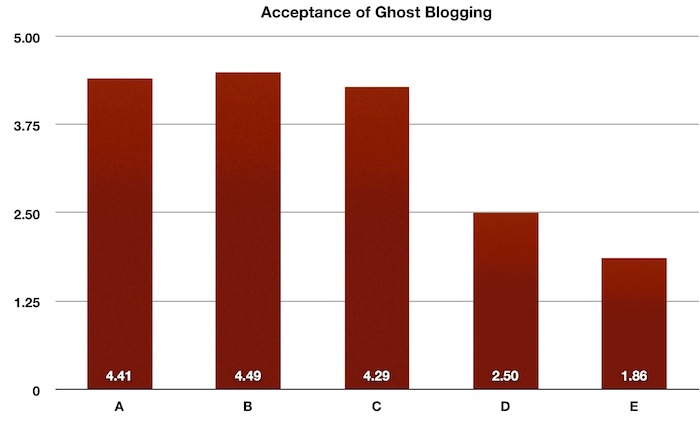
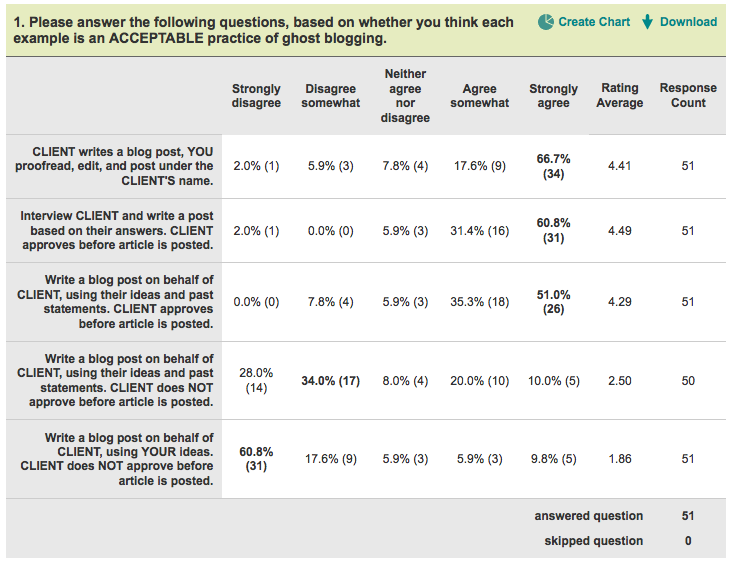
So we created a short little survey to figure out what the most widely understood definition of ghost blogging to be. Survey respondents were given 5 different options of what ghost blogging might entail, and then asked to rate them on a 5 point scale (1 = strongly disagree; 5 = strongly agree). These are the results out of 51 responses, out of a 5 point scale*:

  1. CLIENT writes a post, YOU proofread, edit, and publish under CLIENT’S name: 4 people disagreed or strongly disagreed (7.9%), but 43 people agreed or strongly agreed (84.3%). Rating: 4.41/5
  2. Interview CLIENT and write a post based on their answers. CLIENT approves before article is posted. 1 person strongly disagreed (2%), 47 agreed or strongly agreed 92.2%). Rating: 4.49/5
  3. Write a post for CLIENT using their ideas and past statements. CLIENT approves. 4 people disagreed 7.8%), 44 people agreed or strongly agreed (86.3%). Rating: 4.29/5
  4. Write a post on behalf of CLIENT, using their ideas and past statements. CLIENT does NOT approve post. 31 people scored SD or D (62%), while only 15 people scored A or SA (30%). Rating: 2.5/5
  5. Write a post for CLIENT, using YOUR ideas. CLIENT does NOT approve post. 40 people scored SD or D (78.4%), 8 people scored A or SA (15.7%). Rating: 1.86/5

(*These numbers won’t add up to 51 in this description, because I left the “neither agree nor disagree” out of this text for simplicity and brevity. The actual numbers are at the bottom of this post.)

From these results, we can infer a few basic ideas about ghost blogging’s acceptability:

  • Ghost blogging is acceptable to most people as long as the client approves the posts before they are published. In fact, this was the most important factor in deciding whether ghost blogging is appropriate or not.
  • Ghost blogging is acceptable, as long as the client has input (#2), or at the very least, the ideas used have been addressed in the past (#3). Option #2 is akin to a copywriter sitting down with a client, and synthesizing the client’s thoughts and ideas into a piece of text. Option #3 is similar to a presidential speechwriter who is already familiar with the president’s stance on certain topics, and can write about them with authority.
  • At least 8 people thought it was acceptable to essentially put words in the client’s mouth without their knowledge. Personally, I can’t think of any instance where this would be acceptable, in business or government, let alone blogging. Even when I was writing speeches for the Indiana State Health Commissioner, everything had to follow her vision. Her administrative may have assigned the speech or project, but I had to know the Commissioner’s stand on the issues.
  • Conversely, 4 people thought it is wrong to even proofread and edit a client’s writings, and then post it on the client’s website on their behalf. While I’m a little worried that nearly 16% of the respondents thought it’s okay to pose as a client without the client’s knowledge, I can only wonder at how rigid the beliefs are of the people who are opposed to editing and then copying, pasting, and clicking “Publish.” It also worries me what they would think if they knew I had four editors poring over my book before the publishers printed it for me.

Because the first three options all scored above a 4.4, I can conclude that most people will accept the idea that ghost bloggers need the client’s input and approval before a post gets published. Anything that does not have at least the client’s approval crosses the line of acceptability, and anything that has both input and approval.

So, that is our baseline for acceptable ghost blogging. The next step is to find out how strongly people feel about it, and see if we can get a bigger group to respond. More on that later.

Filed Under: Blog Writing, Blogging, Ghost Writing, Writing Tagged With: ghost blogging, ghostwriting

September 15, 2010 By Erik Deckers

Social Media Makes Us Citizen Journalists

Social media doesn’t just make us consumers of news, it makes us part of the news.

We’re no longer relying on the mainstream media to inform us. In many cases, we’re reporting it ourselves, or at the very least, spreading it beyond the traditional media’s original reach. I can’t count the number of stories I heard about on Twitter, Facebook, or a friend asking me, “hey, did you just hear about __________?”

In some cases, it’s just a link that points back to a story in an online newspaper. It could be a tweet from @IndyStar, it could be a retweet of a story in another part of the world, or it could even be a blogger reporting on news with national ramifications that is still only making ripples in their local media.

My point is we are starting to create our own media. While the mainstream media may sneer and look down their noses at bloggers as citizen journalists, the fact is they are coming up with some interesting stories, often breaking the news before the professionals.

In fact, the Associated Press has gone so far as to not only acknowledged the existence of bloggers, but will even now cite them as a source.

“We should provide attribution whether the other organization is a newspaper, website, broadcaster or blog; whether or not it’s U.S. based; and whether or not it’s an AP member or subscriber,” said the Associated Press’ September 1 online press release.

In other words, they may not like it, but they have to follow their own rules about us.

This is just one more indication that citizen journalists are becoming more important to informing our communities and discussing the things the professionals don’t. This is also one more reason why citizen journalists need to act like real journalists, and not the half-assed rabble rousers they assume us to be.

Want more proof that citizen journalism is continuing to grow? There are a growing number of sites that aggregate our citizen journalist news for us, so we can read more stories about our favorite topics in one location.

  • Newsvine: Community driven news. They reprint wire content, and some members have their own blogs. This one has all the same sections as a traditional newspaper.
  • NowPublic: A citizen journalist network where users do their own reporting, upload videos and audio.
  • The American Reporter: The Internet’s first original content alternative daily newspaper. They publish news from journalists and citizen journalists from around the world. They were the first to break the story about the A.A. Milne estate suing Disney for royalties of Winnie the Pooh. (Disclosure: I have been AR’s humor columnist since 1997.)
  • SB Nation: A collection of sports news, blogs, and scores. It’s done in conjunction with Yahoo Sports, but also a collection of 278 sports blogs from around the country. It’s easy to see a single network — ESPN, Sports Illustrated — covering sports this thoroughly, but SB Nation is able to put it together for a fraction of the cost.
  • Autospies: A collection of automotive news organized by and for automotive enthusiasts. If you are an automotive professional, you may hear breaking news here before you get it in your other industry publications.
  • Tip’d: A finance, investing, and business site that works like Digg. You read a story, “tip” it, and then discuss it.

Filed Under: Blog Writing, Blogging, crisis communication, Social Media, Traditional Media, Writing Tagged With: citizen journalism, Social Media, traditional media

September 9, 2010 By Erik Deckers

10 Blog Writing Lessons Learned from Authors, part 2

Yesterday, we covered the first half of 10 Blog Writing Lessons Learned from Authors. Here are the next 5 lessons I have learned from some of my favorite book authors.

6) Not everything is going to be a hit — Joseph Heller. Heller wrote 7 novels, and 6 of them sucked were not critical or commercial successes His very first one, Catch-22, is considered one of the best books of the 20th century, and is my 3rd favorite book. It was hysterical, absurd, and filled with enough satire to make George Carlin weep with envy. The rest didn’t do so well, but he kept writing. He wrote 3 plays, a series of short stories, and 3 screenplays, all of which had some success, but never reached the pinnacle of Catch-22.
Still, Heller didn’t go all J.D. Salinger on the literary world. He kept trying and plugging away. You’re not going to hit a homer with every post you write, so don’t give up. (But hopefully you’ll have a better success ratio than 14%.)

7) Piss people off — Anthony Bourdain — The Nasty Bits. Anthony Bourdain is great at pissing people off. He will unleash his ideas and his venom on anyone who gets under his skin. I just finished reading The Nasty Bits, and he has a go at everyone from fast food burger joints to fat people on airplanes to pretentious food snobs like Woody Harrelson, who will only ever eat raw fruits and vegetables, no matter where in the world he is who it inconveniences, or which restaurant owner he insults. Bourdain doesn’t pull any punches, and is willing to put even his more acerbic views in writing. You should too. (And don’t be a such a raw food jerk, Woody.)

8) Know the grammar rules. . . so you can ignore them — Elmore Leonard. Someone once told me “you can’t start your sentences with ‘and.'” I pointed out that things had changed since she was in 5th grade English — like the invention of the printing press — and that people have been starting sentences with “and” for a few decades. And since I was the professional writer, I ignored her. I have since found this quote by Elmore Leonard, and keep it in my notebook for future encounters: “(I)f proper usage gets in the way, it may have to go. I can’t allow what we learned in English composition to disrupt the sound and rhythm of the narrative.”

9) You have to go to where the action is — Ernie Pyle. Pyle died doing what he loved: writing. He was a correspondent for the Scripps Howard newspaper from 1935 – 1945, when he died in combat. Pyle actually won the Pulitzer in 1944 for his work, and became the patron saint of newspaper columnists and the National Society for Newspaper Columnists(I was a member for a couple years). But the only way he could have done all this was by being where the action was. You don’t have to put yourself into dangerous combat situations to write your blog, but you do have to get out from behind your computer, and see the things you’re writing about. When you use photos, use your photos. When you write about places around the globe, write about your visits. It’s one thing to write about things you’ve found on the web, but try getting out in the world and see what inspiration you can get out there.

I once asked Dave Barry to read some of my humor columns. He sent me this photo instead.

10) Humor makes you memorable — Dave Barry. It’s the humor writers, not the political columnists who are the most remembered by their readers. I know people who still remember Dave Barry’s piece on the Lawn Rangers precision lawn mowing team or the time he played a corpse in the Eugene (Oregon) Opera’s production of Gianni Schicchi. No one remembers the piece David Broder wrote for the Washington Post about the guy who did the thing at the place. They remember things that are funny. So, if you can pull it off, use humor in your posts. If you can’t, avoid it, because otherwise people will remember you, and not in a good way.

Filed Under: Blog Writing, Blogging, Communication, Writing Tagged With: blog writing, Ernest Hemingway, Joseph Heller, Tom Waits, writing

  • « Go to Previous Page
  • Page 1
  • Interim pages omitted …
  • Page 64
  • Page 65
  • Page 66
  • Page 67
  • Page 68
  • Interim pages omitted …
  • Page 71
  • Go to Next Page »

Primary Sidebar

Subscribe via RSS

Categories

Tags

advice bloggers blogging blog writing books book writing business blogging citizen journalism content marketing copywriting crisis communication digital marketing Ernest Hemingway Facebook freelance writing ghost blogging ghostwriting Google grammar Jason Falls journalism language Linkedin marketing media networking newspapers No Bullshit Social Media personal branding public relations public speaking punctuation ROI SEO Social Media social media experts social media marketing social networking storytelling traditional media Twitter video writers writing writing skills

Archives

Recent Posts

  • The Enshittification of Evernote and Why I Quit Them
  • 11 Tips for New Digital Nomads
  • 13 Things to Do or Not to Do When Connecting With Me for the First Time
  • Why You Need to Write Your Memoir
  • How to Give a 6-Minute Presentation at 1 Million Cups

Footer

BUY ERIK DECKERS’ LATEST BOOK

Erik Deckers' and Kyle Lacy's book - Branding Yourself now available at Amazon

Request a Quote – It’s easy

We write blog posts, manage social media campaigns, write online press releases, write monthly news letters and can write your website content.

Let's figure out the right package for you.

FREE 17 Advanced Secrets to Improve Your Writing ebook

Download our new ebook, 17 Advanced Secrets to Improve Your Writing

Erik recently presented at the Blogging For Business webinar, and shared his presentation "12 Content Marketing Secrets from the Giants of Fiction.

If you attended the event (or even if you didn't!), you can get a free copy of his new ebook on professional-level secrets to make your writing better than the competition.

You can download a copy of free ebook here.

© Copyright 2020 Professional Blog Service, LLC.

All rights reserved. Use of this site indicates your consent to our Privacy Policy and Terms of Use.

1485 Oviedo Mall Boulevard Oviedo, FL 32765
Call us at (317) 674-3745 Contact Us About