• Skip to primary navigation
  • Skip to main content
  • Skip to primary sidebar
  • Skip to footer

Pro Blog Service

  • Business Blogging
    • Blogging and Content Marketing for Search Engine Optimization (SEO)
    • Social Media Strategy and Consulting
    • Blogging Services
    • Content Factory
    • Need a Law Blog or Legal Blog?
    • Download Our White Paper: Business Blogging: The Cost of Corporate DIY Blogs vs. Ghost Blogger
    • Pro Blog Service Books
  • Blog
  • Speaking
  • About Pro Blog Service
    • Erik Deckers
    • 4 Simple Rules for Guest Posting on Our Blog
  • Get Ghost Blogging Quote
  • Link Sharing/Contributed Articles
You are here: Home / Archives for All Posts / Marketing

Marketing

February 10, 2012 By Erik Deckers

Dear Executives, Social Media Does Not Render Your Employees Stupid

Social media does not make people stupid. It does not make them irresponsible, lazy, or unproductive. Social media will make you money, however, if you do it right.

I talk to a lot of business owners and executives who worry that if they start using social media to market their business, their employees’ productivity will plummet.

I’ve had meetings in the last two days with two different business owners. One has embraced Facebook and blogging fully, the other is worried that Facebook will hamper his employees’ ability to get work done.

The first employer urges his employees to do stuff on social media. Almost requires it. His Facebook page gets dozens of visits a day, which is awesome because they sell such a niche product, the customer base for the entire country can be measured in the thousands.

The other employer says — and rightly so — that they have so much administrative work to do around the office, he doesn’t want their Facebook efforts to distract them from getting their admin work done.

The first employer wants to know how he can do more social media marketing. The second employer wants to know the bare minimum he can get by with.

As Doug Karr says, asking what the minimum you can get by with on social media is like asking how slowly you can drive a race car.

Social Media Marketing is Not About Playing

ZOMG! Facebook lets me play with kittehs!!

We as employers trust our employees. We trust them to answer the phones and be pleasant to everyone who calls in. We trust them to make travel to other states and make sales calls and presentations. We trust them to take payments from customers and put our money in the bank. We trust them to buy products from other companies. And we even trust them to use computers without standing over them, watching them type every email.

So what is it about social media that scares the bejeezus out of every employer and makes them think that the second they allow Facebook onto their computers, their entire workforce is going to turn into a bunch of 13-year-old girls jacked up on Red Bull and the most recent Justin Bieber sighting?

If you trust these people enough to do business in your name, collect and spend your money, and talk to your customers, then you need to trust them enough to continue to do these things while Facebook is unblocked on their computers.

If you don’t trust them, that’s your fault. If you don’t trust your employees to not screw around, you’re the problem, not Facebook. You hired the wrong people, and that’s a management issue.

Hire people who will get their work done, and make your expectations for social media usage clear from the outset. These are people who can help your company be more profitable, so why not take advantage of that?

Social Media Marketing is About Making Money

The whole reason for a business to be on social media is to make money. Period. It’s not to play Farmville on Facebook. It’s not to pin the latest novelty cake on Pinterest. It’s not to take photos of a rusted out piece of farm equipment on Instagram. It’s to find people who would be interested in buying your products or services.

Every business owner and manager is always looking for a way to make more money and be more profitable. The problem is, many of them are hampered by doing the things that don’t make them money. Doing payroll. Filing claims. Managing inventory. Filling and shipping product orders.

The problem is, payroll, paperwork, inventory, and shipping don’t make you money. Marketing makes you money. Finding new customers makes your money. If you’re a business owner, and you’re spending your valuable time doing payroll, paperwork, inventory, and shipping, instead of generating revenue, outsource them.

Hire a bookkeeping firm to manage payroll. Hire a virtual assistant to file your claims. Hire a $10 hour college student to count inventory and stick orders in boxes. The less of this non-revenue generating work you can do, the better.

Spend the newly found time pursuing new customers. Spend it on Facebook, Twitter, or writing your blog. It doesn’t take long to bring in a couple choice clients to recover the costs of having a part-time employee handle the grunt work that’s actually losing you money. Have them handle more of your non-revenue workload, and find a couple more. You can grow just by having someone else do the heavy lifting for you.

But it starts with letting go of the fear that your employees are going to be struck stupid the second you allow Facebook, Twitter, or LinkedIn on your company computers.

Photo credit: bjornlifoto (Flickr)

Filed Under: Blogging, Blogging Services, Facebook, Lead Generation, Marketing, Social Media, Social Media Marketing, Social Networks, Twitter Tagged With: Facebook, productivity, social media marketing

February 6, 2012 By Erik Deckers

Social Media Marketing Lessons from a Broken Pilot G2 Pen

My pen died last week.

Normally, this is not big news. In fact, this may be the lamest thing I’ve ever written about, and that includes my “this is my first post” post on Blogger back in 2003.

It gave its life in service of my words.

But it’s a notable event, because I want to brag about my pen, and also talk about the power of strangers in the world of social media marketing.

Social media has turned the marketing world on its ear, because it has disrupted marketing altogether. It used to be that we needed professional marketers to tell us what was cool/great/awesome about a particular product. If the paid professionals told us, then it must be true. Or at least, if it wasn’t true, their shouting generally drowned out the one or two detractors who hated the product. In fact, if there was something we didn’t like about a particular product, we got our talking points from a competitors’ commercial, much like talking points in a political ad.

But several years ago, when we started using early social media, like AOL, and creating websites with comments, we started relying on each other to tell us what was cool/great/awesome about a particular product.

That’s how I became such a fan of my Pilot G2 pen. In 2004, I had just entered the world of Moleskine notebooks, way before they became douche-y, and realized I couldn’t use just any old pen in the same notebooks used by Hemingway, Picasso, and Bruce Chatwin. So I went to the Moleskinerie website, an online community for and by Moleskine fanatics, and looked for any recommendations for a good pen. As it turns out, a few months earlier, someone had posed that very question, and the fans weighed in. In fact, it was one of the most commented-on posts they had.

The commenters far and away raved about the Pilot G2 pen, the 0.5 mm size, so I bought one and immediately loved it. I loved it so much, I have used nothing but Pilot G2 0.5 mm pens for the last 7 years, even carrying the same exact pen for over four years (I cannibalized the cartridges from a box of G2s to replace the empty one, rather than just replacing the entire pen). That pen finally broke last summer, so I had to pull out a second one, which broke last week and leaked all over the place.

The cool thing about this is, for as often as I use this pen, to have only one break or go bad in nearly eight years, I’m very pleased. (I’m especially pleased I found it before it leaked into my shirt pocket.) That’s a pretty good testament to quality — to have one cartridge go bad in 8 years of using them? I’ve never even had a car that long without developing problems.

But the coolest thing? I bought this pen based on the advice of a bunch of people I had never met. I didn’t need the Levenger people telling me what was cool about the $237 Pelikan, or Faber-Castell’s four-color booklet on the long history of the Faber-Castell name. All it took was several random comments from a bunch of strangers who were passionate about a notebook and were choosy about their pens.

Traditional Marketers May Be Out of Work Soon

Marketers who haven’t yet embraced social media need to take note: you’re basically out of a job. Consumers are no longer being persuaded by your beautiful graphics and well-designed websites and brochures. We’re being informed by them, but we’re not being persuaded. Instead, we’re persuading each other.

Italian artist Luc on 24 hours of Le Mans - he sketched and wrote about the highlights of the auto race in his Moleskine notebook

We’re getting advice from each other on where to eat, what to watch, which computers to get for our kids, what cameras to buy, what cars to drive, and yes, even what pens to write with.

Marketers who want to take advantage of this should provide places for your customers to talk to each other. You should get your products and/or services into the hands of influencers. Moleskine went so far as to buy Moleskinerie.com and leave it in place, so Moleskine users could share what they were doing with their notebooks, like Italian artist Luc, who uploaded several photos of his sketches and notes about the 24 Hours of Le Mans auto race.

The smart marketers aren’t telling us what’s cool/great/awesome about their products. They’re providing places for the rest of us to tell each other. They’re sponsoring special niche networks on Ning and other platforms for their target audience. They’re getting their products into the hands of influencers. Or in the case of Fiskars and their Fiskateers (which we discuss in No Bullshit Social Media), they’re turning it into a niche community and a research and development channel. They’re basically letting us do all the work for them, and are getting out of the way.

Social media marketing is disrupting the way traditional marketing is done, and giving us all of the power. Now if I can just get someone to send me another pen, I’ll be happy.

Photo credit: Broken pen – Erik Deckers
Moleskine Notebook – Luc on Not Not Tana

Filed Under: Marketing, Social Media, Social Media Marketing, Writing Tagged With: marketing, Moleskine, social media marketing

January 31, 2012 By Erik Deckers

Three Ghost Blogging Concerns We Hear From Clients

Some people have issues with ghost blogging. We’ve got clients who use it on a regular basis, and love it. Other times, we have run into some people who can’t wrap their brains around it. They’re not sure they want to do it, and they have trouble accepting our help. These people tend to fall into one of three categories.

  • They don’t think they have a high-enough position to need a ghost writer. They don’t think they’re that important to “deserve” it. They think their company needs to be bigger, or they need to have a more prestigious position. I saw this a lot when I was doing speechwriting for a Congressional candidate in 2004. It’s not a matter of prestige, it’s a matter of having the time to do it.
  • Okay, that's kind of creepy.
  • They feel they need to “earn” the words by doing the work themselves. These people have a very strong do-it-yourself ethic, and think that they should be able to and know how to do every aspect of their business. They don’t want someone to do the things they should be capable of doing themselves, and they feel like they’re slacking when they don’t. But a lot of people can’t write quickly or efficiently — they take a couple hours to write a single blog post. That’s a problem when their time is worth $250 an hour, like a defense attorney. Why spend $500 of your billable time, three times a week, when you could hire someone to do the ghost blogging for you?
  • They think writing is so easy that anyone can do it. “After all,” they reason, “I learned how to write in school, so I can just take the skills I learned 20 – 30 years ago, right?” This is like saying, “I know how to work a table saw, so I ought to be able to make my own custom cabinets. Look, we all learned how to communicate via the written word, but that doesn’t make you a writer. A professional ghost blogger has been trained on how to write tight, concise copy that will inform, entertain, or persuade. While some people are able to do this without training, those people are few and far between. Don’t risk turning off your audience with less-than-professional writing that rambles on, is filled with errors, or just plain doesn’t make sense. (Not so surprisingly, these are the same people who demand that every position in their company has experience in their industry, including the accountant, the IT person, and even human resources staff.)

Ghost blogging is one of those services that companies need to maintain an online presence, but don’t have the time or resources to do it. It’s for the people who are too busy to write on a regular basis, no matter what “level” you are in your career. It’s for the people who struggle with writing, or are basically too expensive to do anything that doesn’t directly result in bottom line revenue for their company or firm.

Photo credit: starfish325 (Flickr)

Filed Under: Blog Writing, Blogging, Blogging Services, Marketing, Social Media, Writing Tagged With: business blogging, ghost blogging, ghostwriting

January 24, 2012 By Erik Deckers

Use Communication Theory to Boost Search Engine Optimization

The persuasion theory behind celebrity endorsements is the same theory behind Google’s new social media search.

It’s called Balance Theory, and when you understand the essence of it, you start to understand why Google is putting so much stock into Google+. And how Google+ can enhance your own search experience.

Balance Theory and Celebrity Endorsements

Without getting into all the scientific language we used when I was in graduate school, balance theory basically says this:

  • I like Celebrity A.
  • Celebrity A likes Product B.
  • That means I should like (and buy) Product B as well.

(Fellow philosophy majors will also recognize this as the 2 premises/1 conclusion logical construction.)

In other words, I like Eminem. Eminem likes Chrysler. Therefore, I should also like Chrysler. (The danger is that if I don’t like Celebrity A, I’ll purposely not like Product B just to restore that balance. It’s why a lot of sponsors drop celebrities who get into trouble.)

This is what marketers are counting on when they put a celebrity’s name and face on a product or company. It’s why Eminem is schlepping Chrysler on the Super Bowl. It’s why Reebok is clamoring for contracts with the NFL. It’s why Nike puts famous basketball players on its shoes.

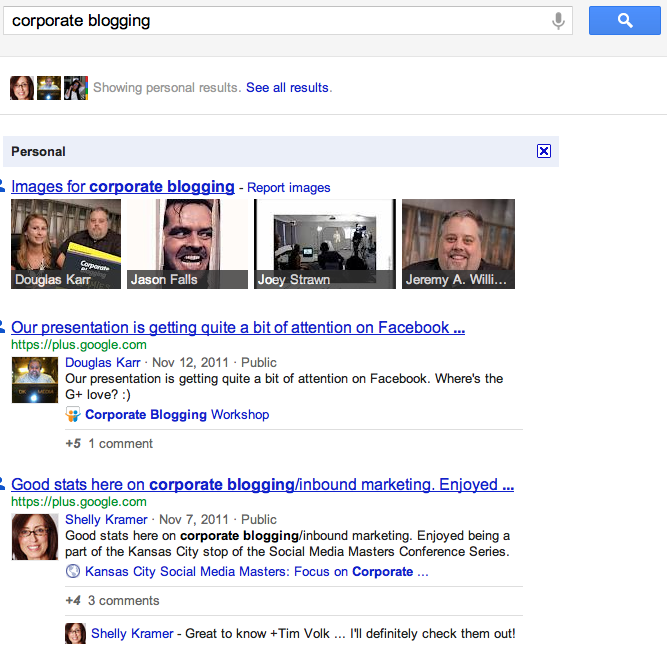
This is the same basic idea that goes into Google’s personalized “My World” search results. If you’ve used Google lately, you’ve noticed that a lot of your friends are appearing in those results. That’s because Google is relying on Balance Theory to help improve your search results. (Maybe not intentionally, but that’s what’s at play here.)

Here’s what they’re doing with it:

  • I like Douglas Karr.
  • Douglas Karr has talked about corporate blogging.
  • That means I should check out what Douglas has said about corporate blogging.

And if I like what Google has shown me, I’ll continue to use Google.

These are the PERSONAL results for "corporate blogging." But that is not really Jason Falls in the 2nd picture from the left.

How Can You Use Balance Theory in Search Engine Optimization?

If you’re building your personal brand, or you’re doing social media marketing for your company, the best way to use Balance Theory for your search engine optimization is to use Google+, and develop relationships with key decision makers at the companies you want to do business with.

  • Connect with the decision makers at the companies you’re trying to reach.
  • Write blog posts about the key areas and problems they’re dealing with at their company. You can find that out just by paying attention to their conversations on LinkedIn, Twitter, and Google+.
  • Continue to share important articles with them related to those same areas and problems. (This is all part of that “be a valuable resource” stuff we’ve talked about before.)

Then, as these people search for those particular keywords, your blog posts and your articles will rise to the top of their search engine results page. End result? “Hmm, this person seems to know an awful lot about this topic. I wonder what else they can help me with?”

However, this is not a reason to connect with everyone you can find on Google+ or to spam the bejeezus out of them with all kinds of articles and blog posts. You do that, and you’ll most certainly be blocked and ignored by everyone you’re trying to reach. Just write about what you want to write about at an acceptable pace, and connect with a reasonable number of people on a level that doesn’t seem creepy, desperate, or spammy.

With a little effort and just by following some common sense, you can use the Balance Theory — something usually only used by marketers with millions to spend — to start winning higher search engine rankings on your chosen keywords.

Filed Under: Blogging, Blogging Services, Marketing, Research Desk, Social Media, Social Media Marketing Tagged With: business blogging, Communication, Google, SEO

December 26, 2011 By Erik Deckers

You Don’t Get Social Media ROI Yet? C’mon, Man!

I was feeling good about social media ROI, and how/whether people understand it. I figured, at least my people — marketers — get it. They understand how to measure social media, or at least the principles behind it.

Apparently not.

eMarketer dashed those hopes to the ground with their December 20, 2011 article When Will Social Media Measurement Mature?.

Marketers know that counting fans, “likes” and followers is not the best way to measure success in social media marketing. Yet these metrics are often the top benchmarks for performance. It’s not surprising, then, that marketers consider calculating return on investment to be the biggest challenge of using social media, and that a majority of them believe they cannot measure social media campaigns effectively.

How to Calculate Social Media ROI

Calculating the ROI of anything is easy. Subtract how much you spent from how much you made, and that’s your answer. If you spent $10,000 on a social media marketing campaign, and you made $50,000, your social media ROI is $40,000.

Simple, right?

$50,000 – $10,000 = $40,000.

So how do you know whether sales are coming from your social media efforts?

I’m not going to delve into the step-by-step process, but I’ll give you the tools and concepts you’re going to need to get started.

  1. Set up Google Analytics, and install the code on every page on your website. If you have a blog, it only needs to be part of the code. If it’s on a website with pre-built pages, it needs to be on every page.
  2. Set up a Bitly account. Bitly is a URL shortener that also lets you do some basic analytics on the number of people that have clicked your link.
  3. Create a Google Analytics tracking campaign for any and all major links you’re sending out. This is how you’re going to measure a particular blog post, tweet, Facebook status update, etc. If it’s just a basic link to the website, a campaign code is optional. But if it’s a blog post about a particular marketing campaign, set up the Google Analytics campaign.
  4. Put a hyperlinked call to action in your blog posts that take people directly to a sales page or order page. Make sure that the hyperlink is given a unique campaign code.

Here’s what will happen:

  • You’ll send out a link to a blog post via Twitter, Facebook, etc. Let’s say that 10,000 people see that link on your various accounts.
  • 1,000 people visit your page and read that blog post, all within a 6-hour span.
  • Of that 1,000 people, 100 people actually make a purchase with a total of $10,000 in sales.
  • Those 100 people also fill out their contact information, which gets placed into your CRM.

By looking at these numbers, you can determine a number of things.

  • 1,000 visitors out of 10,000 social media followers, fans, and friends means you have a 10% click-through rate.
  • 100 sales out of 1,000 visitors is a 10% close rate; out of a 10,000-person network, that’s a 1% close rate.
  • By looking at the entrance and exit paths of that particular 6-hour period, or particular day, you can see that a majority of people were moved enough by the blog post to go directly to the order page. Compare that to another blog post that only lead to 30 sales out of 1,000 visitors, and you know it wasn’t as effective in moving people to act.
  • You can then subtract the cost of that particular campaign from the amount of money you made to calculate the total ROI for the day/week/month.

Calculating social media ROI is not that difficult. It’s just a matter of having the right tools and knowing basic analytics and campaign creation. There are literally hundreds of articles and several books on each step I first described. It’s just a matter of reading, and then trying out what you’ve learned. With some trial and error, and constant measuring, you’ll soon learn what works and what you can stop doing.

Or you could just hire a social media professional to do it all for you.

Filed Under: Marketing, Social Media, Social Media Marketing Tagged With: marketing, ROI, social media marketing, social networking

December 15, 2011 By Erik Deckers

Who Should Rule, Content or Marketing?

Over on his blog, Nashville writer Jeff Goins questions whether content is really king.

Well, actually, no he doesn’t. he said content is not king anymore. It’s a “fat, dethroned monarch, dis-empowered of his royal ability to influence.”

Janus, the two-faced Roman god, should represent content marketing.

Marketing — or as Jeff calls it, “relationships” — are the true king. Without relationships, without marketing, it doesn’t matter how awesome your writing is.

I used to be terrible at this. I thought all I had to do was be a good writer. But I was wrong.

I was scared. And lazy. I didn’t want to have to actually meet people. I just wanted to write.

But that’s not how the world works. So why would I think for one minute the Web would work that way? Yes, even in real life, it’s not just what you know that matters, but also who you know.

And even in business, the best way to promote an idea, product, or service is relationship. We all know this, because in this day of media saturation, we don’t buy what the ads tell us to buy. We buy what our friends recommend.

If I have to give an edge to either of them, I still side with content. Because hidden content can accidentally be discovered one day. I might write a post that gets picked up by search engines, and I could start being found for that topic.

But I could optimize and promote the bejeezus out of something really awful, and a lot of people could see it, but what do you think would happen if everyone showed up and saw — and said — how awful it was?

Still, it’s not a question of whether content or marketing is king.

Content Marketing Rules

This does not have to be an either/or proposition. You shouldn’t have to choose one over the other. And no, this is not one of those “why can’t everyone just get along” cop-outs that I detest. This is like arguing about whether peanut butter or jelly is more important on a PBJ.

Content and marketing have a symbiotic relationship. One cannot exist without the other. You can have great content, but if your marketing sucks, no one will see your stuff. And you can have great marketing, but if your writing sucks, no one will care.

There has to be a happy medium here. Or at the very least, we have to recognize that Content/Marketing is a two-faced king, like Janus, the Roman god of beginnings. You can’t have good marketing and lousy content, and you can’t have lousy marketing and good content. Without one, the other will die.

Content without good marketing is a private diary. Marketing without good content is spam.

I think once writers realize they need to market, we’ll see a bigger explosion in books and ebooks. And once marketers realize that content is not some throwaway afterthought, they’ll start seeing an explosion in sales and profits.

And if you want to learn how to do both, you can buy Branding Yourself or No Bullshit Social Media to see how.

(See what I did there?)

Photo credit: mscolly (Flickr)

Filed Under: Blog Writing, Blogging, Blogging Services, Marketing, Social Media, Social Media Marketing, Writing Tagged With: content marketing, marketing, social networking, writing

  • « Go to Previous Page
  • Page 1
  • Interim pages omitted …
  • Page 19
  • Page 20
  • Page 21
  • Page 22
  • Page 23
  • Interim pages omitted …
  • Page 29
  • Go to Next Page »

Primary Sidebar

Subscribe via RSS

Categories

Tags

advice bloggers blogging blog writing books book writing business blogging citizen journalism content marketing copywriting crisis communication digital marketing Ernest Hemingway Facebook freelance writing ghost blogging ghostwriting Google grammar Jason Falls journalism language Linkedin marketing media networking newspapers No Bullshit Social Media personal branding public relations public speaking punctuation ROI SEO Social Media social media experts social media marketing social networking storytelling traditional media Twitter video writers writing writing skills

Archives

Recent Posts

  • The Enshittification of Evernote and Why I Quit Them
  • 11 Tips for New Digital Nomads
  • 13 Things to Do or Not to Do When Connecting With Me for the First Time
  • Why You Need to Write Your Memoir
  • How to Give a 6-Minute Presentation at 1 Million Cups

Footer

BUY ERIK DECKERS’ LATEST BOOK

Erik Deckers' and Kyle Lacy's book - Branding Yourself now available at Amazon

Request a Quote – It’s easy

We write blog posts, manage social media campaigns, write online press releases, write monthly news letters and can write your website content.

Let's figure out the right package for you.

FREE 17 Advanced Secrets to Improve Your Writing ebook

Download our new ebook, 17 Advanced Secrets to Improve Your Writing

Erik recently presented at the Blogging For Business webinar, and shared his presentation "12 Content Marketing Secrets from the Giants of Fiction.

If you attended the event (or even if you didn't!), you can get a free copy of his new ebook on professional-level secrets to make your writing better than the competition.

You can download a copy of free ebook here.

© Copyright 2020 Professional Blog Service, LLC.

All rights reserved. Use of this site indicates your consent to our Privacy Policy and Terms of Use.

1485 Oviedo Mall Boulevard Oviedo, FL 32765
Call us at (317) 674-3745 Contact Us About