• Skip to primary navigation
  • Skip to main content
  • Skip to primary sidebar
  • Skip to footer

Pro Blog Service

  • Business Blogging
    • Blogging and Content Marketing for Search Engine Optimization (SEO)
    • Social Media Strategy and Consulting
    • Blogging Services
    • Content Factory
    • Need a Law Blog or Legal Blog?
    • Download Our White Paper: Business Blogging: The Cost of Corporate DIY Blogs vs. Ghost Blogger
    • Pro Blog Service Books
  • Blog
  • Speaking
  • About Pro Blog Service
    • Erik Deckers
    • 4 Simple Rules for Guest Posting on Our Blog
  • Get Ghost Blogging Quote
  • Link Sharing/Contributed Articles
You are here: Home / Archives for All Posts

All Posts

May 23, 2011 By Erik Deckers

A Sure Cure For Writer’s Block

So I’m bugging the bejeezus out of this poor woman at a coffee shop, asking to look at one of her books when she’s obviously working hard writing something very scholarly. The name of the book? Professors as Writers: A Self-Help Guide to Productive Writing.


Writer's Block

Having been in higher education for a number of years, and having written a number of scholarly works (and being the son of a professor myself), I was naturally curious what those Ivory Tower residents are talking about writing. I open it up to the first chapter and see:

Telling a writer to relax is like telling a man to relax while being prodded for a hernia. . . He thinks the article must be of a certain length or it won’t seem important. He thinks how august it will look in print. He thinks of the people who will read it. He thinks that it must have the solid weight of authority. He thinks that its style must dazzle. No wonder he tightens. — W. Zinsser, On Writing Well

Wow, I didn’t know writing had to be that hard. I’ve just sort of, well, done it. I never had writer’s block, because I’ve never worried about what other people thought of my writing, except for a few people. I quit worrying about what it would look like in print after the second time it was printed. I never worried about whether it made other people laugh, only if it made me laugh. (Coincidentally, the stuff I think is hilarious never gets that many compliments, but the stuff I think is just throwaway crap I needed to fill a word count is the stuff that gets rave reviews from readers.)

So quit worrying already and start writing. You’re not writing for posterity, for future generations, or for tens of thousands of readers. You’re writing for yourself. You’re writing what makes you happy, what pleases you, what brings you joy. If you like writing mystery novels, then write mystery novels. If you like writing blog posts, then write blog posts. But write your mystery novels, write your blog posts.

They’re not for someone else, they’re for you.

Writers loosen up once they start writing for themselves and stop thinking about the reader. Quit thinking about The Reader.

We all have a mythical buildup in our mind about The Reader. Our writing teachers always tell us to “think of The Reader, don’t forget The Reader.” But you’re not writing for The Reader. Once you start thinking about The Reader — that genderless, faceless judgmental bureauratic-minded nerd who’s all set to jump on your writing with a shrill “a-ha!” — you’re stuck, because you’re always trying to please him*. The only person you have to please is yourself. Pleasing everyone else is just gravy. (*I know that in a more accepting society, I should say “him or her,” but I’m not. It takes away from the rhythm of the language, and your own The Reader is going to be whatever you call it. Mine is a him.)

So, smack The Reader in the face, and write something you know he’ll hate. Do it on purpose. Make it suck. Make it really nasty, something that should be wrapped in newspaper. And then print it out, and put it somewhere where you can see it. Then, point your finger at it, and shout, “You see that, Reader? Choke on it!” (No, I’m not kidding. Ten cool points if you publish your sucky piece to your blog. Let me know you did, and I’ll even link to it out of moral support.)

Once you loosen up and start writing what you want, the ideas will come faster and more easily, your fingers will fly, and the words will come easily, and your writer’s block will be broken. You’ll be writing again. So, kick The Reader in the ass and tell him to go away and leave you alone. You’ve got better things to do than to pander to him.

Filed Under: Blog Writing, Blogging, Writing Tagged With: blog writing, writer's block, writing

May 18, 2011 By Erik Deckers

Measure the Three Most Important Business Metrics With Social Media

Jason Falls is currently rocking the Exploring Social Media Business Summit in Toledo, Ohio, talking about measuring social media marketing, and making sure that businesses are making money from it. There are three Very Important Questions every business manager will ask of their social media manager, and you’d better be able to answer them.

  1. How much did we make?
  2. How much did we save?
  3. Are our customers happy?
Jason Falls rocks his talk about social media measurement at #ESMToledo

That’s right, social media hippies. Social media, just like every other part of marketing, is about making money. It’s not about conversations, friends, followers, Likes, fans, connections, comments, or Google ranking. It’s about sales and conversions, and customer service and satisfaction.

This is why social media monitoring and analytics is so crucial. You need to be able to show your boss that your social media campaign was not $20,000 thrown down the toilet, because you thought it would be cool to sell your bulldozers on Facebook.

Use Google Analytics to Measure How Much You Make

Google Analytics can tell you how people came to your website, what pages they visited, and whether they went to your sales page and placed an order. If 300 people visit your website because of a tweet, 30 people went to your sales information page, and 3 people placed an order, you have a close rate of 1%. If your social media campaign costs $1,000 per month, but those 3 sales are worth $4,500, your ROI is $3,500.

Use Your Accountant to Tell You How Much You Saved.

Social media is a great way to handle customer service complaints, reducing the amount of troubleshooting calls that take 20 minutes, reduce technician visits, or even the total number of calls coming in to your service center. Ask your accountant to tell you how much you saved from month-to-month. Calculate the average cost of troubleshooting calls, technician visits, and the monthly salary of a call center rep. Get with your Google Analytics person and social media monitoring person (#3) to see if you have seen an increase in social media activity. Chances are, the latter had an effect on the former, so count these savings as a win. If you spent $1,000, but saved $3,000 in a month, your ROI is $2,000.

Or, more importantly, if we combine the two, you spent $1,000, and made/saved $6,500, your ROI is $5,500.

Use Social Media Monitoring Services to Measure How Happy Your Customers Are

Radian6, Lithium Technologies, Sysomos, are some of the biggest social media monitoring services around (they’re all subscription-based services, so expect to pay a fee), and if you’re a larger brand, it’s worth doing. If you have a small company, set up a free listening post with tools like a Twitter search (like a TweetDeck column), SocialMention.com and/or Google Analytics to see what people are saying about you. Quickly respond to any complaints or queries, and make sure you’re keeping people happy (see #2 above).

Happy customers are returning customers. Measure the sales of returning customers, especially those who have complained in the past, but you managed to keep by solving their problems, and compare that to the amount you paid for the social media monitoring service, and you’ve got your ROI.

We’re hopefully moving beyond the “social media is all about the conversations” way of thinking, at least in the business world. While this was cool and froody back in 2008, businesses are starting to use this as a new marketing channel. For those companies who want to make money this way, it’s real simple: just measure how much you made, how much you saved, and whether your customers like you.

If you can’t answer these questions, quit playing Farmville and go find someone who can answer it for you.

Filed Under: Marketing, Social Media Tagged With: Jason Falls, social media analytics, social media marketing

May 17, 2011 By Erik Deckers

Who Would You Hire, the Rookie or the Veteran?

I’m occasionally asked by clients whether we have a writer with a specific background. Are/were they in IT, in finance, in animal husbandry?

I can usually find someone with a skill set that matches what the client is looking for, but it’s not always possible. But, it’s not always necessary either. We have two things going for us that make it unnecessary to have a solid background in the client’s industry:

    1. The client provides us with all the information first, and then they approve the final post. If anything is incorrect, they find it before it gets published.
    2. Our writers are smart enough and spend enough time working with a client that they get pretty good at the client’s issues, their value to the client’s, and the features that make the client’s business so awesome. They become marketing copywriters for that company.

So this presents an interesting problem for us. Do we hire a good writer who is smart and can learn the product, or do we hire someone from the industry and fix their writing?

Think of it this way: You’re a baseball coach, and you need to sign a hitter to your team. You have a choice between a rookie who can run from home to 1st in 3.5 seconds, and a veteran who run the same distance in the same time. Who do you pick?

Most people will pick the veteran, because he knows the game and is a proven talent. But the best pick is going to be the rookie. If he can run to 1st in 3.5 seconds right now, think of how great he’ll be if you can hone his technique and teach him a couple tricks to make him run faster.

That’s how we choose our writers. I prefer to work with writers who don’t have the industry skills, because I can teach them about the industry, and help them become better “runners.” But hiring the industry veterans who have reached their writing peak is problematic. I can’t teach them anything new. They’ve gone as far as they’re going to go as writers, unless they dedicate themselves to becoming better writers. (That’s not to say that these adults can’t become writers. It’s just that they have to make a major commitment to improving and becoming better, but I don’t have time to wait for that.)

Who would you choose? Would you go for the industry rookie and teach him or her the ropes, or would you get the industry veteran who has a wealth of knowledge on the topic? Leave a comment and let me hear from you.

Filed Under: Blog Writing, Blogging, Blogging Services, Ghost Writing Tagged With: blog writing, business blogging, ghostwriting, writing

May 4, 2011 By Erik Deckers

What Will Twitter Do With TweetDeck?

The news that Twitter just bought TweetDeck for a reported $50 million has me a little worried, because Twitter has a history of killing its acquisitions, sort of like Lennie and soft things in Of Mice and Men.

It got worse after Mrinal Desai gave his five reasons why they were going to do it. It made me wonder, would Twitter really spend $50 million to kill a program that makes Twitter work better than their clunky interface?

If they were smart, Twitter would use TweetDeck as a way to win new users, not kill it to force people to use Twitter.com.

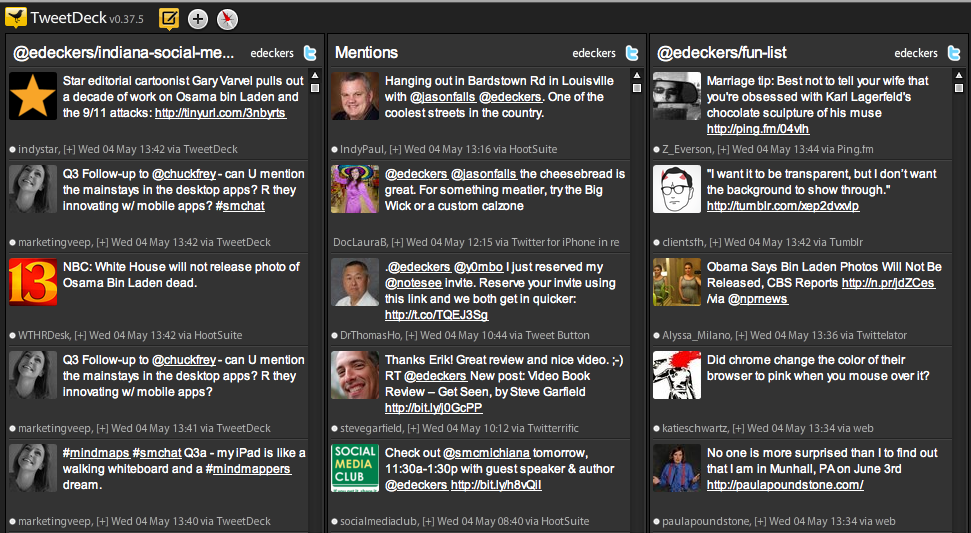
I use TweetDeck to keep up with different groups of people, making my Twitter stream easier to manage and follow.

TweetDeck makes using Twitter easy

I don’t know how many people I’ve talked to who didn’t get Twitter. They stared at Twitter.com and tried to keep up with the 50 people they were following. “Everything keeps going by so fast, I can’t even read it all.” TweetDeck lets you divide your Twitter stream into columns, either based on search terms or groups of people, and tweets are easier to read and follow.

Twitter.com is about as clunky as an old Edsel with square wheels, and is a pain to use. I hate having to click to see different tabs If they want people to use Twitter, they’ll keep TweetDeck around.

Twitter can feed ads into TweetDeck more easily.

Imagine if you’re forced to use Twitter.com for your Twitter stream. My tweets go by so fast on there, I’ll get a couple hundred in 10 minutes. If Twitter wants to slip in an ad, it will be easier for me to miss. While Twitter may be able to sell ads based on how often they’re served, “served” does not equal “seen.”

TweetDeck, on the other hand, makes it easier to see the ads. If I have a hashtag search column up while I’m watching a Colts game, I am more likely to see an ad that is not only slipped into that stream, but it can be targeted to me because I’m talking about the Colts. There are already enough bot programmers in the world, Twitter should be able to figure out how to serve targeted ads to people based on their conversations, and should be able to slide them into searches and lists that meet certain requirements.

For example, put a sporting goods ad in a sports hashtag discussion. Slide a restaurant ad in any list labeled with a city name, or even based on a conference hashtag.

TweetDeck is Just Awesome

I like TweetDeck for any number of reasons (to be fair, there are plenty of people who think HootSuite and Seesmic are awesome too. They’re wrong, but I support their beliefs.).

  • TweetDeck lets me communicate with my Facebook, LinkedIn, and FourSquare accounts.
  • I can support more than one Twitter account, which is important since I manage Twitter accounts for several clients.
  • It lets me view pictures and watch videos in little pop-up windows, rather than just visiting the original website.
  • I can schedule tweets for any minute, not in 5 minute increments like HootSuite used to do (they changed it, but when I had to make the decision, HootSuite was still only doing 10:15, 10:20 etc.)

There are a lot of Twitter clients out there. If they want to kill any apps, they need to look at some of the smaller ones that don’t do very much and kill them instead. It would clean up the market a bit, it would prevent future problems by saving them from accessibility and interface problems, and could give them a preferred client to send people to in order to help them use Twitter better.

My hope is that Twitter is taking all of this into account, and will keep TweetDeck as the official Twitter client. If not, I’m hanging on to mine as long as I can, and will use it for as long as it can send and receive tweets.

Filed Under: Communication, Social Media, Twitter Tagged With: Communication, Social Media, TweetDeck, Twitter

May 3, 2011 By Erik Deckers

Video Book Review – Get Seen, by Steve Garfield

I recently read Steve Garfield’s Get Seen: Online Video Secrets to Building Your Business (New Rules Social Media Series) (affiliate link) because of my growing interest in video, especially as it relates to citizen journalism and crisis communication.

Get Seen is a great book for this, since Steve pretty much made a name for himself as being “that guy” when it comes to video blogging, scoring an interview with Congressman Duncan Hunter — scooping CNN in the process — and Jimmy Fallon, getting a press pass to a Barack Obama rally, and having videos appear on BBC and CNN. He’s got the knowledge and experience to tell you everything you need to know about creating fast videos with a small camera and your laptop.

If you have a hankering to do video, Steve’s book can be a little bad for you, because he talks about all the different cameras he’s been using for the last several years, making you want at least a couple of the cameras he’s got. I’m going to stick with my little Flip camera right now (I’m part of 12 Stars Media’s You Do Video program), but now I’ve already started looking at some new options to include lights and an external mic jack.

So check out the video, check out the book, and see if you can start adding video to your business or personal blog.

Filed Under: Blogging, Blogging Services, Citizen Journalism, Communication, Reviews, Social Media, Tools, Video

April 28, 2011 By Erik Deckers

Why Is Klout Important?

My post about three secrets to improve your Klout score generated a lot of discussion, partly about other techniques, but also wondering why Klout is even important.

Billy Kirsch asked how it would influence him on Twitter. Brooke Randolph wanted to know how it would help her, and why she would want to improve her score beyond bragging rights. And Ivan Torres said it was just an artificial number that didn’t affect the experience.

To answer these questions, let’s take a look at what your Klout score means.

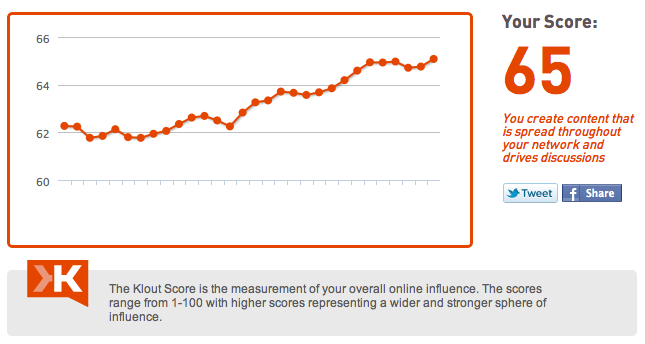
Your Klout score is basically the best way we have to quantify whether you’re doing a good job on social media. While it measures mostly Twitter, it also looks at your activity on Facebook and LinkedIn. It’s a measurement of your social media influence — your clout — and whether people like and trust you enough to respond to the things you do. In other words, if your social media footprint were a sales letter, would your readers respond to your call to action?

Your Twitter “call to action” includes things like:

  • Do people click on the links you send out. If it’s to a new blog post or an interesting article, do they follow the link, or ignore it? If you typically write and tweet interesting stuff, they’re more likely to follow it.
  • Do people retweet the interesting tweets you send out? Do they respond and share it with their networks, or do they just go “meh” and let it rot at the bottom of their Twitter barrel? If you’re engaging, witty, or really smart, then you’re probably tweeting interesting stuff that other people want to share.
  • Are people talking to or about you directly? Are they asking you questions, pointing out interesting articles to you, or inviting you to stuff? Or are you an unknown quantity like that weird kid in high school no one really paid attention to? If people know who you are, you’ll be top-of-mind when it comes time to write original tweets to specific people.

Klout measures things like this and compiles your score, based on a scale of 1 – 100. However, it’s different from your traditional grading scale: 60 is not a D, and you have to be an international star to get 100. Chris Brogan has one of the highest Twitter scores, and he has a 81. Ashton Kutcher has 81, and Justin Bieber has 100. (I also have a higher score than Helio Castroneves, even though he has more followers and more Indy 500 wins than I do, so being a celebrity is no guarantee you have a high Klout score.)

So what does a good Klout score do for you?

Truthfully, not much. You don’t win prizes, you don’t gain fame or fortune, and you don’t get book deals. Beyond bragging rights, there’s not a lot that Klout will do for you.

Except…

Except people with higher Klout scores are considered influencers. People with high Klout scores have worked hard to grow and polish their reputation, and become the kind of person other people want to click through, retweet, and talk to. And these people get some benefits from marketers who want to reach people with good reputations.

  • I received some swag and DVDs from the makers of the TV shows Lone Star and Southland. Lone Star sent me a t-shirt, some beer and martini glasses, a cooler, and a tin of popcorn. Southland sent me similar stuff. Both shows wanted me to watch their show and tell all my followers about it in the hopes that they would watch it to. (Sadly, Lone Star was canceled after two episodes.)
  • Audi asked influential designers, technology pros, and luxury lifestyle thinkers with high Klout scores to test drive their new A8 model at an exclusive San Francisco event. The hope, other than finding that Klout influencer with 100,000 bucks laying around, was that people would talk about the A8 to their friends via Twitter, their blog, YouTube, and Flickr. For the price of a what is normally an automotive journalists’ trip, Audi was able to get some word of mouth advertising and reaching a non-automotive audience who might not normally consider an Audi.
  • Bottlenotes Chicago offered tickets to the Around the World in 8 Sips Chicago free wine and cheese tasting to wine influencers. Restaurants and special events always give away free meals or passes, but by reaching out to Klout influencers, they are able to get some digital ink from the social media influencers for their food costs, without spending any more money on print advertising, or TV or radio commercials.
  • Movie studios have offered free passes to fans in the hopes that they’ll tell their friends about the movie, again providing word of mouth marketing for a fraction of the cost of traditional marketing and advertising. Rather than putting together a special screening for people, they give away free passes and reap the same benefit as the screening.

So what is the benefit to you to having a decent Klout score? Right now, not much. Free movies, free swag from TV shows, free meals, and a chance to drive a car that costs more than the average national salary. Plus, you get to dog on your friends who may have a score lower than yours.

But, and this is what’s most important, you’re getting a good indication of how your social media efforts are working out. Think of this as analytics for your social media influence. It may be an artificial number, but it’s the closest thing we’ve got to a quantitative indication about how well we’re doing. And while people are still debating the efficacy of the Klout score, it’s the best indicator out there.

So use it, take it with a grain of salt, but don’t ignore it or dismiss it out of hand. If you care about whether you’re actually making progress in your social media efforts — or you just want some cool swag — pay attention to Klout until something better comes along, or until they improve.

Filed Under: Personal Branding, Reputation Management, Social Media, Social Networks Tagged With: Facebook, Klout, Linkedin, Twitter

  • « Go to Previous Page
  • Page 1
  • Interim pages omitted …
  • Page 53
  • Page 54
  • Page 55
  • Page 56
  • Page 57
  • Interim pages omitted …
  • Page 71
  • Go to Next Page »

Primary Sidebar

Subscribe via RSS

Categories

Tags

advice bloggers blogging blog writing books book writing business blogging citizen journalism content marketing copywriting crisis communication digital marketing Ernest Hemingway Facebook freelance writing ghost blogging ghostwriting Google grammar Jason Falls journalism language Linkedin marketing media networking newspapers No Bullshit Social Media personal branding public relations public speaking punctuation ROI SEO Social Media social media experts social media marketing social networking storytelling traditional media Twitter video writers writing writing skills

Archives

Recent Posts

  • The Enshittification of Evernote and Why I Quit Them
  • 11 Tips for New Digital Nomads
  • 13 Things to Do or Not to Do When Connecting With Me for the First Time
  • Why You Need to Write Your Memoir
  • How to Give a 6-Minute Presentation at 1 Million Cups

Footer

BUY ERIK DECKERS’ LATEST BOOK

Erik Deckers' and Kyle Lacy's book - Branding Yourself now available at Amazon

Request a Quote – It’s easy

We write blog posts, manage social media campaigns, write online press releases, write monthly news letters and can write your website content.

Let's figure out the right package for you.

FREE 17 Advanced Secrets to Improve Your Writing ebook

Download our new ebook, 17 Advanced Secrets to Improve Your Writing

Erik recently presented at the Blogging For Business webinar, and shared his presentation "12 Content Marketing Secrets from the Giants of Fiction.

If you attended the event (or even if you didn't!), you can get a free copy of his new ebook on professional-level secrets to make your writing better than the competition.

You can download a copy of free ebook here.

© Copyright 2020 Professional Blog Service, LLC.

All rights reserved. Use of this site indicates your consent to our Privacy Policy and Terms of Use.

1485 Oviedo Mall Boulevard Oviedo, FL 32765
Call us at (317) 674-3745 Contact Us About