• Skip to primary navigation
  • Skip to main content
  • Skip to primary sidebar
  • Skip to footer

Pro Blog Service

  • Business Blogging
    • Blogging and Content Marketing for Search Engine Optimization (SEO)
    • Social Media Strategy and Consulting
    • Blogging Services
    • Content Factory
    • Need a Law Blog or Legal Blog?
    • Download Our White Paper: Business Blogging: The Cost of Corporate DIY Blogs vs. Ghost Blogger
    • Pro Blog Service Books
  • Blog
  • Speaking
  • About Pro Blog Service
    • Erik Deckers
    • 4 Simple Rules for Guest Posting on Our Blog
  • Get Ghost Blogging Quote
  • Link Sharing/Contributed Articles
You are here: Home / 2011 / Archives for March 2011

Archives for March 2011

March 3, 2011 By Erik Deckers

Five Online Reputation Management Tactics

Your 15 minutes of fame will last a lifetime on the Internet.

Former Indiana deputy Attorney General found this out a couple weeks ago, when he was fired for posting tweets that called for the use of live ammunition against the Wisconsin protesters. I had the chance to appear on WISH TV the day Cox was fired to talk about the importance of managing one’s personal brand on social media.
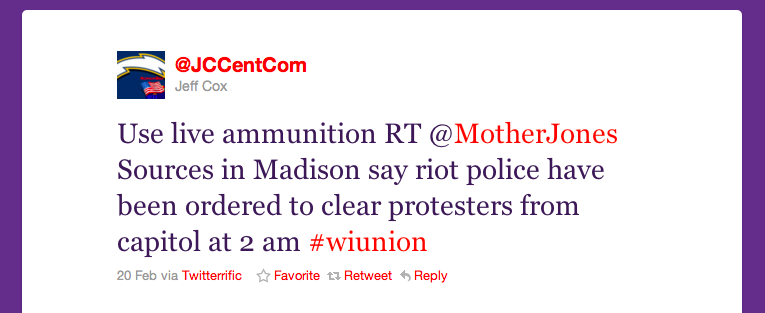
Tweet from Indiana deputy Attorney General Jeff Cox

I told WISH anchor Debby Knox, “Unfortunately, this sort of thing will follow him around forever. When someone, like a new employer, Googles his name — even 10 years from now — this story will forever be associated with it.”

The problem is, as a lot of people are learning the hard way, what you say on the Internet, even something as small as a 140-character tweet or keg-stand photo, will be around forever. And if the wrong people find it, you’ll be crucified with it. Whether that’s a potential employer or someone from the media, you can be guaranteed you’ll be found out.

Here are five online reputation management tactics you need if you’re concerned about your personal brand.

1. Know What The Internet Is Saying About You

We worked with one guy whose name was nearly identical to someone convicted of real estate fraud in the same state. The felon’s name would always appear first in a Google search if you just typed in our guy’s name. Anyone who knew him knew the difference, but when it came to potential clients, they would probably worry that they were going to hire a convicted felon.

Anyone who is named Jeffrey Cox is going to have a similar problem. A quick Google search showed that there are a lot of guys named Jeffrey Cox, even here in Indiana. Imagine the problems they’re going to have for the next several months or few years when people try to find them…

To know what people are saying about you, sign up for Google News Alerts, and have an alert set for your own name, your company name, and even your Twitter handle. Monitor this closely, and pay attention to any mention of your name that’s not on your own blog or website.

2. Know Your Influence

Whether you prefer Klout or Twitalyzer, or any of the myriad of other influence analysis tools out there, you need to know how many people are paying attention to you. If you want to positively manage your reputation, then you need to have that number as high as you can possibly get it. I prefer Klout, only because that’s what everyone is using, and so it’s easier to compare my reach by using the same stats as everyone else.

3. Practice Search Engine Optimization

Normally this is a website-/blog-only technique. If you want to get your blog or website to the top of the search engines, you need to optimize it so Google and the other search engines know exactly what your blog (and each individual post) is about.

This becomes more important if you want to knock something off Google’s front page. If you made a mistake and something is appearing at the top of Google, you need to focus on a couple of properties, like a blog, and optimize it so it sits at the top of the search rankings.

This practice is called reverse search engine optimization, and it’s becoming more important as companies and individuals realize they either made one mistake they don’t want following them around, or in a few cases, someone shares a name with a convicted felon (see below).

4. Use YouTube and Flickr/Picasa

Photos and videos are an excellent SEO tool. Not only do they boost your search rankings, but your photos and videos will often show up in your search results. If you have another result you need to boot off Google, photos and videos can help. Sign up for (and use!) YouTube and either Flickr or Picasa.

I prefer Picasa only because Google owns it, and it’s easier to integrate with my other Google properties, but Flickr is by far the more popular photo sharing site.

The best way to use photos and videos is to embed the code into a blog post, rather than uploading the photo or video to your own blog. Not only does it take up server space, but you don’t get as much search engine juice for an uploaded video as you do for an embedded one.

5. Join a Niche Social Network

If you’re trying to find a new job or establish your expertise in an industry, join a social network that’s specific to that industry. Or join one geared toward your local community. I first started connecting with people on Smaller Indiana, an Indiana-based network for people who live and work in the state. Even now, when my name appears in Google searches, there are a few results from Smaller Indiana that appear in the results.

Additionally, participating in that network will make you more visible to the other people on it. If you’re trying to make your name known in an industry, contributing a lot of valuable content to the network will accomplish this for you. Answer questions, write valuable information, and forward interesting articles to your fellow network members, and they’ll come to rely on you as someone valuable and worth working with or even hiring.

How are you managing your online reputation? Any tools or tricks we should know about? Leave a comment and let us know.

My book, Branding Yourself: How to Use Social Media to Invent or Reinvent Yourself (affiliate link), is available on Amazon.com, as well as at Barnes & Noble and Borders bookstores. I wrote it with my good friend, Kyle Lacy.
Filed Under: Personal Branding, Reputation Management, Social Media, Social Networks, Twitter Tagged With: Branding Yourself, personal branding, Social Media, Twitter

March 2, 2011 By Erik Deckers

A Social Media Strategy for Non-Marquee Sports & Athletes

I’ve had the pleasure of getting to know Dan Clarke (@speedydanclarke), an Indy Lights racer from England who lives in Indianapolis, and learning about his struggles this off-season. He’s looking for corporate sponsors so he can race in the upcoming season.

Dan Clarke at Carb Day 2010

If you don’t know what Indy Lights racing is, then you’re starting to see Dan’s problem. Indy Lights is the developmental racing league for IndyCar — Indianapolis 500 — racing. In a sport with fewer US fans than the NHL, he’s in the minor leagues.

Think of your favorite baseball team. Can you name its AAA minor league affiliate? Can you name their players? Do you know who their best hitter was last year, or their best pitcher?

Now you understand Dan’s problem. He’s looking for sponsors for a sport outside the big three — NFL, NBA, MLB — trying to convince them that the developmental league is a great place for them to be seen.

This is where social media can help. A personal branding campaign, even for athletes, can help build their brand, find new fans, and hopefully, bring in the big sponsors. It doesn’t matter if you’re an IndyLights driver, a minor league baseball player, or even the veteran right guard for the New Orleans Saints. If people don’t know who you are, they’re not going to care, and you’re going to have a tough time getting them to notice you. But by doing some basic personal branding, you can use that network to bring in new opportunities that contribute to your total success.

Start with Twitter

Twitter is one of the easiest places to start. This is where you can immediately see your fan base (# of followers), interact with them, and even measure the impact you’re having. Turn followers into fans, turn fans into evangelists. And as more people follow you, demonstrate to potential sponsors that you carry a lot of weight with your network.

Most athletes ignore their fan base on Twitter, choosing instead to communicate with each other publicly about private issues. For example, most IndyCar drivers have only a few thousand followers and only follow a few dozen people. Helio Castroneves, one of the most famous drivers in the world today, only has 31,000 followers, Ryan Briscoe has 8,600+, and Penske Racing (“one of the most successful teams in sports history with 330 race wins”) has 9,900 followers. To put that in perspective, I have 7,200 followers, I write blogs for a living, and the last thing I won was “Best Comedy Script” in a theater script competition in 2005.

If you don’t follow people, they won’t follow you. When you’re in a small-market sport, you can’t afford to be picky about who you follow. If you’re worried about privacy, don’t tweet your personal life. If you’re worried about managing a large Twitter network, get TweetDeck and use Twitter lists. But don’t make yourself seem unapproachable. Twitter is the one place you can interact with fans and still keep them at arm’s length.

Tip: Use Klout or Twitalyzer to measure the influence you have. Show sponsors that a positive word from you can influence buying behavior among your fans.

Create a blog

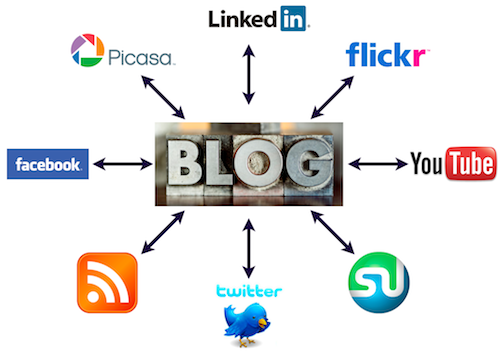
The blog is really the hub of your personal branding campaign. The point of being on those networks is to drive traffic to your blog; the point of your blog is to get people to join you on the other networks.

Your personal branding campaign is a wheel, with the blog at the center.

A blog is a place where you can share a behind-the-scenes look at what you’re doing. Share your exploits on and off the field/court/track, post photos, post videos, and tell stories. Fans love feeling like they’re connecting with their favorite athlete and learning stuff the casual observer or fair-weather fan doesn’t know. This is why celebrity news is so popular. People get to learn something about their favorite stars. But since small-market athletes don’t get the rave coverage that the Peyton Mannings and LeBron James of the world, you have to make your own news.

Blogs are becoming more important and popular among the PR crowd, especially crisis communicators, because they avoid the whole filter of mainstream media. For athletes, this avoids the filter of the sports media, which only gives a scant amount of attention to your sport anyway, and even then, only to the victories of the marquee stars and screwups of everyone else.

Tip: Use Google Analytics or Yahoo Analytics to measure web traffic. Demonstrate to sponsors that you 1) can get traffic to your blog, and 2) can send that traffic to sponsors’ websites.

Social Media PR

Adopt a strategy of sharing with other bloggers in your sport. Even though I’m not a big open wheel racing blogger (I’ll get to blog from the media center of the Indy 500 for the 3rd year running, but won’t be going to any other races), I can name at least five other race bloggers who all have a decent readership. And they’ll gladly share some digital ink with anyone from the sport who will talk to them.

So, talk to them. Tell them stories, give them exclusive news, and grant interviews. In short, treat them like real journalists, and they’ll pay you back with space, exposure, and kindness. Let a few bloggers break the news about your new team, your plans for the year, or even your struggles. They’ll become your fans, and tell their fans all about you, which will make them your fans too.

I’ve been listening to Wall Street Journal sports writer Stefan Fatsis‘ book, A Few Seconds of Panic (affiliate link), about his weeks spent in training camp with the Denver Broncos as a kicker. While I have never been a Denver Bronco’s fan, Fatsis’ look at the danger and drudgery of training camp and football has me looking at the Broncos in a whole new way, and I may have to cheer for them a few times this year (something I would never have done until this week). Can you find bloggers to do that for you? What about bloggers outside the sport? When less than 1% of the country knows who you are or what you do, non-industry bloggers are a rich, untapped vein. (Just don’t blanket every blogger out there. You’ll be labeled a PR spammer.)

Tip: Let other bloggers tell your story. If they make it compelling enough, they’ll win your fans for you. If you connect solidly with 10 bloggers and they each have 1,000 readers, you’ll reach 10,000 people. Now, compare that to the effort you would need to put out to reach 10,000 people yourself.

Build a Facebook Brand Page

You may already have a Facebook page, but that should be kept private. Try not to connect with your fans on your personal Facebook profile, since that’s where you’re also connecting with family and friends. Instead, create a Brand Page, and connect with people there.

However, it’s crucial that you actually use this page regularly; don’t ignore it. Promote your blog posts there. Post status updates when you publish your tweets (but don’t feed your Twitter stream into Facebook; it’s annoying. Just rewrite them to be more Facebook friendly.)

Tip: Republish your videos and photos to your Facebook page too. Ask your fans to share them with your friends. It’s a well-known adage in social media circles that we consumers trust recommendations by our friends. Let your fans evangelize to their friends about you.

There are a whole lot of other strategies I could recommend — posting videos to YouTube and photos to Picasa/Flickr — but that’s for another post. Use these strategies as a place to start and start building your personal branding campaign as a way to get sponsors, build name recognition among fans, and add new fans.

Do you have any strategy suggestions? Anything you’ve done as an athlete, or anything you wish an athlete would do? Share your wisdom in the comments section and let’s learn from each other.

My book, Branding Yourself: How to Use Social Media to Invent or Reinvent Yourself (affiliate link), is available on Amazon.com, as well as at Barnes & Noble and Borders bookstores. I wrote it with my good friend, Kyle Lacy.

Photo credit: Just_Bryan (Flickr)

Filed Under: Facebook, Marketing, Personal Branding, Public Relations, Social Media, Social Networks, Twitter Tagged With: public relations, Social Media, social media marketing

  • « Go to Previous Page
  • Page 1
  • Page 2

Primary Sidebar

Subscribe via RSS

Categories

Tags

advice bloggers blogging blog writing books book writing business blogging citizen journalism content marketing copywriting crisis communication digital marketing Ernest Hemingway Facebook freelance writing ghost blogging ghostwriting Google grammar Jason Falls journalism language Linkedin marketing media networking newspapers No Bullshit Social Media personal branding public relations public speaking punctuation ROI SEO Social Media social media experts social media marketing social networking storytelling traditional media Twitter video writers writing writing skills

Archives

Recent Posts

  • The Enshittification of Evernote and Why I Quit Them
  • 11 Tips for New Digital Nomads
  • 13 Things to Do or Not to Do When Connecting With Me for the First Time
  • Why You Need to Write Your Memoir
  • How to Give a 6-Minute Presentation at 1 Million Cups

Footer

BUY ERIK DECKERS’ LATEST BOOK

Erik Deckers' and Kyle Lacy's book - Branding Yourself now available at Amazon

Request a Quote – It’s easy

We write blog posts, manage social media campaigns, write online press releases, write monthly news letters and can write your website content.

Let's figure out the right package for you.

FREE 17 Advanced Secrets to Improve Your Writing ebook

Download our new ebook, 17 Advanced Secrets to Improve Your Writing

Erik recently presented at the Blogging For Business webinar, and shared his presentation "12 Content Marketing Secrets from the Giants of Fiction.

If you attended the event (or even if you didn't!), you can get a free copy of his new ebook on professional-level secrets to make your writing better than the competition.

You can download a copy of free ebook here.

© Copyright 2020 Professional Blog Service, LLC.

All rights reserved. Use of this site indicates your consent to our Privacy Policy and Terms of Use.

1485 Oviedo Mall Boulevard Oviedo, FL 32765
Call us at (317) 674-3745 Contact Us About