• Skip to primary navigation
  • Skip to main content
  • Skip to primary sidebar
  • Skip to footer

Pro Blog Service

  • Business Blogging
    • Blogging and Content Marketing for Search Engine Optimization (SEO)
    • Social Media Strategy and Consulting
    • Blogging Services
    • Content Factory
    • Need a Law Blog or Legal Blog?
    • Download Our White Paper: Business Blogging: The Cost of Corporate DIY Blogs vs. Ghost Blogger
    • Pro Blog Service Books
  • Blog
  • Speaking
  • About Pro Blog Service
    • Erik Deckers
    • 4 Simple Rules for Guest Posting on Our Blog
  • Get Ghost Blogging Quote
  • Link Sharing/Contributed Articles
You are here: Home / Archives for All Posts / Blogging

Blogging

November 19, 2009 By Erik Deckers

Bloggers Are Citizen Journalists

A common complaint I hear from big-J Journalists about bloggers is that we’re not “real” journalists. That we’re somehow beneath their contempt and notice.

Bullshit. We’re citizen journalists!

I first saw this attitude when I worked at the Indiana State Department of Health, and a few of my colleagues said we would never deal with bloggers because they only wanted to put out bad information. And in dealing with other Journalists, they almost seemed to say “blogger” with a sneer. As if “blogger” was something they stepped in on their way to the office.

Bloggers are citizen journalists, like it or not.
As a result, many Journalists don’t believe things like Reporter Shield Laws should apply to us citizen journalists. For example, if an environmental blog were to uncover environmental violations by a large corporation, that citizen journalist could be forced to reveal who his or her sources were. But if a newspaper wrote the same story, the reporter would not.

The biggest question comes down to who is a real journalist and who is only a blogger/citizen journalists. In the Branzburg v. Hayes case, Justice Byron White said

“Freedom of the press is a ‘fundamental personal right’ which ‘is not confined to newspapers and periodicals. It necessarily embraces pamphlets and leaflets. … The press in its historic connotation comprehends every sort of publication which affords a vehicle of information and opinion.’ … The informative function asserted by representatives of the organized press in the present cases is also performed by lecturers, political pollsters, novelists, academic researchers, and dramatists.”

— Quote from an article by David Hudson of FirstAmendmentCenter.org

Even back in 1973, when Justice White threw open “The Press” to anyone who produced the printed word, technology has widened the definition to anyone who writes for blogs, the 21st century’s electronic pamphlet.

In his article, Hudson also cited Kurt Opsahl, the staff attorney for the Electronic Frontier Foundation, who mentioned a couple examples where bloggers outperformed the big-J Journalists

“Bloggers hammered on the Trent Lott story (Lott’s comments about Strom Thurmond) until mainstream media was forced to pick it up again,” he said. “Three amateur journalists at the Powerline.com blog were primarily responsible for discrediting the documents used in CBS’s rush-to-air story on President George Bush’s National Guard service. And the list goes on.”

Cox lists several other national-headline stories affected greatly by reporting from blogs, including: Dan Rather and the Texas Air National Guard memos, the White House giving press credentials to James Guckert/Jeff Gannon, the resignation of CNN news executive Eason Jordan after publicity surrounding his remarks at the World Economic Forum and the John Kerry-Swift Boat Veterans for Truth controversy.

Or to put it another way, the big political scoops in the last 5 years have not been by the media, but by bloggers. Also called little-J journalists.

So, other than an overwhelming sense of elitism by the men and women of the dead-tree media, what really separates us from being real Journalists?

Is it the medium? Many former newspaper reporters and columnists have left the printed word, and gone on to start their own blogging career:

  1. Ruth Holladay who is serving brilliantly as a cheerleader for traditional media and a thorn in the side of her former employer, Gannett
  2. Lori Borgman the former arts columnist for the Indianapolis Star
  3. Columnist Saul Friedman who retired from Newsday rather than let his column go up behind a paywall

(I’m curious what their colleagues think? Have these writers somehow fallen from grace, and are no longer “good enough” to be considered Journalists? Are they now mentioned with the same sneer I heard three years ago?)

Maybe the pay is the issue. The fact that bloggers don’t get paid as much as newspaper writers (who, frankly, are not known for their lavish pay and glamorous lifestyle) may be the deciding factor. However, there are some online writers who make a lot more money than most successful businesspeople, let alone Journalists. So that argument doesn’t seem to hold weight.

Maybe it’s the training. The aforementioned paper-turned-pixel writers notwithstanding, Journalists seem to think they have the super-secret training that makes them a font of reliability and trustworthiness. Yet I know a lot of journalists who can’t spell, don’t know grammar, and in some cases, just plain can’t write. I took several journalism classes in college, and I can tell you they don’t teach anything extra special that someone with a penchant for the written word couldn’t pick up.

Even the Washington Post isn’t immune from bad writers. Meanwhile, there are several outstanding bloggers who produce some outstanding prose that would make any big-J Journalist green with envy.

Maybe it’s because the media is trustworthy and bloggers aren’t? You know, trustworthy. People like Jayson Blair, Stephen Glass, and Ruth Shalit. Of course, Shalit is back in journalism, Blair is a life coach in Virginia, and Glass is now a multi-millionaire, thanks to the book and movie deals he has gotten.

Admittedly, these three are the exception to the rule, and not the rule themselves. But my point is there are bad apples in blogging and bad apples in Journalism. Still if you’re going to accuse bloggers of not telling the truth, you need to look at the journalists who make stuff up too.

I just don’t see what the big difference is, other than bloggers don’t kill a lot of trees to get their message out through a dying medium. Yes, there are bad bloggers, but there are bad journalists. Yes, there are bloggers who lie, but there are lying journalists as well. (Some people might say that term is redundant.) Yes, journalists are trained as writers, but there are a lot of trained writers who use the electronic medium instead of newsprint.

If the U.S. Supreme Court opened up the definition of Citizen Journalists to pamphleteers and leaflet-writers, then they can certainly open it up to bloggers. And as bloggers, we need to make sure we can meet that expectation. We need to take on the mantle of Citizen Journalist ourselves, and then make sure we live up to that standard. (I’ll discuss that more in the future.)

So what do you think? Are bloggers journalists? Or are we a bunch of cranks sitting in our parents’ basement under bare light bulbs, writing about conspiracy theories and Paris Hilton sightings?

Stacks of newspapers photo: John Thurm
Ann Arbor News photo: mfophoto

Filed Under: Blogging Services, Communication, Writing Tagged With: journalism, media, newspapers, writers, writing

November 10, 2009 By Erik Deckers

Making the Argument for Ghost Blogging. Yet Again.

My good friend Lindsay Manfredi and I were both interviewed about ghost blogging last week, and asked whether we thought it carried any ethical dilemmas.

The answer is no, it doesn’t. Not if it’s done correctly.

I’ve talked about ghost blogging before, and said if it follows a few basic procedures, it’s as ethical as, say, public relations. (Er, on second thought. . . )

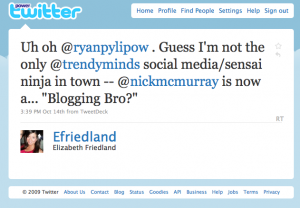
Yet, the issue keeps getting brought up, as if we’re committing some unpardonable ethical sin, like medical testing on baby seals. But the only people who seem to care are social media purists and “social media ninjas” who talk about transparency, yet work in industries where their efforts, if done correctly, are anonymous and behind the scenes as well.

Ghostwriting = copywriting

Anyone who does freelance copywriting can tell you that their name doesn’t go on squat when it comes to their efforts. Sales brochures, web copy, sales letters, speeches, you name it, the writer’s name is not-so-noticeably absent from the final copy. And that’s fine. That’s the life we choose.

Marketing agencies don’t get their names on their clients’ campaigns. No one whines that “my name isn’t on that sales brochure I wrote” or “my name isn’t in the newspaper article I sent the press release about.” Frankly, if you’re worried about getting credit for your work, you’re in the wrong business. If you want a byline, be a journalist.

Maintaining Ethical Boundaries for Ghost Blogging

A good ghost has procedures they follow with their clients:

  1. I interview the client, who tells me — in his own words — his thoughts about their industry-specific issues.
  2. I transcribe the interview and clean it up, turning it into 350 – 450 words of clear, informative copy.
  3. The client approves the article.
  4. I publish the article on their blog.

It’s the clients thoughts, the client’s words. I just transcribe it. Or as we like to say, “we do the work so you can go to your meetings.”

How is this any different from the CEO’s letter at the front of the company’s annual report? Or a politician’s speech to her constituents? Or the catalog copy that was supposedly written by the company’s founder? How is it any different from a PR flak’s press release that becomes the basis for a news article? (I say this as a former flak whose press releases were often turned into “Staff Wire Reports” by one county newspaper.)

Answer: It isn’t. Not a bit. They are exactly the same thing. (In fact, Jason Falls says that we’re not ghostwriters, we’re copywriters, and that it’s okay.)

These are the same steps that every other copywriter, speechwriter, and marketing director in the world follows when they produce work for a client. This has been an acceptable practice since well before Judson Welliver ghosted for Warren G. Harding, thus becoming the first presidential speechwriter.

The only place ghostwriting isn’t acceptable is journalism and academia, as it should be. Your merit is based on the work you produce; in business, it’s based on the results you achieve. (Although academia seems to have some of its own ghostwriting issues.)

So if you are against ghost blogging, you need to be against all ghostwriting. You need to speak out against speechwriters for politicians. You need to put an end to all freelance copywriting. You need to stop sending out press releases that don’t include your name as a quoted source.

Otherwise, it’s a non-issue. The people who hire me are the ones I’m concerned with. The social media purists? Well, you just give me something to blog about, thus boosting my own search engine rankings.

So, thanks for that.

Filed Under: Blogging, Blogging Services, Communication, Ghost Writing, Writing Tagged With: blog writing, ghostwriting, Social Media, social media experts

  • « Go to Previous Page
  • Page 1
  • Interim pages omitted …
  • Page 36
  • Page 37
  • Page 38

Primary Sidebar

Subscribe via RSS

Categories

Tags

advice bloggers blogging blog writing books book writing business blogging citizen journalism content marketing copywriting crisis communication digital marketing Ernest Hemingway Facebook freelance writing ghost blogging ghostwriting Google grammar Jason Falls journalism language Linkedin marketing media networking newspapers No Bullshit Social Media personal branding public relations public speaking punctuation ROI SEO Social Media social media experts social media marketing social networking storytelling traditional media Twitter video writers writing writing skills

Archives

Recent Posts

  • The Enshittification of Evernote and Why I Quit Them
  • 11 Tips for New Digital Nomads
  • 13 Things to Do or Not to Do When Connecting With Me for the First Time
  • Why You Need to Write Your Memoir
  • How to Give a 6-Minute Presentation at 1 Million Cups

Footer

BUY ERIK DECKERS’ LATEST BOOK

Erik Deckers' and Kyle Lacy's book - Branding Yourself now available at Amazon

Request a Quote – It’s easy

We write blog posts, manage social media campaigns, write online press releases, write monthly news letters and can write your website content.

Let's figure out the right package for you.

FREE 17 Advanced Secrets to Improve Your Writing ebook

Download our new ebook, 17 Advanced Secrets to Improve Your Writing

Erik recently presented at the Blogging For Business webinar, and shared his presentation "12 Content Marketing Secrets from the Giants of Fiction.

If you attended the event (or even if you didn't!), you can get a free copy of his new ebook on professional-level secrets to make your writing better than the competition.

You can download a copy of free ebook here.

© Copyright 2020 Professional Blog Service, LLC.

All rights reserved. Use of this site indicates your consent to our Privacy Policy and Terms of Use.

1485 Oviedo Mall Boulevard Oviedo, FL 32765
Call us at (317) 674-3745 Contact Us About