Google Wants You to be a Better Blog Writer

The days of schlocky web copy and $1/post off-shore blog writing are over.

Thanks to Google’s new Panda update, your writing can no longer suck. You can’t just get by on 8th grade writing skills, or by hiring an off-shore blog writer for a buck a post anymore.

The new Google Panda update stresses usability and the user experience over whether you have the right keywords in your title and body copy, and over backlinks. Oh sure, they’re still counted, but Google is not putting as much emphasis on those as they once were, thanks to the recent JC Penney backlinking scandal.Photo of a panda

As a result of this, and other Google gaming-techniques that were being abused, Google said, “You know what? That’s it. No more trying to trick us. Now we’re going to start looking at what your users are doing.” (Watch the Rand Fishkin video at the bottom of this post for a much better explanation than I just gave.)

Now, Google is starting to pay attention to the user experience: Do they visit more than one page, which means they like what they see? Are they on for a minute or more, or do they bounce out after 10 seconds, which means you didn’t captivate them? Did they even visit your page when you were at the top of the search engine (i.e. did your page even look interesting)?

The short of it is, if your site sucks, people won’t visit. If they visit, they won’t stick around. And they certainly won’t subject themselves to more than one page of it.

So how do you get them to stick around? You’d better have great content. Not just good enough, not barely readable. Not “meh.” It needs to be awesome. Because, like Scott Stratten (@unmarketing) said, “people share awesome.”

For writers, this means that your knowledge of SEO isn’t as important as it once was. You don’t have to know every single trick to get Google to pay attention to you. You now just have to write good stuff.

That means it needs to be readable, interesting, compelling, and persuasive. It means that if you suck at writing, you’re going to have troubles. It means if you don’t write compelling copy, people aren’t going to stick around. And if you don’t have a good looking, easy-to-navigate website, people aren’t going to want to spend time on your site.

For too long, writing has been a commodity at best, and completely ignored and dismissed at worst. I’ve written for people who didn’t care about the written word, and wouldn’t know good writing if it bit them on the ass. And yet, they were the first to complain when their crappy writing didn’t give them the results they believed they deserved.

These companies throw up cheap, schlocky copy with misspelled words and horrible grammar, knowing that if they gamed Google’s system, it was good enough to get a front page ranking. Well, no more.

While Panda isn’t the savior of all wordsmiths out there, it’s at least something that we can use to our advantage. It means that clients will — hopefully — start paying attention to the quality of their website or blog’s copy. And best of all, it means clients will — hopefully — start paying.

Panda doesn’t mean that this is the end of bad copy. Horrible writers are everywhere, foisting their drivel on an unsuspecting public. But it does mean that they will no longer be rewarded for their sub-par language skills.

Wistia

Photo credit: peromhc (Flickr)

Ernest Hemingway’s Five Secrets to Good Blogging

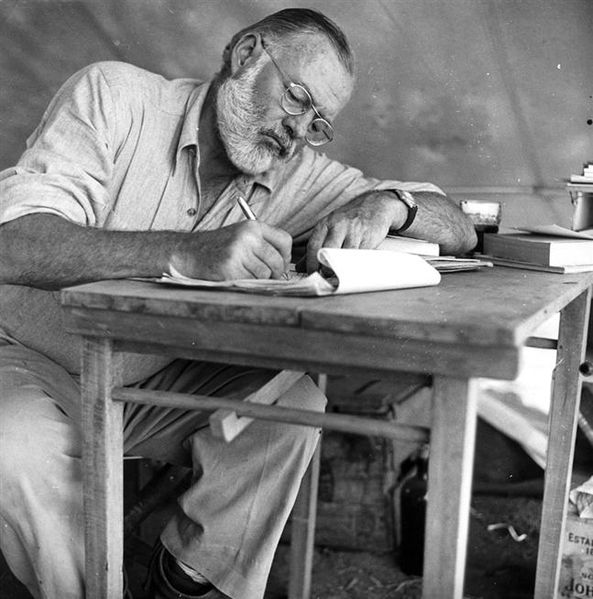
Ernest Hemingway

Ernest Hemingway would have kicked ass as a blogger.

No, really. I’ve been on a major Hemingway kick for the last several weeks, reading his short stories, his books and ideas on writing, and even a collection of stories he wrote when he was a cub reporter with the Kansas City Star, and I’m convinced he would be an A-List blogger in a matter of weeks.Ernest Hemingway

Hemingway’s writing habits are what would have made him an ideal blogger, and so here are what I think his five secrets to good blogging would be.

  1. Write and speak with authority.Hemingway knew he was a great writer. He was not humble about it at all. While I’m not suggesting you act cocky and arrogant, you do need to write with authority.Don’t waffle around with qualifying statements, like “I think it may be possible” or “If I had to make a choice, but only if I really had to make one.” It makes you sound like a ninny. Hemingway once said of his criticism of F. Scott Fitzgerald’s Tender is the Night, “Jesus, it’s marvelous to tell other people how to write, live, die, etc.”

    Without being an insufferable jerk about it, have the confidence to tell people how to do the thing you’re writing about.

  2. Avoid adverbs.Adverbs are those things that tell how something was done. “He ran quickly.” “She laughed loudly.”Don’t use adverbs at all. You can’t run slowly, otherwise you’re jogging. You can’t laugh loudly, but you can belly laugh or guffaw or snort; a soft laugh is a chuckle. Don’t describe the verb, use a more descriptive one.

    So, don’t tell us something is “really cool” or “fairly unique.” For one thing, cool is cool, and unique is unique. For another, “unique” means “one of a kind, there is nothing like it in all the world.” You can’t be “fairly one of a kind.”

    While Hemingway was not a fan of adjectives either, he and many other writers, have spoken out against adverbs. It’s something you should quit using as well.

  3. Don’t write for “The Reader.”In a letter to Arthur Mizener, Hemingway wrote, “I believe that basically you write for two people; yourself to try to make it absolutely perfect; or if not that, then wonderful. Then you write for who you love whether she can read or write or not and whether she is alive or dead.”That means, don’t worry about what the critics and haters and jackasses are going to say. Don’t anticipate what comments you might get, and how you can head them off at the pass. Don’t avoid controversial topics just because you think someone might disagree with you.

    Write for you, and make it awesome. Then, write it for just one person, and whether it will please him/her or not.

  4. Have a set writing schedule.I’m trying to adopt this idea myself now. Block out a time each day where you can write uninterrupted. Don’t take meetings, don’t answer email, don’t do Twitter. Just write.Hemingway’s schedule was to get up early, get to the typewriter by 7:00, and write until lunchtime. Even when he was starting out and had to work odd jobs, he would only do them after lunch. He didn’t drink until he was done writing, and he would even get up when he was hung over. But no matter what, he was always writing at the same time every day.
  5. Leave stuff out.Hemingway believed in the Iceberg Theory of writing. That is, while an iceberg may look massive, only 20% of it is sticking out of the water. There is sooooo much more that lies beneath the surface. It’s that below-the-surface structure that makes the visible part so impressive.Ernest would omit everything he could. He already hated adverbs (#2). In his dialogue, he never used any word other than “said,” not replied, shouted, retorted, or complained. He avoided entire scenes of action, leaving the reader to come up with his own idea of what happened.

    His greatest example of Iceberg writing is his now-famous six word novel, “For sale: Baby shoes. Never used.” All kinds of questions hang over that story, most notably, “why?” The answers we create in our own heads are the hidden part of the iceberg that Hemingway wanted us to understand.

    Similarly, as bloggers, we need to leave things out. Don’t use descriptions of what you were thinking when you came up with a certain blog topic. Don’t do exposition. Explain why something is important, and what it means to us. If you want exposition and background, create a separate post and link to it — “if you’re curious as to why I thought of this, click here” — and then count the clicks. If no one clicked it, you didn’t need it.

Blogging is the new newspaper. Posts need to be short, punchy, and interesting right from the very beginning — all characteristics that marked a Hemingway story. Follow these Hemingway techniques to make your posts more interesting and dramatic.

Sources for this post include:


No Bullshit Social Media: No Tree-Hugging, Kumbaya BS

No Bullshit Social Media cover

The following is a guest post by my fellow author and good friend, Jason Falls. It originally appeared on his Social Media Explorer blog.

Now that the world knows Erik Deckers and I have written the soon-to-be-published No Bullshit Social Media: The All-Business, No-Hype Guide To Social Media Marketing, we’re beginning to do a lot of interviews. The first question we’re typically asked is, “Why did you write this book?” While that question is somewhat answered in the promotional video (see below) we recorded for the book’s spiffy new website, I thought it might be wise to dive a little deeper into that reasoning here.

No Bullshit Social Media cover

Available at NoBullshitSocialMedia.com

As you may have seen on the Exploring Social Media infographic Social Media: Bridging The Gap we published last month, the stark reality of the marketplace is that too many businesses, especially small businesses, aren’t using social media. Heck, 44 percent of small businesses don’t even have a website! Only 27 percent of small businesses use Facebook. Just 18 percent use LinkedIn. The numbers are similarly staggering for the use of SEO techniques and online advertising. An astonishing 65 percent of small businesses — many brick-and-mortar retail shops — say that mobile marketing is not valuable to them. And this one floored me: 68 percent of businesses update their websites no more frequently than once per month. (See the infographic for the various sources of that data.)

While I’m sure Erik and I could have penned, “No Bullshit Digital Marketing,” and frankly, we may have to, we wanted to deliver the business possibility for social media to the masses. Business owners, marketing managers, executives … the people who are running these companies who don’t use or see much reason for using social media, mobile marketing or Internet marketing at all … they need to see that you can use social media marketing with business in mind. You can plan for success. You can establish goals.

I’ve said a few times I think this might be the first book that looks at social media marketing through a strategic planning filter, like you would other communications channels. We’ve stripped away the tree-hugger, Kumbaya bullshit and laid out the seven drivers social media can fuel for your business. We’ve collected case studies and examples of how others are using social media to drive those seven areas and we’ve put it all together into a book that hands you a blueprint for success in the social realm.

In my opinion, the book should have been written and published two years ago. But fate/timing/whatever got in the way. It might be a little late to the conversation for some of you, but I’ll guarantee you it isn’t for the mainstream business owners and executives who are showing up in those statistics as not getting it.

My professional mission at this point in my career is to make social media marketing more accessible. I help individuals do that through my learning community and question-answer site at Exploring Social Media. I help companies do that individually as a social media marketing strategic consultant. I try to translate that when I give talks and speeches as a social media keynote speaker.

No Bullshit Social Media: The All-Business, No-Hype Guide To Social Media Marketing is another way Erik and I can evangelize what we do and make social media marketing more accessible to those that need it most.

Download a free chapter at NoBullshitSocialMedia.com and pre-order your copy for a mid-October delivery today. We’d be honored if you did.

No Bullshit Social Media: One Jujuflop Away from Civil Collapse

There’s a great piece of narration from the Hitchhiker’s Guide to the Galaxy that talks about how certain words, which were once distasteful and unspeakable, are now perfectly acceptable to say.

Like “jujuflop.”No Bullshit Social Media cover

In today’s modern Galaxy there is, of course, very little still held to be unspeakable. Many words and expressions which only a matter of decades ago were considered so distastefully explicit that were they merely to be breathed in public, the perpetrator would be shunned, barred from polite society, and, in extreme cases, shot through the lungs, are now thought to be very healthy and proper, and their use in everyday speech is seen as evidence of a well-adjusted, relaxed, and totally unf**ked-up personality.

So, for instance, when in a recent national speech, the financial minister of the Royal World Estate of Qualvista actually dared to say that due to one thing and another, and the fact that no one had made any food for awhile and the king seemed to have died, and that most of the population had been on holiday now for over three years, the economy had now arrived at what he called, “One whole juju-flop situation,” everyone was so pleased he felt able to come out and say it, that they quite failed to notice that their five-thousand-year-old civilisation had just collapsed overnight.

I feel that way about No Bullshit Social Media, the book I wrote with Jason Falls. I’m not embarrassed by the title. I’m only worried that this is America’s jujuflop: 1) That no one is shocked by the title because we’ve all heard and said worse, and 2) that everyone is so pleased to see it in print that they fail to notice everything else has collapsed around them.

I can’t remember whose idea the title was, but when we pitched it to our editor, Katherine Bull (@katherinebull) and her department, there wasn’t a whole lot of pushback on it. There was some concern over what some of the bookstores might say, but they were all “meh” about it, so we knew we were golden.

I’m proud of the “No Bullshit” title and I’m proud of the work. There’s no question about that (although I won’t let my kids repeat it). And I know there are still some people who, despite my best efforts, will not speak or even write out the name of the title, despite my entreaties that they should honor the literary integrity of the book’s title.

(I actually respect them for this. But that doesn’t mean I’m going to quit trying to get them to say it.)

We picked the title, because that was the only way to describe the approach we were going to take in the book. That, and because we thought Gary Vaynerchuk might want the title . . .And The Horse You Rode In On for his next book.

So, don’t worry about whether you like the title. If you don’t believe social media is right for your company, you need to read it. You don’t have to say the name, you just have to read the book. This book is for you, whether you like the title or not.

No Bullshit describes the approach and it describes the attitude. We’re not going to snow you with lilting chants about “be a part of conversations with your customers” or other tree-hugging hippie bullshit, as Jason calls it. Social media marketing is about the bottom line. About making money. About finding a way to turn this free marketing channel into one that brings in revenue.

Because the executives and business owners who pooh-pooh social media as a passing fad or merely for young people are missing out on a chance to make more money, win new customers, and ensure their company’s very survival.

And that’s no bullshit.

Announcing The New No Bullshit Social Media Book with Jason Falls

No Bullshit Social Media cover

I’ve always wanted to have a book cover with a dirty word on it. Nothing horrific, nothing you would find in “those” bookstores with a plain brown wrapper on it. But something a little shocking.No Bullshit Social Media cover

That’s what I’ve written with my good friend Jason Falls: No Bullshit Social Media: The All-Business, No-Hype Guide to Social Media Marketing.

We’re launching this book in October, and it will be found in “real” bookstores like Barnes & Noble, Books-A-Million, and Borders. You can also get it on Amazon.com and BN.com.

As I’ve talked to businesses over the last few years about social media marketing, I run into the same excuses for why they’re scared to they don’t want to use social media:

  • Our customers don’t use it.
  • People will talk about us.
  • Our employees won’t use it right.
  • It’s still just for young people.

And we cite statistics and show real-world examples — here are your customers on it; they’re already talking about you; the fastest growing Facebook demographic is women age 50 – 60 — and still run into the same resistance and fears that have been ruling them. The same stupid reasons they gave for the telephone, the personal computer, cell phones, and the fax machine. Customers don’t use it, staff will abuse it, yada yada yada.

No Bullshit Social Media makes the business case for small businesses and large corporations about why and how they should use social media to improve their bottom line. It’s not a strategy-development book, or a how-to book. It’s written at a mid-level view for the C-level and for the small business owner about what social media does and where other companies have used it with great success. It shows what departments you can use it in, and how you make money with it.

Jason and I also want to come to your town and deliver the No Bullshit message in person. We’re putting together a book tour and quickly adding more dates.

If you have a group, organization or business that would like to sponsor a book tour visit, we’re keeping it simple: Travel expenses and 100 books for one of us, travel expenses and 200 books for both. (We can even help you get bulk book discounts.) Give the books away to the attendees, your company, or local businesses. We’ll talk to your group, get them fired up about social media marketing, and even sign books.

I’m thrilled and honored that Jason agreed to write this book, after a late-night text this past December. He’s been great to work with, and I’m constantly amazed at the way his brain works, as well as the Pearson editorial staff’s ability to deal with it. And him.

I’m looking forward to how well you — and the hopefully thousands of business owners — receive the book. Thank you for your support.

Your Blog Openings Suck

I truly don’t care why you wrote your blog post.

It doesn’t matter that you were sitting in a coffee shop with your friend, Joe, when you were discussing some amazing idea. I don’t care that those of us who may know you may know that you’re committed to saving the manatees. I don’t care that you’ve been reading Gary Vaynerchuk’s new book, “And The Horse You Rode In On.” (Not a real Gary Vaynerchuk book.)

I want you to impress the hell out of me and make me want to read your post. And frankly, telling me that you were discussing the importance of light bulb recycling over a non-fat lemon chai with ginger sprinkles — which is Doug Karr’s favorite drink — doesn’t impress me at all.

Houston Chronicle

Want to write good leads? Study newspapers.

(I will admit that I am still guilty of these kinds of leads sometimes, but have committed to never do them again.)

An opening sentence in a blog, also called a lead — or lede if you’re a newspaper traditionalist — is supposed to grab your readers’ attention and fling them to the next paragraph (graf, if we’re still going old-school newspaper). The goal of that graf is to propel people to the one after that, and so on.

But you’re not even going to get out of the starting gate if your lead sucks.

When I took my Intro to Journalism class way back when newspapers were still thriving, our professor drummed the importance of writing good leads into us for weeks. “It’s the most important sentence in the entire article,” he would tell us. “Your lead tells people exactly what happened, but it does it with drama and flair.”

In short, your lead doesn’t blather about coffee shops and books. Your lead needs to grab people and intrigue them, or it needs to provide information, or both.

My lead — the fact that I don’t care about why you wrote your blog post — is a true one. I really don’t. Or if I do, I don’t want it to be the first thing you tell me. Drop it in later, if you want to give me the background. It can almost be an aside, but it shouldn’t be the thing you start with.

I think we get into storytelling mode when we write blog posts. We’re so used to “Once upon a time” that we think it’s important to our blog writing as well. Believe me, I love a good story. I love telling stories, hearing stories, reading stories. But when I go to a blog, I want to be educated and informed.

Chances are, your lead is buried under 3 – 4 paragraphs. You could get rid of the opening couple of paragraphs and be all set, although some writers will tell you — maybe a little cynically — that most people could get rid of the first half, and still be fine.

So when you write your blog post, start it any way you want. But then go back and start deleting paragraphs until you get down to the most important point in the whole piece. Lead off with that. If you need to add the old paragraphs back in for background information, do it. But do it later on in the piece.

As you get better, and your leads begin to surface sooner, you’ll reach the point where you’re writing that stellar opening lead right off the bat, getting your readers’ attention earlier, and propelling them all the way through the post. Time on site will go up, conversions will go up because people made it all the way to the end, and you’ll look like a genius.

And you can tell me all about it over a cup of coffee.

Photo credit: JudsonD (Flickr)

3 Secret Blogging Ideas That Professional Writers Don’t Want You To Know

I’ve written enough blog posts that I’ve figured out what it is that wins readers, and what bores the bejeezus out of them. If I’m stuck for a blog post idea, I’ve got a few general topics and idea kickstarters that will get my creative juices flowing, and get a decent post out of it. I use these same kickstarters to come up with topics for my own clients, especially when they think they’re stuck for ideas or have run out of things to write about.

These are the three best kickstarters I’ve found that work, regardless of the topic or industry.

List posts

I know, I know, you hate them. They’re boring, they’re trite, they’ve been done to death. But do you know who loves them? I mean, really looooooooooves them?

Your readers. They eat them up. They love that there is a small number of ideas that they can read and understand. It brings order to chaos. “Five Best Dishwashers” is way more interesting than “How to choose a dishwasher.”

Secretly, you still think they’re interesting too. Why else would you be here? Admit it, you saw the number 3, and thought, “Three, huh? I guess I have a couple minutes to check it out.”Secret Bunker sign

Still don’t believe me? Do a little test. Next time you’re in the supermarket, pay attention to the magazines at the checkout lane, especially Cosmo. Look at the headlines on the cover. They all follow this format, and they sometimes use the next two ideas.

Every month, for years and years and year, we’ve been promised “Three Secrets Men Won’t Tell You About Sex,” and “Five Ways to a Sexier Love Life.” For YEARS, I tells ya!

And why? Because people love lists. If they didn’t, Cosmo would quit doing it. So I’ll keep writing list posts for as long as Cosmo does. Why? Because if you’re a fellow blogger, you’re not my customer. Corporations and small businesses are my customers. They’re the ones I need to appeal to. And if they want list posts, then I can think of Seven Reasons Why People Love List Posts.

Debunk long-standing myths and stick it to The Man

This is ingrained in our culture. We’re the little guy. We despise the big guy. David hates Goliath. Everyman and Everywoman hates bullies, corporations, and faceless bureaucrats. And if we can see evidence where the little guy sticks it to The Man, we go nuts! So who’s the Man? Big business, the government (state and local too), bullies, TV preachers, and teachers.

Not today’s teachers. Our teachers from when we grew up. We were little kids back then, and had all kinds of knowledge jammed into our brains that we didn’t want. We wanted to rebel, but were held down. Even people in their 60s still harbor a little of that Inner Rebel, and they still want to stick it to their old English teacher who’s been dead for 30 years. By writing a post about debunking an educational topic, I can reach that Inner Rebel and make him or her want to read.

Last week, I wrote a blog post about Five Writing Rules You’re Allowed to Break, and people liked it. Another one — Five Grammar Myths Exploded — was extremely popular. Why? Because I attacked the sacred cow of 7th grade English and showed where it was wrong. The little guy stuck it to The Man by proving he was wrong.

Special professional secrets

Want to get someone’s attention? Share something special with them that no one else gets to find out about. Or “they don’t want you to know.” (And who’s “they?” The Man.) But if it’s something secret — that “they” don’t want you to know — it must be really hot stuff.

Posts like “Five Gas Saving Secrets the Oil Companies Don’t Want You to Know” or “Three Secrets Your Credit Card Company Won’t Tell You” are a whoooole lot more interesting than “Five Ways to Save Gas” or “Three Little-Known Tidbits About Your Credit Card.” People love this kind of stuff; they eat it up.

I used all three of these tactics with this post, and chances are you were very intrigued by the fact that I:

  • Used a number.
  • Promised secrets.
  • Stuck it to an elite group of people — professional writers.

It was actually the idea of sharing secrets that led to this blog post, and I added the other two tactics to the headline later. But even if you just use one of these three kickstarters in your own industry or niche, you can come up with some awesome ideas on your own. For example:

  • Three Ways to Lower Your AC Bill This Summer.
  • History Answers: Who REALLY Flew the First Airplane?
  • Five Secrets to Avoiding Fines Your Library Doesn’t Want You to Know.

So the next time you’re stuck for a post idea, ask yourself: Is there a number of small ideas I can list, a sacred cow I can slay, or “insider secrets*” I can reveal to entice my readers? Once you start thinking this way, there is no end to the number of posts you can write.

* Please note that I don’t mean real insider or corporate secrets. Do not reveal business secrets at all ever. EVER!

Photo credit: Marcmos (Flickr)

Five Writing Rules You’re Allowed to Break

Chances are, you’re repeating some grammar and writing rules as gospel, not knowing they’re completely wrong. Or that they changed. Or that they were never really rules to begin with.

Whatever the reason, you can stop doing them. In fact, you should stop doing them.

Ernest Hemingway

Ernest Hemingway - This guy knew a few things about writing and breaking rules.

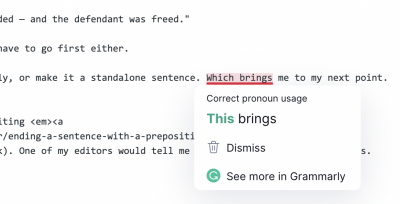
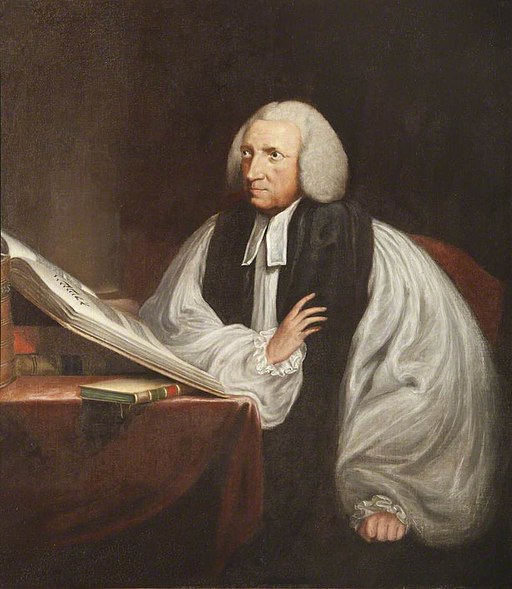
I’m trying to undo the writing rules my daughter’s 8th grade teacher has been foisting upon her, showing her that they’re not really legitimate, but some arbitrary rule that someone made up to make our language fit a preconceived structure. The English language is an ever-changing organic system that defies most rules. The ones that were created hundreds of years ago — like “don’t end your sentences in a preposition” — was never correct. Other ones like “don’t use incomplete sentences” have changed.

1. You CAN end your sentences with a preposition.

This one doesn’t always work, but for a good bit of the time it’s true. The rule was created by a scholar, Robert Lowth, who wanted English to bend to the same rules as Latin. In the Latin sentence structure, it’s not possible to have a sentence end with a preposition. Ergo, said Lowth, English shouldn’t either.

But it’s wrong. There are times you have to end your sentences in a preposition. For example, let’s say you stepped in something that stinks, and your friend says to you, “In what did you step?”

Wouldn’t you look at her like she lost her mind?

In that instance, it’s perfectly okay to say “what did you step in?” It’s proper English, it’s grammatically correct, and it doesn’t sound completely idiotic.

On the other hand, “where’s it at?” is wrong.

The basic rule is that if you can remove a preposition and the sentence still works, you shouldn’t use the preposition. But if you remove it, and the sentence changes, you should leave the preposition at the end.

Okay: What did you step in?
Not Okay: Where is it at?

2. You CAN start a sentence with And, But, or Or.

This may have been a real English class rule at one point, but no longer. Common usage has rendered it obsolete. People talk this way. People write this way. It may not be completely accepted in business writing, but I can foresee that hurdle breaking down in the next ten years as more business people speak that way.

Besides, it looks pretty cool. And dramatic. And punchy. And intense.

And it turns out the practice has been around since the 10th century. It’s just some arbitrary rule our English teachers liked to enforce without ever knowing why.

3. You don’t have to start with the dependent clause first

A dependent clause is that sentence clause that can’t exist on its own. “Before the trial even ended” is a dependent clause (also called a subordinate clause). And we were told that you needed to start sentences with a dependent clause.

“Before the trial even ended, the real killer had been arrested and the defendant was set free.” not “The real killer had been arrested and the defendant was set free, before the trial even ended.” Even though you might want the important information at the front of the sentence, our teachers told us to put the dependent clause first.

You don’t have to do that anymore. For one thing, it sounds clunky. For another, there are times where the dependent clause will get in the way. Third, there are times a dependent clause needs to be set apart in a different way.

“The real killer was arrested — before the trial even ended — and the defendant was freed.”

It doesn’t always fit at the end, but it doesn’t always have to go first either.

Your better bet? Eliminate the dependent clause completely, or make it a standalone sentence. Which brings me to my next point.

4. You CAN use incomplete sentences.

This was a very minor point of contention while I was writing Branding Yourself (affiliate link). One of my editors would tell me not to use incomplete sentences.

Like this.

“But it’s a style choice,” I would say. “Not a grammar issue.”

And while you don’t want to make that a regular habit, stylistically, it doesn’t hurt to do it once in a while. It’s another common usage issue, where enough people have begun doing this that the grammar sticklers have to bow to majority rules and allow the change in the accepted use. (They don’t have to like it, and they’ll talk about it at dinner parties, but they’ll generally leave you alone about it.)

They also add some punch and drama to your writing, whether it’s fiction or nonfiction. Pepper them occasionally throughout your writing and see what it does for you.

5. A sentence does not always contain a subject, a verb, and an object. A paragraph does not always contain 3 – 5 sentences.

Journalists violate this rule all the time.

Because it’s a dumb rule. And untrue.

For one thing, people read differently than they did 30 years ago. We’re so impatient that we don’t want to read a lot of text. We need white space to break up the monotony of the Tolstoy-esque blocks of text we find in some books, tech manuals, and magazines. If you’ve ever looked at a page with a lot of tiny text and no breaks at all, you know what I’m talking about.

Newspaper publishers learned a long time ago that people won’t read long paragraphs and über-long sentences. So they encouraged writers to use short punchy words, short sentences, and short paragraphs.

Even one sentence paragraphs.

My daughter has been told her paragraphs all need to be 3 – 5 sentences long, and I keep telling her it’s not only unnecessary, but it leads to bad writing. If you try to fill up every paragraph with 3 – 5 sentences, you start writing filler just to get there.

But if you keep some extra white space in your writing — by using short paragraphs — people are more likely to continue reading long beyond when they thought they would quit.

How about you? What writing rules do you gladly (or unwittingly) violate? Are there rules you wish you could break? Leave a comment and let me know.

A Sure Cure For Writer’s Block

So I’m bugging the bejeezus out of this poor woman at a coffee shop, asking to look at one of her books when she’s obviously working hard writing something very scholarly. The name of the book? Professors as Writers: A Self-Help Guide to Productive Writing.

Writer's Block

Having been in higher education for a number of years, and having written a number of scholarly works (and being the son of a professor myself), I was naturally curious what those Ivory Tower residents are talking about writing. I open it up to the first chapter and see:

Telling a writer to relax is like telling a man to relax while being prodded for a hernia. . . He thinks the article must be of a certain length or it won’t seem important. He thinks how august it will look in print. He thinks of the people who will read it. He thinks that it must have the solid weight of authority. He thinks that its style must dazzle. No wonder he tightens. — W. Zinsser, On Writing Well

Wow, I didn’t know writing had to be that hard. I’ve just sort of, well, done it. I never had writer’s block, because I’ve never worried about what other people thought of my writing, except for a few people. I quit worrying about what it would look like in print after the second time it was printed. I never worried about whether it made other people laugh, only if it made me laugh. (Coincidentally, the stuff I think is hilarious never gets that many compliments, but the stuff I think is just throwaway crap I needed to fill a word count is the stuff that gets rave reviews from readers.)

So quit worrying already and start writing. You’re not writing for posterity, for future generations, or for tens of thousands of readers. You’re writing for yourself. You’re writing what makes you happy, what pleases you, what brings you joy. If you like writing mystery novels, then write mystery novels. If you like writing blog posts, then write blog posts. But write your mystery novels, write your blog posts.

They’re not for someone else, they’re for you.

Writers loosen up once they start writing for themselves and stop thinking about the reader. Quit thinking about The Reader.

We all have a mythical buildup in our mind about The Reader. Our writing teachers always tell us to “think of The Reader, don’t forget The Reader.” But you’re not writing for The Reader. Once you start thinking about The Reader — that genderless, faceless judgmental bureauratic-minded nerd who’s all set to jump on your writing with a shrill “a-ha!” — you’re stuck, because you’re always trying to please him*. The only person you have to please is yourself. Pleasing everyone else is just gravy. (*I know that in a more accepting society, I should say “him or her,” but I’m not. It takes away from the rhythm of the language, and your own The Reader is going to be whatever you call it. Mine is a him.)

So, smack The Reader in the face, and write something you know he’ll hate. Do it on purpose. Make it suck. Make it really nasty, something that should be wrapped in newspaper. And then print it out, and put it somewhere where you can see it. Then, point your finger at it, and shout, “You see that, Reader? Choke on it!” (No, I’m not kidding. Ten cool points if you publish your sucky piece to your blog. Let me know you did, and I’ll even link to it out of moral support.)

Once you loosen up and start writing what you want, the ideas will come faster and more easily, your fingers will fly, and the words will come easily, and you’ll be writing again. So, kick The Reader in the ass and tell him to go away and leave you alone. You’ve got better things to do than to pander to him.

Who Would You Hire, the Rookie or the Veteran?

I’m occasionally asked by clients whether we have a writer with a specific background. Are/were they in IT, in finance, in animal husbandry?

I can usually find someone with a skill set that matches what the client is looking for, but it’s not always possible. But, it’s not always necessary either. We have two things going for us that make it unnecessary to have a solid background in the client’s industry:

  1. The client provides us with all the information first, and then they approve the final post. If anything is incorrect, they find it before it gets published.
  2. Our writers are smart enough and spend enough time working with a client that they get pretty good at the client’s issues, their value to the client’s, and the features that make the client’s business so awesome. They become marketing copywriters for that company.
  3. So this presents an interesting problem for us. Do we hire a good writer who is smart and can learn the product, or do we hire someone from the industry and fix their writing?

    Think of it this way: You’re a baseball coach, and you need to sign a hitter to your team. You have a choice between a rookie who can run from home to 1st in 3.5 seconds, and a veteran who run the same distance in the same time. Who do you pick?

    Most people will pick the veteran, because he knows the game and is a proven talent. But the best pick is going to be the rookie. If he can run to 1st in 3.5 seconds right now, think of how great he’ll be if you can hone his technique and teach him a couple tricks to make him run faster.

    That’s how we choose our writers. I prefer to work with writers who don’t have the industry skills, because I can teach them about the industry, and help them become better “runners.” But hiring the industry veterans who have reached their writing peak is problematic. I can’t teach them anything new. They’ve gone as far as they’re going to go as writers, unless they dedicate themselves to becoming better writers. (That’s not to say that these adults can’t become writers. It’s just that they have to make a major commitment to improving and becoming better, but I don’t have time to wait for that.)

    Who would you choose? Would you go for the industry rookie and teach him or her the ropes, or would you get the industry veteran who has a wealth of knowledge on the topic? Leave a comment and let me hear from you.