A Humor Writing Secret – Let People Make the Connection

Oh nooooo

People say humor writing is hard. It’s not that hard. Not if you know the formula.

Yes, there are actually steps you can follow to write humor.

(Now, writing humor well is another topic entirely. For that, you’ll need years of practice spent studying humor and language.)

Humor is based on a number of different things that all have to happen at the same time, chief among them is letting people make the connection in their own brains (there’s also Recognition and Surprise, but we’ll discuss those later). If the reader can make that connection on there own, something is funny. If they don’t make it, because they’re unfamiliar with the topic, the joke dies, and you lose the laugh.

This is why you should never explain jokes or repeat them. The connection, and the surprise that comes with it, are gone, and so is the opportunity to laugh.

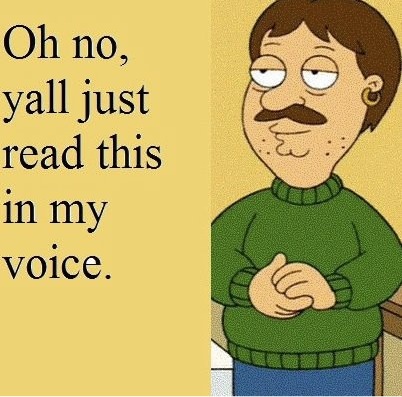
Here’s an example:

If you watch Family Guy, you’ll get this, and it should have made you at least chuckle. If you don’t, you don’t know who this is, and you’ll never get the joke.

So for you Family Guy viewers, why was it funny? Because a few things all happened at the same time:

  1. You recognized the character Bruce from Family Guy. You know what his catchphrase, and you know how he sounds. (Recognition)
  2. You read the text, and seeing “Oh no” triggered his voice in your head. (Connection)
  3. As you read the rest of the text, you realized you did exactly what it says. (Surprise)

If those three things happened — all at once, mind you — the joke scores and you laughed. But if you didn’t recognize Bruce, or you don’t know what he sounds like, or you’ve already seen this before, there’s no laugh.

To make a joke score, whether you’re telling it or writing it, you need to let people make a connection in their own minds.

Author :  •  Content Location : Indianapolis, IN  •  Copyright Year : 2011  •  Headline : A Humor Writing Secret - Let People Make the Connection  •  Keywords : humor writing, Family guy, humor, psychology  • 

3 Secrets of Creating Effective and SAFE Humor for Your Writing

Inigo Montoya #LessIconicMovieLines quote - Hello, my name is Iñigo Montoya. You grilled my bratwurst. Prepare some fries.

I’ve been writing newspaper humor columns for over 17 years.

And I can tell you one of the hardest things to do is to be funny week after week. So hard that I can’t always do it. In fact, I slacked off for six months in 1998, but apparently no one noticed.

Sarah Schaefer at 92Y Tribeca Comedy Festival

Sarah Schaefer at 92Y Tribeca Comedy Festival

But I have learned a few secrets about writing humor over the years, based on how humor itself works. These aren’t just the “rule of three” or “end words in a hard K” tricks, but the psychological motivation of humor. If you can learn how to write jokes using these secrets, you can start safely adding humor to your blogs, your articles, or your presentations.

(I have to give special thanks to my dad, Dr. Lambert Deckers, a psychology professor who studied the motivation of humor for a number of years, and Dick Wolfsie, fellow humor writer and features reporter for WISH-TV, for teaching me all of this. I totally stole all of this information from them.)

Humor Rule #1: All Humor is Based on a Surprise

The Purdue University linguist Victor Raskin wrote that all humor is based on a surprise, or a lie. That is, comedians lie to us by setting us up with one premise, and then lie to us (or surprise us) with the punchline. The laugh comes from the surprise.

Here’s an example: writer Dorothy Parker once famously said, “If all the girls who attended the Yale prom were laid end to end, I wouldn’t be a bit surprised.”

Did you see it? As you started reading Parker’s line, by the time you got to “laid end to end,” your mind already started thinking about what was going to come next, like a measurement of distance: “they would stretch across campus” or something similar. But she surprised us by instead questioning the moral virtue of the girls who attended the Yale prom. And that’s where the laugh came from.

This type of sentence is called a paraprosdokian, which is from the Greek meaning “expectation.”

However, not all surprises are paraprosdokian in nature. There are times when endings are just unexpected, but didn’t require a single sentence to get there. Most punchlines to jokes are surprises, which is what makes them humorous.

If you want to add a joke to your posts, throw in a surprise thought or two, almost as a parenthetical statement, at the end of a paragraph where a punchline would typically sit.

Humor Rule #2: Good Humor is Based on Recognition

Writing a punchline that requires previous knowledge of the source material is a great way to get a laugh. If the audience is already familiar with the source of a punchline, the reason behind it, the source it references, or if it’s something they’ve experienced before, you’ll get a laugh. For example, telling computer jokes to a bunch of IT geeks will get a laugh, but telling the same joke to a bunch of fashion models won’t. The way Dick Wolfsie explained it, the reader feels like they’re in on the joke, which makes them feel good, and they laugh.

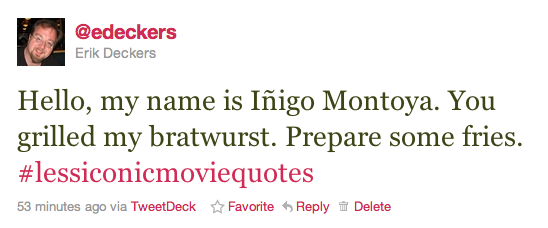
Inigo Montoya #LessIconicMovieLines quote - Hello, my name is Iñigo Montoya. You grilled my bratwurst. Prepare some fries.

I can't help it, I was REALLY proud of this one.

Here’s an example: As I was writing this post, my friend Rhett Cochran started the #LessIconicMovieLines meme on Twitter. Several of us threw out suggestions based on memorable movie lines. The movie lines that did the best were fairly popular ones — you couldn’t use lines from a movie no one had seen, like Ishtar — and they were surprising enough to be funny.

This is also why “callbacks” work so well: they “call back” to something that was said earlier. A lot of standup comics use callbacks during their act. When the audience recognizes the joke, and remembers where it came from, they feel like they were in on it, and the joke scores.

A lot of character-driven sitcoms rely on recognition for their humor. You get to know their characters, their foibles, their tendencies, their likes and dislikes. Then, whenever they’re placed in a particular situation that draws on one of those facets, it’s funny. But when a different character is placed into the same situation, it won’t be funny.

Recognition is also why jokes often fall flat, especially when you tell inside jokes to someone who wasn’t there. If you have to say “I guess you had to be there,” that’s a good indication the joke won’t be funny.

Humor Rule #3: Humor is Based on Making the Reader Feeling Superior. Good Humor is Self-Deprecating

Making a reader feel superior is another key to humor. Basically, if I feel smarter, better, prettier, richer, or more successful than the subject of the joke, the joke scores. It can often piggy-back off Recognition. That is, if I understand the inside joke or the callback, then I feel smarter, like I’m in on something special, and I’ll laugh.

However, this is where a lot of humor can be dangerous, and I urge you to use it carefully. It’s why people are told to avoid using humor at all. People love to make jokes at someone else’s expense, and end up offending somebody (or a whole lot of somebodies). It’s one thing to make a joke about a single person, but then it becomes tempting to make a joke about a group of people — computer geeks, people from a neighboring state — which can then turn into jokes about race, disability, size, etc., which then creates all kinds of problems.

To safely follow this rule, never, ever make a joke at someone else’s expense, because it will promptly backfire. Don’t think it won’t happen? Think back carefully to that one awful cringe moment in your life where you made a joke about a friend, only to discover that the punchline was related to some childhood condition, sensitive subject they’re in counseling about, or the tragic death of a loved one. (Congratulations if you only have one of those.)

In essence, if your humor has to rely on someone else feeling bad, then don’t do it.

There is one exception where it’s okay to violate this rule: if you make fun of yourself, you are completely safe. By making fun of yourself, the authority, you’re making the audience feel superior to you. I used this in the last sentence of the first paragraph, “In fact, I slacked off for six months in 1998, but apparently no one noticed.”

This is a great trick used by public speakers. By being up on stage, speaking to the audience from a position of authority, they are in the power position. So good speakers will make fun of themselves, which makes the audience feel like they’re superior to the speaker, and the joke scores.

There are several other humor secrets you can use, like exaggeration, being outrageous, or absurd, that can also make your writing or speaking funny.

In a future post, I’ll discuss how to string a few small jokes together to make your next presentation or blog post rock.

At least from a humor perspective. If you suck at speaking, I can’t help you.

My book, Branding Yourself: How to Use Social Media to Invent or Reinvent Yourself (affiliate link), is available on Amazon.com, as well as at Barnes & Noble and Borders bookstores. I wrote it with my good friend, Kyle Lacy.

Photo credit: Sarah Schaefer, 92YTribeca (Flickr)
Twitter screenshot: Erik Deckers

Why Writers Need a Dedicated Website or Blog

Writers are some of the worst self-promoters I know.

“I’m a writer, not a marketer” is the familiar lament.

Writers suffer from the all-too-familiar “if you build it they will come” syndrome. If I write something, publishers should leap out of their chair, shouting that their lifelong search is over, and take the private jet to my house and sign me to a huge book deal. Problem is, it just doesn’t work that way.nude woman with write or be written off

Show me a writer who’s not a marketer, and I’ll show you a failed writer.

Fellow humor writer Bruce “8 Simple Rules” Cameron (yeah, those 8 Simple Rules) recently said in an email, “So, despite the fact that nobody can prove to me that a writer needs a dedicated web site, I re-designed and re-launched my writer website last month.”

There are any number of reasons why writers need their own website. First and foremost, it’s a marketing tool. You build awareness with your website, you give this increasingly-online world a place to find you. Before it was easy to build a website, Bruce built an email subscription list of 40,000 people in 52 countries in the late 1990s. That was his marketing tool, and one he used to great effect, but it wasn’t easy to find or join.

Secondly, it’s a publishing tool. If you’re just starting out as a writer, there’s no better way to start publishing and finding readers. Set up a blog, write stuff, and gather readers. Then, keep writing stuff and gathering more readers. Eventually, your writing will be seen by influential people, and you’ll find newer and bigger opportunities.

So to answer Bruce’s question, and in keeping with his writings, I give you…

8 Simple Rules Why Writers Need Their Own Dedicated Website:

  1. Readers and editors can find you.
  2. Your readers become big fans. Big fans tell their friends, who also become big fans. Big fans buy your books, that you were asked to write by the editors.
  3. You hotlink to your book on Amazon, and drive your big fans to it so you can sell your book. Your big fans buy your book from your Amazon affiliate link so you make a couple bucks more with each sale.
  4. People who pay speakers a few thousand bucks to speak at corporate gigs can find you.
  5. People who see you speak at their national corporate event become big fans.
  6. You remember what big fans do, right?
  7. You need a place to tell people to go when you’re on Twitter, Facebook, LinkedIn.
  8. What do you mean, you’re a writer, not a social media geek?

You don’t need a dedicated website that cost $5,000 though. Maybe if you want some funky graphics or an ecommerce site, you can spend that much. (I can even put you in touch with the people who can help you.)

Instead you can just get by with a simple WordPress.com or Blogger.com website. Or if you want to get really complex, lease some server space, download WordPress.org to it, and you can have your own look and design, and even add your own plugins. (Our Pro Blog site is made with WordPress.org.)

The great thing about WordPress and Blogger is that they all allow you to add pages. You don’t have to deal with the typical blog look of only having one page. Not only will you have your blog page, you can create additional pages for your bio, contact information, videos of you doing book readings, and useful links.

While you don’t have to sell your soul and become a dedicated marketer, it won’t hurt to start thinking that way. (We’ll give you a good price for it.) If you still don’t want to, don’t worry. There are still thousands of writers — many of whom are worse than you — who are out promoting and marketing themselves online, being found by editors, and having important meetings about special projects. But you can console yourself with the thought that you didn’t resort to marketing (eww!) to promote your work.

You’ll need to when you see their books in the bookstore.

Photo credit: Djuliet (Flickr)