Well, Evernote, this is goodbye.
I’m done with you. Finished. Finito. I wash my hands of you. This enshittification of Evernote by new owners Bending Spoon has pushed me away completely.
I’ve been a paying member since December 2008 — more than 17 years — and stuck with you through everything. Even when Bending Spoons bought the company, and people began leaving in droves, I thought, “This isn’t bad. The Evernote I know and love is still there.”
But you enshittified and enshittified, making things worse, taking features out, and raising prices at the same time.
And now you’ve gone too far, raising your rates from a $14.99 per month rate I had been paying for a few years to $25 per month.
That’s way too much, and it doesn’t give me anything I need.


I did the annual plan for a long time, but switched to the monthly plan a couple years ago because I knew I was going to abandon shit ship sooner or later.
And that day has finally come.
You finally lost me because you couldn’t keep your grubby little hands out of my pockets. I was happy with the way things were, but apparently, you thought you could get a little more out of me.
And all for what? Things we don’t want or need? Things that aren’t original or revolutionary?
Ooh, an AI Assistant that is built “in close collaboration with OpenAI.” What did you do, license their API? Do you know what else works like a close collaboration with OpenAI? My $20/month OpenAPI subscription.
It’s not like you sent your programmers to work in OpenAI’s office; they haven’t sent programmers to work at Bending Spoons’ offices in Italy, have they? So how close is this collaboration, exactly? Because unless you guys are sharing cubicle space in the same building, you’re not “closely collaborating” with anyone. What you’re offering is no better than me actually paying for ChatGPT on my own.
“But wait!” you say. “We also have AI Meeting notes!” That’s great. So do Zoom and Microsoft Teams. So do Read, Fathom, Granola, Fireflies, and tl;dv. So does recording a voice memo on my phone and uploading it to Otter. So does a pen and paper.
Again, this is not new. There are so many AI meeting notetakers out there, the Internet actually gets heavier every time someone tries to list them all.
What about Semantic Search, the ability to use AI to refine search results that don’t match my exact keywords? You mean, instead of taking 30 more seconds to refine my first search effort? Good Lord, what did we ever do without Semantic Search before? Entire economies have no doubt collapsed because someone couldn’t look a little harder for an electronic document.
Evernote’s Advanced Plan Is Not That Advanced
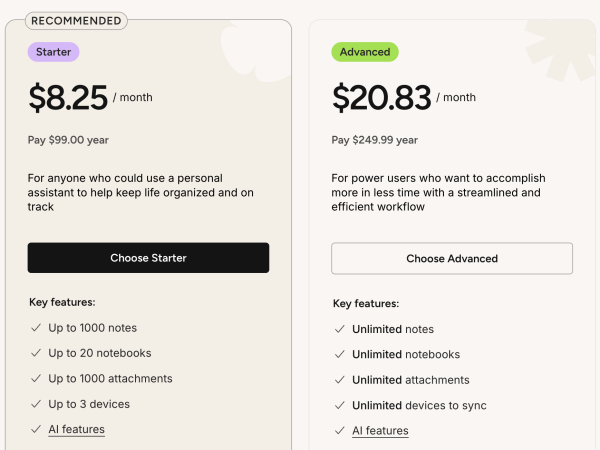

So you reduced what you offer for the lower package and made an unlimited package for a lot more money? Why not just add the additional Unlimited level for that new amount of money?
Your new Starter package (the version I’m already on) is not out of the realm of possibility for me. It’s the same price as my current Personal plan, but you downgraded the total number of notes and notebooks that I can use, which means it’s pretty much useless.
It’s my own fault, I suppose. It’s more my own disorganized use that means I have more notebooks and attachments than this new plan. And I could just go through and delete enough notebooks and attachments to fit within your ever-shrinking plans.
But I don’t love Evernote enough to do all that work or cover a two-thirds price increase born out of your insatiable greed.
Instead, I’m switching to Notion. Sure, it’s got a steep learning curve, but it’s free, and I don’t have to deal with them price-gouging me because of a set of uninspired and uninventive “Me too!” features that frankly everyone else has.
AI was baked into Notion from almost the beginning, not tagged on as an API afterthought. You just looked at what everyone else was doing and then copied it in the most unimaginative way possible, and thought that a 66.71% price increase was worth the minimal amount of effort.
Evernote Used to be the Best. Now It’s Just a Has-Been
You used to be cool, Evernote. You were one of the best products out there. You were definitely the best notetaker, and I couldn’t find a “Five Must-Have Apps” listicle that didn’t have your name on it. Google Keep, Apple Notes, and Microsoft OneNote all wanted to be you, and everyone stood in your shadow.
But now? Now, you’ve enshittified yourself so badly, and people are quitting you so quickly that you have to raise prices so you don’t feel the dip in your profits. People are paying more and getting a lot less, so people are leaving because they’re tired of you.
So now you’re the king of also-rans and has-beens.
Long live the king.
Photo credit: DesignerPoint (Pixabay, Creative Commons 0)