• Skip to primary navigation
  • Skip to main content
  • Skip to primary sidebar
  • Skip to footer

Pro Blog Service

  • Business Blogging
    • Blogging and Content Marketing for Search Engine Optimization (SEO)
    • Social Media Strategy and Consulting
    • Blogging Services
    • Content Factory
    • Need a Law Blog or Legal Blog?
    • Download Our White Paper: Business Blogging: The Cost of Corporate DIY Blogs vs. Ghost Blogger
    • Pro Blog Service Books
  • Blog
  • Speaking
  • About Pro Blog Service
    • Erik Deckers
    • 4 Simple Rules for Guest Posting on Our Blog
  • Get Ghost Blogging Quote
  • Link Sharing/Contributed Articles
You are here: Home / 2012 / Archives for January 2012

Archives for January 2012

January 31, 2012 By Erik Deckers

Three Ghost Blogging Concerns We Hear From Clients

Some people have issues with ghost blogging. We’ve got clients who use it on a regular basis, and love it. Other times, we have run into some people who can’t wrap their brains around it. They’re not sure they want to do it, and they have trouble accepting our help. These people tend to fall into one of three categories.

  • They don’t think they have a high-enough position to need a ghost writer. They don’t think they’re that important to “deserve” it. They think their company needs to be bigger, or they need to have a more prestigious position. I saw this a lot when I was doing speechwriting for a Congressional candidate in 2004. It’s not a matter of prestige, it’s a matter of having the time to do it.
  • Okay, that's kind of creepy.
  • They feel they need to “earn” the words by doing the work themselves. These people have a very strong do-it-yourself ethic, and think that they should be able to and know how to do every aspect of their business. They don’t want someone to do the things they should be capable of doing themselves, and they feel like they’re slacking when they don’t. But a lot of people can’t write quickly or efficiently — they take a couple hours to write a single blog post. That’s a problem when their time is worth $250 an hour, like a defense attorney. Why spend $500 of your billable time, three times a week, when you could hire someone to do the ghost blogging for you?
  • They think writing is so easy that anyone can do it. “After all,” they reason, “I learned how to write in school, so I can just take the skills I learned 20 – 30 years ago, right?” This is like saying, “I know how to work a table saw, so I ought to be able to make my own custom cabinets. Look, we all learned how to communicate via the written word, but that doesn’t make you a writer. A professional ghost blogger has been trained on how to write tight, concise copy that will inform, entertain, or persuade. While some people are able to do this without training, those people are few and far between. Don’t risk turning off your audience with less-than-professional writing that rambles on, is filled with errors, or just plain doesn’t make sense. (Not so surprisingly, these are the same people who demand that every position in their company has experience in their industry, including the accountant, the IT person, and even human resources staff.)


Ghost blogging is one of those services that companies need to maintain an online presence, but don’t have the time or resources to do it. It’s for the people who are too busy to write on a regular basis, no matter what “level” you are in your career. It’s for the people who struggle with writing, or are basically too expensive to do anything that doesn’t directly result in bottom line revenue for their company or firm.

Photo credit: starfish325 (Flickr)
Filed Under: Blog Writing, Blogging, Blogging Services, Marketing, Social Media, Writing Tagged With: business blogging, ghost blogging, ghostwriting

January 24, 2012 By Erik Deckers

Use Communication Theory to Boost Search Engine Optimization

The persuasion theory behind celebrity endorsements is the same theory behind Google’s new social media search.

It’s called Balance Theory, and when you understand the essence of it, you start to understand why Google is putting so much stock into Google+. And how Google+ can enhance your own search experience.

Balance Theory and Celebrity Endorsements

Without getting into all the scientific language we used when I was in graduate school, balance theory basically says this:

  • I like Celebrity A.
  • Celebrity A likes Product B.
  • That means I should like (and buy) Product B as well.

(Fellow philosophy majors will also recognize this as the 2 premises/1 conclusion logical construction.)

In other words, I like Eminem. Eminem likes Chrysler. Therefore, I should also like Chrysler. (The danger is that if I don’t like Celebrity A, I’ll purposely not like Product B just to restore that balance. It’s why a lot of sponsors drop celebrities who get into trouble.)

This is what marketers are counting on when they put a celebrity’s name and face on a product or company. It’s why Eminem is schlepping Chrysler on the Super Bowl. It’s why Reebok is clamoring for contracts with the NFL. It’s why Nike puts famous basketball players on its shoes.

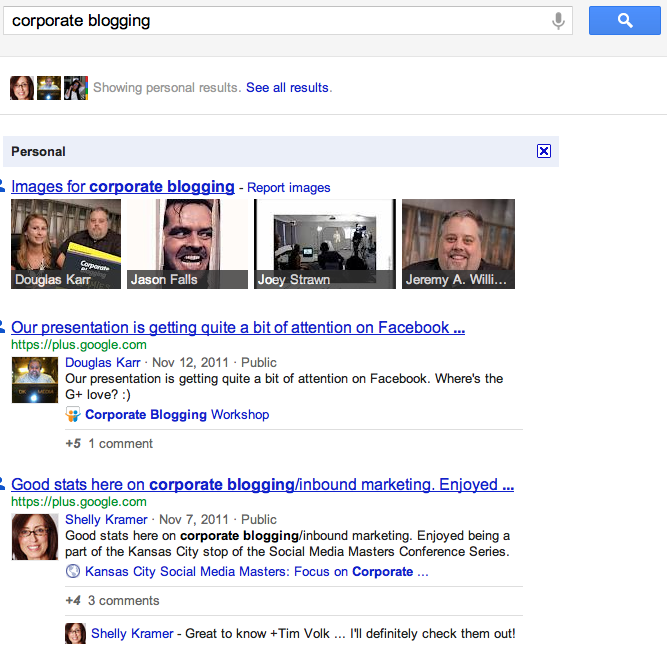
This is the same basic idea that goes into Google’s personalized “My World” search results. If you’ve used Google lately, you’ve noticed that a lot of your friends are appearing in those results. That’s because Google is relying on Balance Theory to help improve your search results. (Maybe not intentionally, but that’s what’s at play here.)

Here’s what they’re doing with it:

  • I like Douglas Karr.
  • Douglas Karr has talked about corporate blogging.
  • That means I should check out what Douglas has said about corporate blogging.

And if I like what Google has shown me, I’ll continue to use Google.

These are the PERSONAL results for "corporate blogging." But that is not really Jason Falls in the 2nd picture from the left.

How Can You Use Balance Theory in Search Engine Optimization?

If you’re building your personal brand, or you’re doing social media marketing for your company, the best way to use Balance Theory for your search engine optimization is to use Google+, and develop relationships with key decision makers at the companies you want to do business with.

  • Connect with the decision makers at the companies you’re trying to reach.
  • Write blog posts about the key areas and problems they’re dealing with at their company. You can find that out just by paying attention to their conversations on LinkedIn, Twitter, and Google+.
  • Continue to share important articles with them related to those same areas and problems. (This is all part of that “be a valuable resource” stuff we’ve talked about before.)

Then, as these people search for those particular keywords, your blog posts and your articles will rise to the top of their search engine results page. End result? “Hmm, this person seems to know an awful lot about this topic. I wonder what else they can help me with?”

However, this is not a reason to connect with everyone you can find on Google+ or to spam the bejeezus out of them with all kinds of articles and blog posts. You do that, and you’ll most certainly be blocked and ignored by everyone you’re trying to reach. Just write about what you want to write about at an acceptable pace, and connect with a reasonable number of people on a level that doesn’t seem creepy, desperate, or spammy.

With a little effort and just by following some common sense, you can use the Balance Theory — something usually only used by marketers with millions to spend — to start winning higher search engine rankings on your chosen keywords.

Filed Under: Blogging, Blogging Services, Marketing, Research Desk, Social Media, Social Media Marketing Tagged With: business blogging, Communication, Google, SEO

January 4, 2012 By Erik Deckers

It’s Called “Personal Branding.” Get Over It.

Being a personal branding book author and speaker, I get a little protective of the term. I always want to roll my eyes at people who claim “I’m not a brand, I’m a person,” or at people like Olivier Blanchard, who call people with personal brands fake, saying the personal brand is an artifice.

Personal branding is really just the fancy 21st century word for “reputation.” It’s how people perceive you.

Do you do what you say you do? More importantly, do other people say you do what you do? Are you a kind and helpful person? Do other people say so? Then your personal brand — your reputation, if you must — is that you’re kind and helpful. Do people think you’re an arrogant jerk? Then your personal brand is that you’re an arrogant jerk.

We call it personal branding for two reasons:

A brand is an emotional response on the part of the people who see it.

It’s much more than just a company’s logo and a tagline. It’s how you feel when you see that logo and tagline.

Think of your feelings toward McDonald’s, the Chicago Cubs, and even BP Oil. Love them or hate them, that is what you feel, and that’s how you react when you see symbols of that corporate brand. You won’t eat at that place, you’ll remain a fan for life, or you refuse to buy gas from that company. That’s your emotional response.

Basically, what other people feel, and how they react, when they hear your name and see your face is your personal brand. Does your face make people happy? Or does the mere mention of your name make people make gagging noises? That’s their emotional response, which makes it your personal brand. (Again, we can still call it your reputation.)

A brand is what people say it is.

The control of marketing has been seized from the professionals by real people. It’s no longer in the hands of the trained marketers to say whether a product or company is good. We now trust the say-so of people, often friends, but sometimes strangers.

Think about the last time you bought a piece of electronic equipment or a book, or even visited a new restaurant. Did you check the reviews or ask friends what they thought of it? Or were you persuaded by the marketing copy, the photos, and the search engine placement?

Like most of us who are plugged into this Web 2.0 world, you took the unsolicited and unmoderated recommendations of friends (and even strangers) over the hard work of the trained professionals. And that equipment, book, or restaurant was as good or as bad as your friends said it was.

In other words, the marketing message of a particular company or product has been seized by the people who will react to it, share it, spread it, buy into it, boycott it, or denigrate it.

People control the brand now. The marketers may be able to control the information, but people control the reputation.

How does this affect your personal brand?

This is true of people and their perceptions of us: right or wrong, we have become the sum of what people think of us. Their “reviews” of us come in the form of responses to our tweets, comments on our blog posts, even things they say about us when we’re not around.

In many cases, the thing we’re selling is us. We’re selling ourselves when we apply for a job. Or when we’re pitching a project. Or getting a speaking gig. Or selling a book. People are buying us, and if they don’t like who we are, based on our reputation, we won’t get the “sale.”

A personal brand is not an act, it’s not a character, it’s not a fake you. It’s the real you that wants to be seen and respected by other people. It’s the person you want to be, not the person you want people to think you are. That’s fakery — acting like a jerk to people in private while trying to be sunshine and light in public.

Being true to your personal brand means that you’ll act the same way in public as you do when no one is looking, or at least no one with a decent Klout score. If you’re kind (or a jerk) in public, you’ll be kind (or a jerk) in private. That’s the real personal brand.

It comes down to this. I don’t care what you call it: call it a personal brand, call it your reputation, call it your image. But whatever you call it, be true to it. Don’t fake it, and don’t try to pass as something you’re not.

Just know that most of the people around you are going to call it “personal branding,” whether you like the term or not. Fighting this battle is about as fruitless as people not wanting to call blogging “blogging” anymore, or think that “social media” just needs to be called “media.” It’s all just tilting at windmills while everyone else is actually doing the thing, regardless of what people call it.

Filed Under: Personal Branding, Reputation Management, Social Media, Social Networks Tagged With: personal branding, Social Media

Primary Sidebar

Subscribe via RSS

Categories

Tags

advice bloggers blogging blog writing books book writing business blogging citizen journalism content marketing copywriting crisis communication digital marketing Ernest Hemingway Facebook freelance writing ghost blogging ghostwriting Google grammar Jason Falls journalism language Linkedin marketing media networking newspapers No Bullshit Social Media personal branding public relations public speaking punctuation ROI SEO Social Media social media experts social media marketing social networking storytelling traditional media Twitter video writers writing writing skills

Archives

Recent Posts

  • The Enshittification of Evernote and Why I Quit Them
  • 11 Tips for New Digital Nomads
  • 13 Things to Do or Not to Do When Connecting With Me for the First Time
  • Why You Need to Write Your Memoir
  • How to Give a 6-Minute Presentation at 1 Million Cups

Footer

BUY ERIK DECKERS’ LATEST BOOK

Erik Deckers' and Kyle Lacy's book - Branding Yourself now available at Amazon

Request a Quote – It’s easy

We write blog posts, manage social media campaigns, write online press releases, write monthly news letters and can write your website content.

Let's figure out the right package for you.

FREE 17 Advanced Secrets to Improve Your Writing ebook

Download our new ebook, 17 Advanced Secrets to Improve Your Writing

Erik recently presented at the Blogging For Business webinar, and shared his presentation "12 Content Marketing Secrets from the Giants of Fiction.

If you attended the event (or even if you didn't!), you can get a free copy of his new ebook on professional-level secrets to make your writing better than the competition.

You can download a copy of free ebook here.

© Copyright 2020 Professional Blog Service, LLC.

All rights reserved. Use of this site indicates your consent to our Privacy Policy and Terms of Use.

1485 Oviedo Mall Boulevard Oviedo, FL 32765
Call us at (317) 674-3745 Contact Us About