• Skip to primary navigation
  • Skip to main content
  • Skip to primary sidebar
  • Skip to footer

Pro Blog Service

  • Business Blogging
    • Blogging and Content Marketing for Search Engine Optimization (SEO)
    • Social Media Strategy and Consulting
    • Blogging Services
    • Content Factory
    • Need a Law Blog or Legal Blog?
    • Download Our White Paper: Business Blogging: The Cost of Corporate DIY Blogs vs. Ghost Blogger
    • Pro Blog Service Books
  • Blog
  • Speaking
  • About Pro Blog Service
    • Erik Deckers
    • 4 Simple Rules for Guest Posting on Our Blog
  • Get Ghost Blogging Quote
  • Link Sharing/Contributed Articles
You are here: Home / 2011 / Archives for May 2011

Archives for May 2011

May 31, 2011 By Erik Deckers

Video Review – HTC Thunderbolt 4G and Verizon 4G Mifi

I had a chance to review the HTC Thunderbolt 4G smartphone and the Verizon 4G Mifi unit, thanks to Verizon Wireless and Kyle Communications, Verizon’s PR firm here in Indianapolis.

Right after I reviewed the video, and griped for several seconds about the battery life on the Thunderbolt, James from Kyle Communications showed up to pick up the phone, and told me the reason the battery life is so short is because this is a 4G unit, and it’s carrying a bigger load. Some people have said the Samsung unit has a better battery life, but James says that’s because it’s still a 3G unit. He says Samsung’s new 4G Fascinate will have similar issues. However, they have an extended battery available at Verizon, although James didn’t know much about it. My only concern with the Thunderbolt, other than the one I stated in the video, is that the battery life could be an issue if you find yourself in a place where you don’t have any access to power. Otherwise, you’ll want power cords in your car, your office, and your home just to make sure you don’t run out.

Do you have a Thunderbolt or a Samsung Fascinate? What have you found? Do you use a Mifi? Love it or hate it? Let me know what technology you’re using, or what technology you would like me to review, and I’ll see what I can do.

Update

After I posted this video, I received an update from my new bestie, Michelle Gilbert, the Verizon PR genius who arranged for me to review these units. (She can be even more geniuser if she can arrange for me to do a two year review of the Xoom.) Here are some corrections she offered, and I’m just posting them verbatim.

With respect to the 4G mobile hotspot device, you are correct that when you tether it to your laptop (for charging or any other purpose), you make it a private connection. If you charge it in the wall, however, you can still use it as a Wi-Fi hotspot.

I also wanted to address your concerns about the battery life on the Thunderbolt and your conversation with James. James is correct that a 4G device works harder than a 3G device, so battery life may be impacted. With that being said, however, I have used both devices and do feel that the Samsung DROID Charge has stronger battery life. I think it boils down to what operating system does a customer prefer – HTC or Samsung? Both are great devices. I do agree with you that Thunderbolt users should invest in an extended battery and car charger.

For your blog post, I’m not sure if you want to clarify, but there is no 4G Fascinate. The Samsung 4G smartphone is the DROID Charge.

After Michelle’s clarification, I am convinced that I’ll stick with the HTC and just get the extended battery. And given the fact that I take my laptop with me everywhere I go, I can always plug the USB charger into the computer and charge up the Thunderbolt that way. Plus if they made one for the mini-USB, I would even consider getting a hand crank charger.

Thanks again to Michelle for the great information, and for letting me try out these new devices. Looking forward to getting one of my own.


Filed Under: Opinion, Research Desk, Reviews

May 30, 2011 By Erik Deckers

Businesses Don’t Care About the Social Media Expert Debate

After reading a few of the different posts about social media experts, including ours, our partner and founder, Mike Seidle (@IndyMike), wrote this response:

First, I am not a social media expert. I do sit on the board for a company that has several people that I would classify as experts on the payroll. Anyone who is saying “there are no social media experts” falls into one of two groups:

  • People who can’t accept that others may have more experience/deeper understanding than they do. This argument boils down to “since I don’t understand it, or can’t keep up, you can’t.”
  • People who do not have the resume to actually be an expert that are trying to get a job or gig that is for an expert. These people will claim that no experts can exist because of massive recent change that obsoletes past experience.

In the end, anyone who claims that social media experts are like the tooth fairy, Santa Claus or the Easter bunny ends up looking pretty silly:

Executive: So, you are here for the social media director position. I see here you’ve been using social media for two years. What makes you an expert?

Social Media Not Expert: There are not experts in social media. We are all explorers at sail on an undefined sea filled with incredible wonders and indescribable dangers. You see, no one can possibly be an expert on social media since it changes so fast. What I learned last year has no application to the future, and the tools we use and strategies we build often are rendered obsolete in the blink of an eye.

Executive: So, if it’s not possible to be an expert, then why are companies shelling out bucks on social media people?

Social Media Not Expert: Well, social media can get incredible results. Most social media campaigns fail because they are not well planned and are mismanged. On top of that it’s impossible to measre the ROI on social media… so do not count on predictable ROI or even expect a return you can measure. But social media will greatly enhance your brand. That’s why most companies are doing social media.

Executive: So, most social media campaigns fail for lack of management or knowege. I can’t expect any ROI, and you are not an expert. Right?

Social Media Not Expert: Well, when you put it that way… it doesn’t sound right. I would say that I’m not an expert, but I have experience and can guide your company around making mistakes that will make your social media campign fail. While we can’t …

Executive (Redfaced, Cuts off Social Media Not Expert): The door. Use it. Use it now.

Filed Under: Marketing, Social Media, Social Media Experts, Social Media Marketing Tagged With: business, ROI, Social Media, social media experts, social media marketing

May 27, 2011 By Erik Deckers

Interview with Paul Schmidt of Blue C Advertising on Motor Sports PR

I’ve been spending time at the Indianapolis Motor Speedway as a racing blogger this year (my 3rd year). I had a chance to interview Paul Schmidt, the director of account services at Blue C Advertising, an advertising and PR firm in California.

He was there to support one of their clients who were sponsoring a few drivers in the 500. They had organized a contest for their client as a way to build traffic and name recognition for their client. At the time, the contest had yielded 2,500 new “likes” on their Facebook page, and nearly as many members in their text club.

Sports marketing is a different animal from regular marketing, in that you’re selling a product that — unless you’re working directly for a league or team — you have to center around a particular event or other organization. In Paul’s case, they had to promote a very specialized niche product to the audience most likely to appreciate what the company, racing fans.

While there are media outlets and TV shows about street racing, this is a way to use a marquis event like the Indy 500 to create a special event and celebratory feeling about the product. Combine that with a special promotion as a way to launch a new product, and you can see how interesting (and difficult) sports marketing/advertising can be.

Filed Under: Marketing, Public Relations, Social Media, Social Media Marketing Tagged With: Indianapolis 500

May 24, 2011 By Erik Deckers

Five Myths About “No Social Media Experts” Busted

Still? We’re still talking about whether there are social media experts?

This argument has reared its ugly head again, when some social media practitioners (frankly, people who I would call experts) have declared that they would never ever hire a social media expert, because there’s no such thing.

It’s interesting how people can declare there are no experts with an air of authority that they just implied doesn’t exist. I’m firmly in the “there are social media experts, so deal with it” camp, and have been talking about this for a couple years now, even arguing with other social media experts about their own existence.

So here are the same five myths I hear over and over, and my response to them.

Myth #1) Social media is new.

Social media is not new. It’s really, really old. It’s older than Kyle Lacy, and it’s even his birthday today.

Social media goes back before the mid-90s when AOL cracked 1 million members. (I became member #832,000-something in 1994).
Social media goes back before the mid-80s when AOL was born.
Social media goes back to the late-70s when BBSes and the Usenet were born.

Social media is at least 30 years old, even if we didn’t call it social media back then. But if you don’t want to accept that BBSes and AOL aren’t early forms of social media, then remember: Facebook is 7 years old, LinkedIn is 8 years old. That’s not new either.

2) Social media is always changing.

Yes, and so is medical science, but we still call doctors medical experts. So is finance, but we still call financial planners experts. So is auto racing, but we still call the engineers experts. So is animal husbandry, but we still — okay, that hasn’t changed since the dawn of time.

The social media tools may change, but the idea of relationship marketing has not. People still don’t want to be screamed at by TV ads, or spammed by, well, spammers. People want to have relationships with their brands. That hasn’t changed.

The only thing in social media that’s changing are the numbers of people joining it. But the idea of “being a valuable resource to your customers,” of “don’t spam people,” of “practice good customer service” has never changed.

3) Social media is just a channel. You can’t be an expert at a channel.

Tell that to the TV advertising guys, tell that to the radio advertising guys. Tell it to people who excel at trade shows, who kick ass at street teams, or are wizards at special events.

Social media may be a channel, but so is every other form of communication we use.

4) Social media is just a tool. You can’t be an expert at a tool.

No one said they were an expert at the tool. You said that’s what we had to be when you said “Malcolm Gladwell says you need 10,000 hours to be an expert.”

Remember, it’s not the tool that’s important, it’s message creation and social psychology. In other words, can you create an effective message? Do you know how your target audience will respond to that message?

A good communicator understands his or her audience, and can tailor a message that will move, inform, educate, or persuade that audience. Journalists know how to write good news stories that people want to watch or listen to (now there’s an industry that’s changing all the time. No one’s whining that there’s no such thing as a news expert.) Marketers know how to create compelling copy that makes people want to buy stuff. TV producers know how write shows that make people want to watch.

5) Malcolm Gladwell says you need 10,000 hours to be an expert.

Oh dear God, he did not! Malcolm Gladwell said if you want to be an outlier, the freak of nature who outshines everyone else, you need 10,000 hours of solid practice. Hence the name of his book, Outliers.

To get 10,000 hours of anything, you need to do it for a full-time job, 40 hours a week, for 5 years. If you’re going to quote the 10,000 hour rule at me, then I’m calling anyone with six or more years of experience at anything an expert.

This Is What An “Expert” Is

To me, a real expert is someone who knows more about something than most other people. Even the dictionary agrees with me: a person who has special skill or knowledge in some particular field; specialist; authority: a language expert. (Dictionary.com).

An expert is not the person who knows the most, is the best in the world, or has stopped learning new stuff. They know more than the average person. That’s it. They don’t get to wear a sash, they don’t get a parade, they don’t get the best seats in restaurants. They get to say “I know more than most people about this subject,” and that’s it.

My doctor better know more than me. My financial planner better know more than me. Dario Franchitti’s engineer better know more about fixing race cars than anyone in his garage. They don’t have to be the best there is, they just need to know enough to help me succeed at what I (or Dario Franchitti) want to do.

And as long as you know more than most people — at least enough to fill a book — you need to wear the mantle of expert and don’t be a snob about it. Otherwise, you shouldn’t be charging thousands of dollars to speak at an event, and should tell your publisher you don’t know as much as you claimed when you signed your book contract.

Filed Under: Social Media, Social Media Experts Tagged With: books, Social Media, social media experts, Usenet

May 23, 2011 By Erik Deckers

A Sure Cure For Writer’s Block

So I’m bugging the bejeezus out of this poor woman at a coffee shop, asking to look at one of her books when she’s obviously working hard writing something very scholarly. The name of the book? Professors as Writers: A Self-Help Guide to Productive Writing.

Writer's Block

Having been in higher education for a number of years, and having written a number of scholarly works (and being the son of a professor myself), I was naturally curious what those Ivory Tower residents are talking about writing. I open it up to the first chapter and see:

Telling a writer to relax is like telling a man to relax while being prodded for a hernia. . . He thinks the article must be of a certain length or it won’t seem important. He thinks how august it will look in print. He thinks of the people who will read it. He thinks that it must have the solid weight of authority. He thinks that its style must dazzle. No wonder he tightens. — W. Zinsser, On Writing Well

Wow, I didn’t know writing had to be that hard. I’ve just sort of, well, done it. I never had writer’s block, because I’ve never worried about what other people thought of my writing, except for a few people. I quit worrying about what it would look like in print after the second time it was printed. I never worried about whether it made other people laugh, only if it made me laugh. (Coincidentally, the stuff I think is hilarious never gets that many compliments, but the stuff I think is just throwaway crap I needed to fill a word count is the stuff that gets rave reviews from readers.)

So quit worrying already and start writing. You’re not writing for posterity, for future generations, or for tens of thousands of readers. You’re writing for yourself. You’re writing what makes you happy, what pleases you, what brings you joy. If you like writing mystery novels, then write mystery novels. If you like writing blog posts, then write blog posts. But write your mystery novels, write your blog posts.

They’re not for someone else, they’re for you.

Writers loosen up once they start writing for themselves and stop thinking about the reader. Quit thinking about The Reader.

We all have a mythical buildup in our mind about The Reader. Our writing teachers always tell us to “think of The Reader, don’t forget The Reader.” But you’re not writing for The Reader. Once you start thinking about The Reader — that genderless, faceless judgmental bureauratic-minded nerd who’s all set to jump on your writing with a shrill “a-ha!” — you’re stuck, because you’re always trying to please him*. The only person you have to please is yourself. Pleasing everyone else is just gravy. (*I know that in a more accepting society, I should say “him or her,” but I’m not. It takes away from the rhythm of the language, and your own The Reader is going to be whatever you call it. Mine is a him.)

So, smack The Reader in the face, and write something you know he’ll hate. Do it on purpose. Make it suck. Make it really nasty, something that should be wrapped in newspaper. And then print it out, and put it somewhere where you can see it. Then, point your finger at it, and shout, “You see that, Reader? Choke on it!” (No, I’m not kidding. Ten cool points if you publish your sucky piece to your blog. Let me know you did, and I’ll even link to it out of moral support.)

Once you loosen up and start writing what you want, the ideas will come faster and more easily, your fingers will fly, and the words will come easily, and your writer’s block will be broken. You’ll be writing again. So, kick The Reader in the ass and tell him to go away and leave you alone. You’ve got better things to do than to pander to him.

Filed Under: Blog Writing, Blogging, Writing Tagged With: blog writing, writer's block, writing

May 18, 2011 By Erik Deckers

Measure the Three Most Important Business Metrics With Social Media

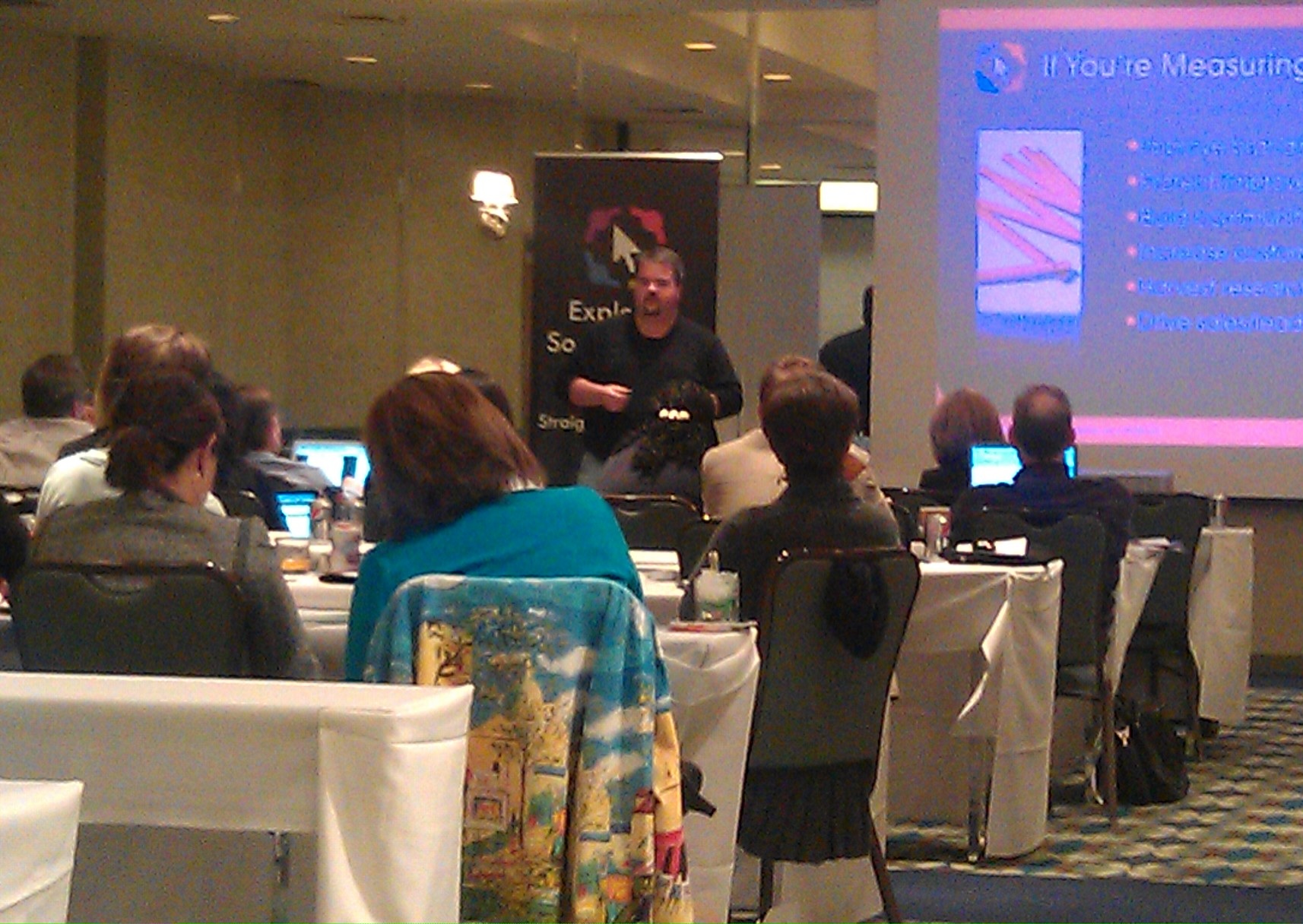
Jason Falls is currently rocking the Exploring Social Media Business Summit in Toledo, Ohio, talking about measuring social media marketing, and making sure that businesses are making money from it. There are three Very Important Questions every business manager will ask of their social media manager, and you’d better be able to answer them.

  1. How much did we make?
  2. How much did we save?
  3. Are our customers happy?
Jason Falls rocks his talk about social media measurement at #ESMToledo

That’s right, social media hippies. Social media, just like every other part of marketing, is about making money. It’s not about conversations, friends, followers, Likes, fans, connections, comments, or Google ranking. It’s about sales and conversions, and customer service and satisfaction.

This is why social media monitoring and analytics is so crucial. You need to be able to show your boss that your social media campaign was not $20,000 thrown down the toilet, because you thought it would be cool to sell your bulldozers on Facebook.

Use Google Analytics to Measure How Much You Make

Google Analytics can tell you how people came to your website, what pages they visited, and whether they went to your sales page and placed an order. If 300 people visit your website because of a tweet, 30 people went to your sales information page, and 3 people placed an order, you have a close rate of 1%. If your social media campaign costs $1,000 per month, but those 3 sales are worth $4,500, your ROI is $3,500.

Use Your Accountant to Tell You How Much You Saved.

Social media is a great way to handle customer service complaints, reducing the amount of troubleshooting calls that take 20 minutes, reduce technician visits, or even the total number of calls coming in to your service center. Ask your accountant to tell you how much you saved from month-to-month. Calculate the average cost of troubleshooting calls, technician visits, and the monthly salary of a call center rep. Get with your Google Analytics person and social media monitoring person (#3) to see if you have seen an increase in social media activity. Chances are, the latter had an effect on the former, so count these savings as a win. If you spent $1,000, but saved $3,000 in a month, your ROI is $2,000.

Or, more importantly, if we combine the two, you spent $1,000, and made/saved $6,500, your ROI is $5,500.

Use Social Media Monitoring Services to Measure How Happy Your Customers Are

Radian6, Lithium Technologies, Sysomos, are some of the biggest social media monitoring services around (they’re all subscription-based services, so expect to pay a fee), and if you’re a larger brand, it’s worth doing. If you have a small company, set up a free listening post with tools like a Twitter search (like a TweetDeck column), SocialMention.com and/or Google Analytics to see what people are saying about you. Quickly respond to any complaints or queries, and make sure you’re keeping people happy (see #2 above).

Happy customers are returning customers. Measure the sales of returning customers, especially those who have complained in the past, but you managed to keep by solving their problems, and compare that to the amount you paid for the social media monitoring service, and you’ve got your ROI.

We’re hopefully moving beyond the “social media is all about the conversations” way of thinking, at least in the business world. While this was cool and froody back in 2008, businesses are starting to use this as a new marketing channel. For those companies who want to make money this way, it’s real simple: just measure how much you made, how much you saved, and whether your customers like you.

If you can’t answer these questions, quit playing Farmville and go find someone who can answer it for you.

Filed Under: Marketing, Social Media Tagged With: Jason Falls, social media analytics, social media marketing

  • Page 1
  • Page 2
  • Go to Next Page »

Primary Sidebar

Subscribe via RSS

Categories

Tags

advice bloggers blogging blog writing books book writing business blogging citizen journalism content marketing copywriting crisis communication digital marketing Ernest Hemingway Facebook freelance writing ghost blogging ghostwriting Google grammar Jason Falls journalism language Linkedin marketing media networking newspapers No Bullshit Social Media personal branding public relations public speaking punctuation ROI SEO Social Media social media experts social media marketing social networking storytelling traditional media Twitter video writers writing writing skills

Archives

Recent Posts

  • The Enshittification of Evernote and Why I Quit Them
  • 11 Tips for New Digital Nomads
  • 13 Things to Do or Not to Do When Connecting With Me for the First Time
  • Why You Need to Write Your Memoir
  • How to Give a 6-Minute Presentation at 1 Million Cups

Footer

BUY ERIK DECKERS’ LATEST BOOK

Erik Deckers' and Kyle Lacy's book - Branding Yourself now available at Amazon

Request a Quote – It’s easy

We write blog posts, manage social media campaigns, write online press releases, write monthly news letters and can write your website content.

Let's figure out the right package for you.

FREE 17 Advanced Secrets to Improve Your Writing ebook

Download our new ebook, 17 Advanced Secrets to Improve Your Writing

Erik recently presented at the Blogging For Business webinar, and shared his presentation "12 Content Marketing Secrets from the Giants of Fiction.

If you attended the event (or even if you didn't!), you can get a free copy of his new ebook on professional-level secrets to make your writing better than the competition.

You can download a copy of free ebook here.

© Copyright 2020 Professional Blog Service, LLC.

All rights reserved. Use of this site indicates your consent to our Privacy Policy and Terms of Use.

1485 Oviedo Mall Boulevard Oviedo, FL 32765
Call us at (317) 674-3745 Contact Us About