Five Reasons to Use Posterous as a Social Media Distribution Point

Posterous.com Screenshot

I’ve been enjoying playing with Posterous for about a year now, and while I don’t recommend it for everyone, it can be a great tool for some people. You should consider using Posterous if you are a:

  • Beginning blogger
  • Social media specialist
  • Mobile blogger
  • Crisis communicator

Posterous is an email submission blog. You send your post as an email to your own Posterous.com address, treat the subject line as the headline, and any attachments you send are incorporated into the post itself. It’s not pretty at times, but if you need something fast, this is it. Plus, you can go in and edit stuff to make it look better later.
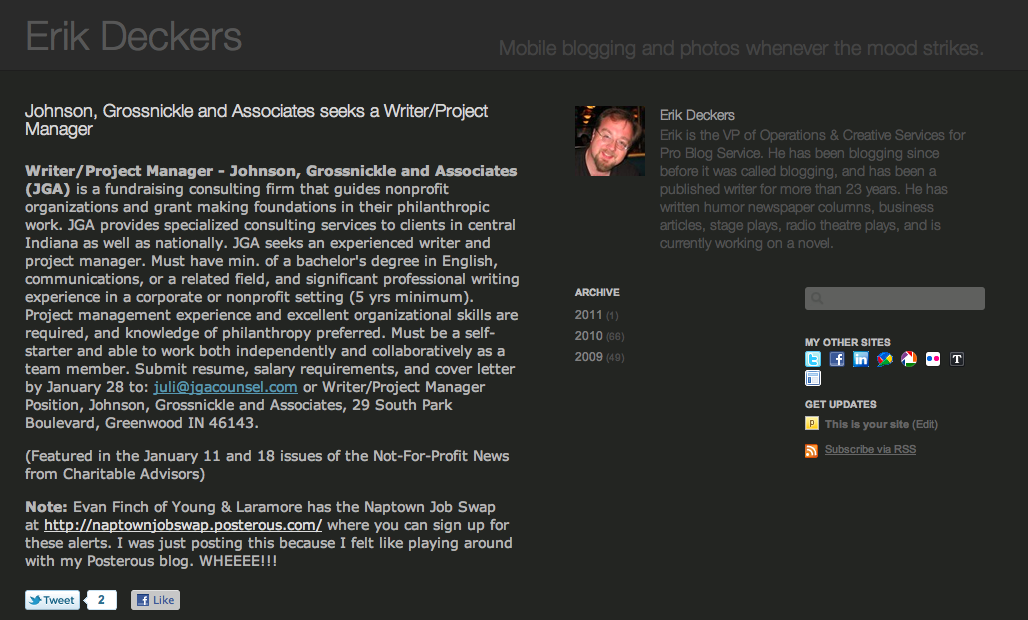
Posterous.com Screenshot

My Posterous.com blog

I’ve often said, “Using a blog interface is a lot like sending an email.” Now, thanks to Posterous, it really is sending an email.

Here are five reasons to use Posterous as a blog platform and social media distribution point:

  1. It’s ideal for mobile phone users. If you’re constantly on the go, and want to blog about the things you see, Posterous allows you to upload photos or videos to your site, along with any accompanying text. Posterous takes advantage of the overall computing power of today’s mobile phones. When I need to demonstrate Posterous during a talk, a few minutes before I go on, I’ll snap a picture of the gathering audience on my mobile phone, attach it to an email, and type in a couple of lines. Before my talk begins, I tell the audience, “I’m going to hit send on this email right now. You’ll see why it’s important in 10 minutes.” Then, when I get to that point in my talk, I show them my Posterous page, which has the picture of them. If you’re a crisis communicator or a mobile blogger, this is an ideal tool for communicating with the public on the fly.
  2. Posterous will automatically send videos and photos to other sites. I have tied my Flickr, Picasa, and YouTube accounts to my Posterous account; it also sends videos to Vimeo. Whenever I take photos or videos, and send them to Posterous, they are automatically uploaded to the appropriate networks. I don’t have to upload them first, and then download the embed code. The downside for anyone who is concerned about search engine optimization is that your digital properties are on Posterous, not on YouTube or Flickr, so you lose any search engine juice that would normally come from a well-optimized video or photo that links to your site. There are workarounds for this, but they take some extra time after your post has been uploaded. If you’re a social media specialist, you’ll love this feature.
  3. Posterous will automatically repopulate content to other blog platforms. You can tell Posterous to re-send your content on to your WordPress, Blogger, Drupal, TypePad, LiveJournal, Xanga, or Tumblr site. Publish a post on Posterous, republish it on your “official” blog. Yes, there are plugins and apps that let you email your posts in to these platforms, but they won’t necessarily upload your video and photos to YouTube and Flickr. Again, crisis communicators or mobile bloggers who need to get information out to several networks will love this feature.
  4. Tell Posterous NOT to post to certain networks. The default setting for Posterous is to repost everything to every network you want it to (i.e. email my post to post@posterous.com. But what if you have a photo you don’t want to send to Flickr, or you don’t want a post to show up on your WordPress blog? By using a specific email address — for example facebook+youtube+blog+twitter@posterous.com — I can tell Posterous to post to my different properties, but leave out a specific network. In this example, I’m leaving out Flickr.
  5. Posterous can automatically notify Twitter, Facebook, Google Buzz, etc. about new blog posts. Tie your Posterous blog into your different social networks, and notify your followers when a new post is up.
Author :  •  Content Location : Indianapolis, IN  •  Headline : Five Reasons to Use Posterous as a Social Media Distribution Point  •  Keywords : blog writing, blogging, crisis communication, Flickr, photos, Posterous, video, WordPress, YouTube  • 

What Does It Take to be a Social Media Expert?

My friend, Hazel Walker, wrote a blog post recently about how “Anyone With a Book Can Call Themselves an Expert,” and we were discussing it over coffee

“Uh, you know my book launch is tonight, right?”

She did know, but said it wasn’t books like mine that she was talking about, it was the self-published kind. “Anyone can self-publish a book, and anyone can regurgitate stuff someone else said. That doesn’t make them an expert,” she said.

Hazel’s gripe was about the proliferation of social media experts who are springing on the scene, armed with a few dozen hours of using the necessary tools, thinking this somehow made them an expert.

My mother, age 72, has decided that she is a social media expert. Heck why not, she uses Facebook, and has for about 6 months, she tells all her friends how to use it, when is the best time of day to use it, why it’s important to use it, and on and on. All things considered she has as much experience as many out there calling themselves an expert.

I agree with Hazel on this. Her mom notwithstanding, there are too many people who are eager to call themselves an expert when they’re not even an enthusiastic amateur. This prompts other people to rant against the faux experts (fauxperts?), which makes the real experts hesitant to adopt that mantle in the first place.

It’s a shame really.

There are some really smart, bright people who have earned the term “social media expert,” but they’ve been scared out of using it because other people are snarky, or just downright brutal, to the “fauxperts.” The real experts don’t want to get caught in the crossfire, so they eschew the title they deserve.

So what does a social media expert have that the non-expert does not have?

    1. More than five years experience in creating effective messages that educate, persuade, or inspire. The more, the better.
    2. More than five years of understanding their target market/audience (social psychology, and how their messages affect that audience.
    3. More than five years spent creating strategies and executing them. Not just executing someone else’s strategy, and doing someone else’s grunt work. You created the strategy, then you executed it.
    4. Has frequent speaking engagements to industry groups about their knowledge and experience.
    5. A lot more knowledge than their customers, including the ones that keep up with social media.
    6. A regular publishing schedule of thoughts, news, and research on a blog that’s older than a year. Even better, a regular publishing schedule of their thoughts, their news, and their research.
    7. A breadth of experiences, responsibilities, and first-hand knowledge from a variety of jobs. They don’t still have the same job they got after college, five years ago.
    8. Enough knowledge about social media message creation and social psychology that can, and hopefully does, fill a book.
    9. Paying clients.

This last point is probably the most important one. Printing out cards at a cheap overnight business card service doesn’t make you an expert. Being hired by your mom’s Pilates friend to create a Twitter account for her dried flower arrangement business doesn’t mean you have clients. You need to make a living at this. It’s not a sideline, and not a hobby. It’s not something you decided to do because you’re having trouble finding a job. It’s not a fallback option because you didn’t get into bartending school.

Also, notice I didn’t mention any specific tools, any scores, analytics, etc. For one thing, numbers can be gamed; value and reach are earned. For another, the real expert doesn’t rely on the tools, they rely on their network. And they would have that network if they were using Twitter, Facebook, or a 7-year-old email newsletter. The tools are constantly changing and evolving, some are dying, while others are growing (anyone remember AOL’s heyday?). So why put all your stock in the tool, when it’s the connections you need?

Being an expert is all about real-life experience and real-life work. It’s not about numbers and networks, it’s about what you can do with them.

I think the real social media experts need to man up (or woman up), step up, and assume the title. Don’t let the snarky people scare you off. Don’t adopt this falsely humble, “aw shucks, I’m not smart enough to be an expert” attitude. If you’ve been in the persuasion business for more than five years, you can start calling yourself an expert. Everyone else in every other field is calling themselves an expert in their job. Why should the charlatans and fakers scare you off?

They need to stop being scared off by those people who heard someone once say “there are no social media experts” and are now parroting it like it’s gospel; the people who think social media is rapidly changing, but no other industry in the world is; the people who think social media is brand new, forgetting that Facebook started in 2004, LinkedIn started in 2003, blogging has been around since 1994, and AOL was actually one of the first social media networks. Since the mid 1980s.

(And for those people who are going to say, “Nuh-uh, Malcolm Gladwell says you need 10,000 hours to be an expert,” please go actually read the book. He said you need 10,000 hours to be an outlier, not an expert. The outlier is that person who is outstanding in their field — Peyton Manning, Michael Jordan, Bobby Fisher, Bill Gates — the expert is the person who knows a hell of a lot about their field, but may never rise to the level of the outliers.)

My book, Branding Yourself: How to Use Social Media to Invent or Reinvent Yourself (affiliate link), is available on Amazon.com, as well as at Barnes & Noble and Borders bookstores. I wrote it with my good friend, Kyle Lacy.

Author :  •  Content Location : Indianapolis, IN  •  Headline : What Does It Take to be a Social Media Expert?  •  Keywords : Malcolm Gladwell, social media, social media expertise, social media experts, social networking  • 

Five Tips to Being Productive While You’re on the Road

Paul Lorinczi, president of Professional Blog Service

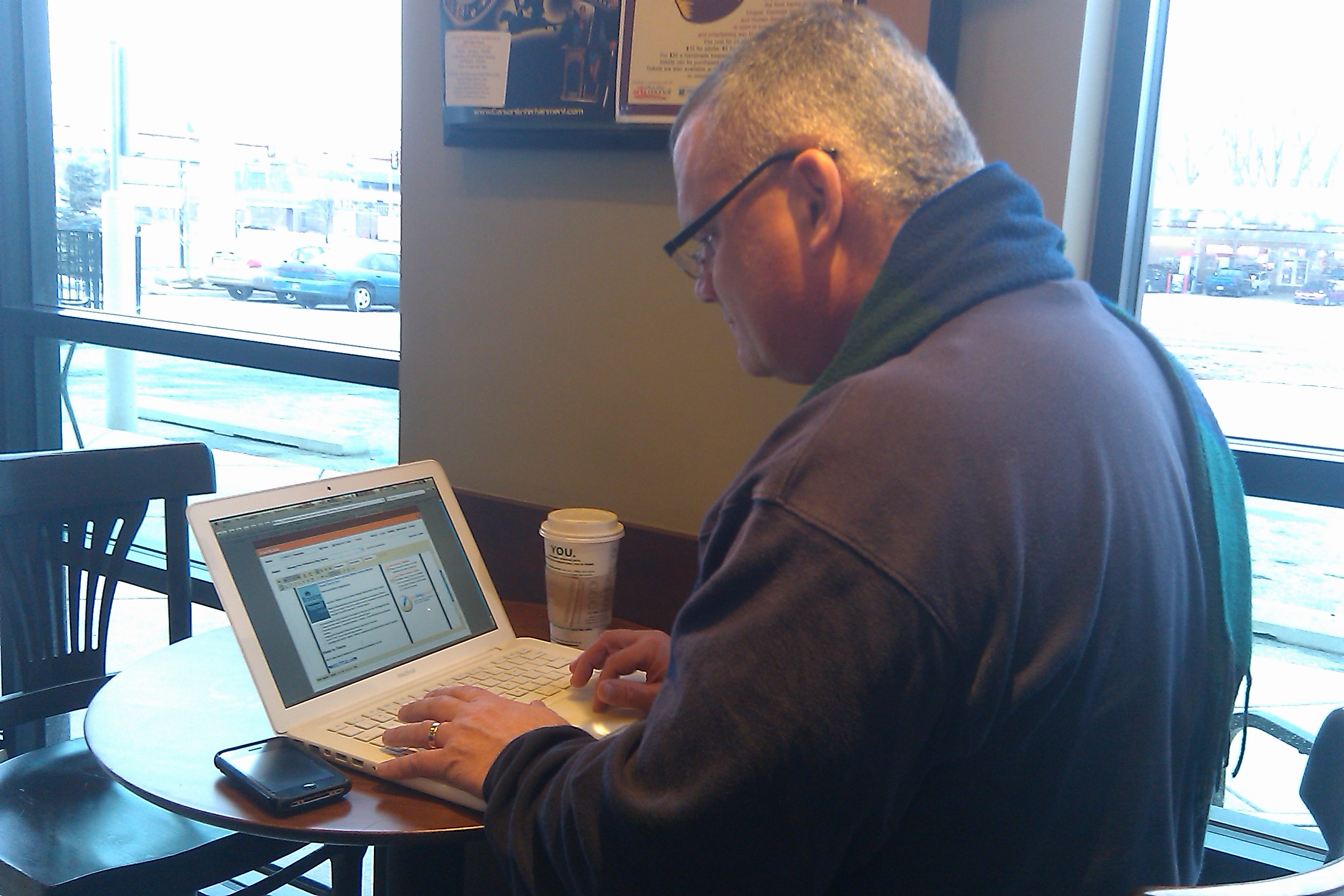
I’ve been traveling a lot lately, with speaking gigs and client meetings, and I’m finding it harder to be productive, especially when these are all day trips, and the time I would normally spend in a hotel or a coffee shop is instead spent driving to or from my events. I’m also a regular entre-commuter, carrying my office in my backpack and working wherever I can find a coffee shop with free wifi.

While days like this mean a lot of evening, night, and weekend work (and a lot less sleep), there are some ways I have found I can still be productive while I’m out and about.

  • Get someone else to drive. When Paul and I drive anywhere, we take turns driving, so the other can get some work done. Get a friend or colleague to drive you to an appointment, or once you’re a big shot making a few thousand bucks for a speech, hire a driver. Do some work while the other person drives, and don’t be afraid to say “I can’t talk right now, I have to get this done.”
  • Keep projects “in the cloud” on your laptop. When we’re driving, I can tether my mobile phone to my laptop and get some very slow, basic wifi. This means that loading websites, answering emails, and writing blog posts is painful and I just give up. Instead, I write email responses and blog posts on my laptop and upload them when I get to a coffee shop or my destination. Since our writers turn in their submissions via Google Docs, I download them before I ever leave, make the changes, and upload them when we get to our next stop.
  • Paul Lorinczi, president of Professional Blog Service

    Paul's working on our new monthly email newsletter.

  • Plan for work breaks. I’m sitting in a coffee shop in Columbus, Indiana, on the way back from giving a talk in Lexington, KY, to write this post, because we had some client work to take care of. Yes, we could just keep going, but we’re about to head north into Indianapolis’ rush hour traffic, and by delaying now, we’ll miss the bulk of the 5:00 rush. It also lets us get some work done so we don’t have to deal with it when we get home. Why slog through rush hour traffic only to do some more work when we just want to relax? Normally, we try to plan a 30 minute break in our longer trips so we can stop off and handle any surprise client requests — publishing a blog post, sending a Facebook message, responding to a tweet — that come in while we’re in the car.
  • Make phone calls instead of emails. My efficiency-expert friends say to stay off the phone and send emails, because I can write a note in two minutes, but a phone call can take 10. But when I’m driving, I’ve got 2 – 3 hours before I get to my location, so why not kill some time on the phone? I get to make that personal touch with people I do business with, and I avoid the 10-email-exchange that we try to do to get a task out of our inbox and into the other person’s. In some cases, a phone call even lets us finish a project completely.
  • Plug your laptop in whenever possible. I’m watching my laptop slowly drain its battery to below 50%, and I remember that I didn’t plug in earlier when I had the chance. Whenever you stop for a quick break (#3), your time and productivity may be limited by the fact that your battery wasn’t charged previously. This also cuts your productivity in the car — if your battery dies, you and your companion are forced to talk about your feelings any topic that randomly comes to mind. One way to avoid this is to get a DC converter for your car, like the truckers use. Get a decent one at your local hardware store or a truck stop, and plug it into your car’s cigarette lighter, then plug your laptop into it. Some really good ones even have a USB charger so you can charge your mobile phone with your USB cable.

What are your tips? How do you keep productive while you’re in the car? Leave a comment and share your wisdom.

Headline : Five Tips to Being Productive While You're on the Road  •  Keywords : productivity, public speaking, mobile office, entre-commuter  •  Author :  •  Content Location : Indianapolis, IN  •  Copyright Year : 2011  •  Creator : Erik Deckers  •  Version : 2.0  • 

Six Reasons You Should NOT Feed Your Twitter Stream Into Your Facebook Stream

After yesterday’s post, Ten Signs You’re NOT a Social Media Expert, my friend Josh Husmann asked “Help me out! Why shouldn’t my twitter feed forward to Facebook?”

It’s a fair question, and it’s something I see a lot of people doing it. I even did it for a few weeks, until someone who wasn’t on Twitter told me to stop it. Here are six reasons you shouldn’t feed your Twitter stream into your Facebook stream.

  1. Most of your Facebook friends aren’t on Twitter. They don’t understand #hashtags and @replies. Your Twitter messages that contain those will just be confusing and/or boring.
  2. No one wants to read half a Twitter conversation, especially if they have no way of reading the other half.
  3. If you also automate your blog feed to Facebook, then your Facebook friends will get hit with two messages about new blog posts.
  4. If you’re trying to create an effective personal brand, then automating your feed will work against you. Take the time to write a custom message for both Twitter and Facebook.
  5. Facebook status updates can hold a whole lot more than a tweet. Why limit yourself to 140 characters on something that gives you a few hundred?
  6. Your Twitter audience is not necessarily your Facebook audience. Most of my Facebook network is made up of friends, family, people from high school and college, and people who live in the Indianapolis area. But they are not necessarily social media or PR people that I work with. A good number of my tweets are about business, social media, etc., and while I don’t mind sharing personal information with my Twitter stream, I don’t want to bother my personal stream with work information.

My book, Branding Yourself: How to Use Social Media to Invent or Reinvent Yourself (affiliate link), is available on Amazon.com, as well as at Barnes & Noble and Borders bookstores. I wrote it with my good friend, Kyle Lacy.

Photo credit: NathanGibbs (Flickr)

Author :  •  Content Location : Indianapolis, IN  •  Headline : Six Reasons You Should NOT Feed Your Twitter Stream Into Your Facebook Stream - Professional Blog Service  •  Keywords : facebook, social media, social networking, social networks, twitter  • 

Ten Signs You’re NOT a Social Media Expert

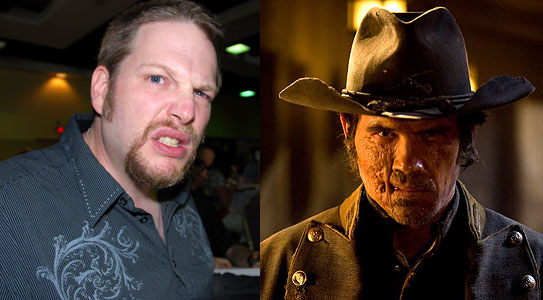
Chris Brogan and Josh Brolin

Ten Signs You’re NOT a Social Media Expert

10. You updated your blog in December. 2009.

9. You’re convinced that Orkut will be the breakout social network of 2011.

Chris Brogan and Josh Brolin

This is not the same dude.

8. You’re feeding your Twitter stream into Facebook.

7. You think Chris Brogan was the star of “Jonah Hex.”

6. You’re still quoting the Malcolm Gladwell “10,000 hour rule,” unaware that you’re quoting someone who quoted someone else who didn’t actually read the book.

5. Your business email address ends with “@aol.com,” but you don’t work for AOL.

4. You work for AOL.

3. You play Farmville so much, Zynga’s revenues plummeted the week you went on vacation.

2. You tell people you had the high score on Technorati when you were in high school.

1. Your social media experience consists of your unpaid college internship at your dad’s accounting firm.

My book, Branding Yourself: How to Use Social Media to Invent or Reinvent Yourself (affiliate link), is available on Amazon.com, as well as at Barnes & Noble and Borders bookstores. I wrote it with my good friend, Kyle Lacy.

Author :  •  Content Location : Indianapolis, IN  •  Headline : Ten Signs Youre NOT a Social Media Expert  •  Keywords : AOL, Chris Brogan, facebook, Farmville, social media, social media expert, social media internship, social network, twitter, Zynga  • 

Random Thoughts on Writing a Book

I’ve finished my second book, Branding Yourself, with my good friend, Kyle Lacy, and am working on a third book on networking with Jeremy Dearringer, CEO of Slingshot SEO, an SEO company here in Indianapolis. I also have a couple other writing projects in the works, although those are still under wraps. I hope to have some news about those by Springtime.

But I’ve learned a few things about becoming a book author, things that I thought were easy, and things that I learned are hard.

  • Writing a book isn’t really that hard, if you write on a regular basis. I used to think the advice “write every day” was stupid. “Who has time for that?” I thought. “I have work to do.” Turns out the work I was doing was writing anyway, and when I decided to write intentionally — to focus on new aspects of writing and become better at them — my writing improved.
  • Have a good editor. I learned a long time ago that while I’m a stickler about grammar and punctuation, I make a crapload of mistakes. Even though I catch them on second and third edits, I still usually find one or two that has to be fixed. Pearson just sent Kyle and me the “gathers” of the book. Individual chapters that we need to read over and mark any errors before the second printing. Believe it or not, with two writers and four editors, I found a couple errors. (What’s worse, they were mine!)
  • The hard part isn’t writing the book, it’s marketing it. In order to support the book, and sell copies, I’m starting to travel more to promote it during talks. Next week, I’ll be in Northern Indiana one night and Lexington, Kentucky the next day. I’m trying to do some paid speaking gigs, but am thinking about adopting Scott Stratten’s idea when he was promoting UnMarketing (affiliate link). Scott made an offer to any group: buy 100 of my books, and I’ll travel out to you. I’m thinking about doing that for anyone who buys 50 of my books, as long as you’re within driving distance. But compare that to writing. I could write at home, spend three hours, and knock out about 6,000 words, or almost an entire chapter. It’ll take me that long to drive to most of my speaking gigs.
  • Know your subject matter. Writing teachers love to say “write what you know” (which presents a problem for science fiction or fantasy writers). But this makes life so much easier when you’re writing a book. I remember struggling with a couple of chapters on Twitter Marketing for Dummies because I didn’t use some of the tools we were writing about. I had to spend a lot of time using them before I could write about them, which threw a huge monkey wrench into my writing schedule.
  • Have a writing schedule, and stick with it. John Grisham’s writing schedule, when he first started out, was to write from 7 am to 8 am, before he opened his law office. Christopher Moore’s schedule involves a lot of screwing around all day before he settles down after lunch and writes for 4 or 5 hours. Mine is to write at night, after the kids are in bed, and go for about 4 hours. Ignore the people who tell you to wake up early because mornings are more productive, or the people who tell you to stay up late because no one is awake then. Do what’s best for your body and your schedule. If you’re a night owl, stay up late. If you’re an early bird, get up and get that worm. But create a schedule and stick to it.
  • Shut off distractions. I love my Twitter network, and love chatting. But they are also the biggest interruption of my day, because they’re always more interesting than whatever I’m doing (even as I’ve written this post, I’ve sent 4 tweets). So when I’m writing, and have the willpower to do so, I shut off TweetDeck, close my Gmail, turn off the notifiers, and get to work. I can save myself 30 minutes of writing when I do that. My wife once asked me why I didn’t do that more, and I told her to “rephrase your question in the form of a tweet.”

Writing styles and processes are different for everyone. What are yours? Do you do anything special to get your writing done, to be more efficient and effective, or even to avoid distractions? Leave a comment and let me know.

My book, Branding Yourself: How to Use Social Media to Invent or Reinvent Yourself (affiliate link), is available on Amazon.com, as well as at Barnes & Noble and Borders bookstores. I wrote it with my good friend, Kyle Lacy.

Author :  •  Content Location : Indianapolis, IN  •  Headline : Random Thoughts on Writing a Book  •  Keywords : book writing, Branding Yourself, Marketing, public speaking, speaking, writing, writing process, writing style  • 

How To Turbocharge Your LinkedIn Profile

li-tutorial.png

Web pages are useless without traffic, and the same is true about LinkedIn profiles. It doesn’t matter if you are looking for new customers, a job or just more connections, no traffic = no opportunity. Here’s a simple strategy I used to increase the traffic to my LinkedIn profile page from 3-4 people per day to 70-80 people per day (that means 27,000+ visits in a year). Feel free to make it your own:

Step 1: Figure out what your goal is with your LinkedIn Profile.

This isn’t that hard. Your LinkedIn profile is a resume with a couple of places you get to be creative, and there are really only a few practical uses for LinkedIn. Most likely your goal is one of these four: [Read more...]

Author :  •  Content Location : Indianapolis, IN  •  Headline : How To Turbocharge Your LinkedIn Profile  •  Keywords : linkedin, social media, social networking, social networks  • 

3 Secrets of Creating Effective and SAFE Humor for Your Writing

Inigo Montoya #LessIconicMovieLines quote - Hello, my name is Iñigo Montoya. You grilled my bratwurst. Prepare some fries.

I’ve been writing newspaper humor columns for over 17 years.

And I can tell you one of the hardest things to do is to be funny week after week. So hard that I can’t always do it. In fact, I slacked off for six months in 1998, but apparently no one noticed.

Sarah Schaefer at 92Y Tribeca Comedy Festival

Sarah Schaefer at 92Y Tribeca Comedy Festival

But I have learned a few secrets about writing humor over the years, based on how humor itself works. These aren’t just the “rule of three” or “end words in a hard K” tricks, but the psychological motivation of humor. If you can learn how to write jokes using these secrets, you can start safely adding humor to your blogs, your articles, or your presentations.

(I have to give special thanks to my dad, Dr. Lambert Deckers, a psychology professor who studied the motivation of humor for a number of years, and Dick Wolfsie, fellow humor writer and features reporter for WISH-TV, for teaching me all of this. I totally stole all of this information from them.)

Humor Rule #1: All Humor is Based on a Surprise

The Purdue University linguist Victor Raskin wrote that all humor is based on a surprise, or a lie. That is, comedians lie to us by setting us up with one premise, and then lie to us (or surprise us) with the punchline. The laugh comes from the surprise.

Here’s an example: writer Dorothy Parker once famously said, “If all the girls who attended the Yale prom were laid end to end, I wouldn’t be a bit surprised.”

Did you see it? As you started reading Parker’s line, by the time you got to “laid end to end,” your mind already started thinking about what was going to come next, like a measurement of distance: “they would stretch across campus” or something similar. But she surprised us by instead questioning the moral virtue of the girls who attended the Yale prom. And that’s where the laugh came from.

This type of sentence is called a paraprosdokian, which is from the Greek meaning “expectation.”

However, not all surprises are paraprosdokian in nature. There are times when endings are just unexpected, but didn’t require a single sentence to get there. Most punchlines to jokes are surprises, which is what makes them humorous.

If you want to add a joke to your posts, throw in a surprise thought or two, almost as a parenthetical statement, at the end of a paragraph where a punchline would typically sit.

Humor Rule #2: Good Humor is Based on Recognition

Writing a punchline that requires previous knowledge of the source material is a great way to get a laugh. If the audience is already familiar with the source of a punchline, the reason behind it, the source it references, or if it’s something they’ve experienced before, you’ll get a laugh. For example, telling computer jokes to a bunch of IT geeks will get a laugh, but telling the same joke to a bunch of fashion models won’t. The way Dick Wolfsie explained it, the reader feels like they’re in on the joke, which makes them feel good, and they laugh.

Inigo Montoya #LessIconicMovieLines quote - Hello, my name is Iñigo Montoya. You grilled my bratwurst. Prepare some fries.

I can't help it, I was REALLY proud of this one.

Here’s an example: As I was writing this post, my friend Rhett Cochran started the #LessIconicMovieLines meme on Twitter. Several of us threw out suggestions based on memorable movie lines. The movie lines that did the best were fairly popular ones — you couldn’t use lines from a movie no one had seen, like Ishtar — and they were surprising enough to be funny.

This is also why “callbacks” work so well: they “call back” to something that was said earlier. A lot of standup comics use callbacks during their act. When the audience recognizes the joke, and remembers where it came from, they feel like they were in on it, and the joke scores.

A lot of character-driven sitcoms rely on recognition for their humor. You get to know their characters, their foibles, their tendencies, their likes and dislikes. Then, whenever they’re placed in a particular situation that draws on one of those facets, it’s funny. But when a different character is placed into the same situation, it won’t be funny.

Recognition is also why jokes often fall flat, especially when you tell inside jokes to someone who wasn’t there. If you have to say “I guess you had to be there,” that’s a good indication the joke won’t be funny.

Humor Rule #3: Humor is Based on Making the Reader Feeling Superior. Good Humor is Self-Deprecating

Making a reader feel superior is another key to humor. Basically, if I feel smarter, better, prettier, richer, or more successful than the subject of the joke, the joke scores. It can often piggy-back off Recognition. That is, if I understand the inside joke or the callback, then I feel smarter, like I’m in on something special, and I’ll laugh.

However, this is where a lot of humor can be dangerous, and I urge you to use it carefully. It’s why people are told to avoid using humor at all. People love to make jokes at someone else’s expense, and end up offending somebody (or a whole lot of somebodies). It’s one thing to make a joke about a single person, but then it becomes tempting to make a joke about a group of people — computer geeks, people from a neighboring state — which can then turn into jokes about race, disability, size, etc., which then creates all kinds of problems.

To safely follow this rule, never, ever make a joke at someone else’s expense, because it will promptly backfire. Don’t think it won’t happen? Think back carefully to that one awful cringe moment in your life where you made a joke about a friend, only to discover that the punchline was related to some childhood condition, sensitive subject they’re in counseling about, or the tragic death of a loved one. (Congratulations if you only have one of those.)

In essence, if your humor has to rely on someone else feeling bad, then don’t do it.

There is one exception where it’s okay to violate this rule: if you make fun of yourself, you are completely safe. By making fun of yourself, the authority, you’re making the audience feel superior to you. I used this in the last sentence of the first paragraph, “In fact, I slacked off for six months in 1998, but apparently no one noticed.”

This is a great trick used by public speakers. By being up on stage, speaking to the audience from a position of authority, they are in the power position. So good speakers will make fun of themselves, which makes the audience feel like they’re superior to the speaker, and the joke scores.

There are several other humor secrets you can use, like exaggeration, being outrageous, or absurd, that can also make your writing or speaking funny.

In a future post, I’ll discuss how to string a few small jokes together to make your next presentation or blog post rock.

At least from a humor perspective. If you suck at speaking, I can’t help you.

My book, Branding Yourself: How to Use Social Media to Invent or Reinvent Yourself (affiliate link), is available on Amazon.com, as well as at Barnes & Noble and Borders bookstores. I wrote it with my good friend, Kyle Lacy.

Photo credit: Sarah Schaefer, 92YTribeca (Flickr)
Twitter screenshot: Erik Deckers

Author :  •  Content Location : Indianapolis, IN  •  Headline : 3 Secrets of Creating Effective and SAFE Humor for Your Writing  •  Keywords : humor, humor writing, jokes, newspaper columns, writing  • 

Your Best Editor Is the One Who Shreds Your Writing

I was just talking with Kyle Lacy’s and my editor, Katherine, about the editing of our book, Branding Yourself.

We were talking about the strong-arm nature of our development editor, Leslie, and the work she did for us on our book. Leslie was tough, asked a lot of hard questions, and really made us work. There were days I spent almost as much time fixing her edits as I did writing the original chapter.

“Would you ever want to use her again on future projects?” Katherine asked

“Oh absolutely. She kicked our asses.”

The list of editors at Pearson Educations who made Branding Yourself a great book

These people made Branding Yourself as good as it is.

That’s the beauty of a really good editor. They won’t let you get away with anything. They do whatever is necessary to make your writing the best it can be. And for me and Kyle, that was making sure our book wasn’t a piece of schlock that came across as one long hastily-written blog post.

A good editor will ask questions, point out errors, make corrections, show inconsistencies, and make you revise your work. A bad editor will read your work, tell you they liked it, and maybe point out a couple punctuation errors.

A good editor will make your life hell, a bad editor will make your life as easy as possible.

A good editor will make your writing rock, a bad editor will let your writing suck.

I can’t tell you the number of times I got irritated with Leslie’s questions and comments in the manuscript that personally attacked me and questioned my ability as a writer. I would work on them at my dining table at 1:00 in the morning, writing snarky responses to most of them.

It took the light of day to bring a fresh new perspective to her helpful questions and comments that showed me where I skipped an important piece of information or had a poorly-constructed sentence. I quickly deleted the snarky responses, happy that I had waited until the morning before I finished making the changes. (I learned to stop reading her edits when I was running on empty at 1 in the morning, but started making them during the day when I was fully rested. She became much nicer when I did that.)

I have learned over the years that editors are only there to make your work better, not to make you look stupid or to make you question why you ever pursued writing and didn’t just go into roadkill cleanup as a career. If you’re lucky enough to find an editor for your work, whether it’s a professional editor looking at a manuscript or a know-it-all friend with a hyperactive red pen, treasure this person. Hold on to them for as long as you can, and give them as much of your work if they can handle.

And when they hand you back your baby, filled with more questions and red ink than you think can fit in one pen, say thank you, get a good night’s sleep, and then make the changes they suggested.

After all, it’s your name and your reputation going on that piece. You look like a genius because of them, and all they get — if they’re lucky — is their name on an inside page of the book.

My book, Branding Yourself: How to Use Social Media to Invent or Reinvent Yourself (affiliate link), is available on Amazon.com, as well as at Barnes & Noble and Borders bookstores. I wrote it with my good friend, Kyle Lacy.

Author :  •  Content Location : Indianapolis, IN  •  Headline : Your Best Editor Is the One Who Shreds Your Writing  •  Keywords : book, book editor, Branding Yourself, editor, writing  • 

Inc. Magazine is NOT Charging You to Write Their Story

Hi Erik, this is Ken Lehman of Winning Workplace. You wrote that blog post about Inc. Magazine’s Top Small Company Workplaces.

Uh-oh.

I recognized the company name, even if I didn’t recognize Ken’s name.

Ken had read my blog post where I questioned the ethics of Inc. Magazine’s Top Small Company Workplaces story, and the fact that they were charging $149 for the application review just to be considered for the TSCW review.

Turns out I was barking up the wrong tree. And I have to thank Ken for patiently, and kindly, setting the record straight. Here’s what he told me:

Winning Workplaces is a 501(c)(3) nonprofit founded by his family in 2001. They were the Fel-Pro family, a business that was started and run by his family for more than 80 years, before they were sold.

Winning Workplaces was created to help small and mid-sized enterprises to become great places to work. They have done this project for 8 years. This is their 9th year for the award.

2010 was the first year Inc. was their media partner. Prior to that, they worked with the Wall Street Journal, and prior to that with Fortune Small Business.

In other words, Winning Workplaces gives the awards, and they have a relationship for Inc. Magazine to write the article. From there, other journalists pick it up, and it gets published in other news outlets.

The fees that are assessed — and they didn’t assess for the first several years — are paid to Winning Workplaces, not to Inc. They are nominal and cover the administrative costs to do the project. They are not any kind of editorial or advertorial, as I had previously thought. No one needs to apply without seeing the application first, and on the website, you can preview the application before you put any money up.

Winning Workplaces is made up of a small staff and his family has put a lot of money into the project over the years. Ken doesn’t even get paid for this. He does it for the satisfaction of helping other companies.

Ken said that the people who complete the application will often tell Winning Workplaces that the process is very instructive to their own businesses, and it helps them think about their workplaces differently. It gives them ideas about how they can improve themselves, regardless of whether they win, become a finalist, or even miss the first cut.

This year, they have 28 people lined up to do the initial reviewing and screening. Some of them volunteer, and others get paid nominal amounts to follow their whole methodology to do it. That’s where the money goes, not to Inc. Magazine.

When Ken’s family started Winning Workplaces, they did it because there was no recognition project for smaller organizations. In the 90s, when Ken was working for Fel-Pro, they made Forbes list of one of the good places to work in America. And when Fortune magazine started its 100 best companies to work for list, Fel-Pro was #4. When Fel-Pro was sold in 1998, one of the things they did was to share what they had learned with others, so they hit upon starting an organization. That’s where WW came from.

However, in 2000, Fortune Magazine stopped accepting applications from companies under 1,000 employees, and there was nowhere for smaller companies to go for this kind of recognition. That’s where the Top Small Company Workplaces project came from.

Since that time, it has proliferated, and there are now a number of recognition projects and lists around the country.

But — and this is where Winning Workplaces is different — theirs is the only ones where you can win once. Then you go into their hall of fame, and you can’t repeat.

Everyone else, on the other hand, has a business model where they sell their feedback to help companies move up the list, and earn a higher number, or at least to not fall off the list. In other words, companies will “sell” you consulting to keep you on the list; Winning Workplaces purposely avoids that kind of contamination.

So, having learned all that from Ken Lehman, I can see how the Top Small Company Workplaces award is actually worthwhile and beneficial to companies. I have to say a special thank you to Ken for calling me and setting me straight.

And now I want to enter the contest myself. But since we just moved into our new space 2 days ago (and we’re sharing it), I don’t know that we qualify.

Author :  •  Content Location : Indianapolis, IN  •  Headline : Inc. Magazine is NOT Charging You to Write Their Story  •  Keywords : ethics, Inc. Magazine, journalism, magazines, Winning Workplaces  •