• Skip to primary navigation
  • Skip to main content
  • Skip to primary sidebar
  • Skip to footer

Pro Blog Service

  • Business Blogging
    • Blogging and Content Marketing for Search Engine Optimization (SEO)
    • Social Media Strategy and Consulting
    • Blogging Services
    • Content Factory
    • Need a Law Blog or Legal Blog?
    • Download Our White Paper: Business Blogging: The Cost of Corporate DIY Blogs vs. Ghost Blogger
    • Pro Blog Service Books
  • Blog
  • Speaking
  • About Pro Blog Service
    • Erik Deckers
    • 4 Simple Rules for Guest Posting on Our Blog
  • Get Ghost Blogging Quote
  • Link Sharing/Contributed Articles
You are here: Home / 2010 / Archives for December 2010

Archives for December 2010

December 30, 2010 By Erik Deckers

I’ll Read Your Ad for $250. My New Pay-For-View Pricing

Kim Kardashian annoyed more than a few Twitter users when it was leaked that Kardashian commands $10,000 to send a promotional tweet out to her then-2.7 million followers (now 5+ million).

(Kardashian denies that she receives that much money. Rather, she says she just tweets about products she likes.)

While I don’t follow her, I’m sure that her 5 million followers (minus the ones who aren’t spam bots and people who abandoned Twitter after a month) are looking forward to reading something interesting and not very vapid or shallow. (Yeah, good luck with that.)

How disappointing is it for her fans to learn that their favorite non-celebrity celebrity is only telling you she likes her shoes because someone forked over 10 grand to say so? While marketers think a so-called celebrity’s time and endorsement are valuable, they are also showing they think my time or interest isn’t.

So I have a new offer to marketers who want me to read celebrity endorsements and social media marketing messages: I will read anyone’s tweet, watch their commercial, or read their marketing copy for a fee.

That’s right. You can pay me to absolutely look at, read, watch, and consider your product. Think of it as a personal endorsement. After all, my time is valuable. Time I could spend working or being with my family is instead interrupted by you and your spokespeople trying to get me to buy something. And I do my best to ignore it, hide from it, or block it completely. So you come up with something new and creative, which means I have to do something new and creative to avoid it.

So how about you pay me instead? If you pay me, I will read whatever you put in front of me (except for that damn Kay Jewelers ad where the brain-addled woman is afraid of a thunderstorm). Rather than spending $10K on someone who is famous without actually doing anything useful, spend the money on me, and I will read or watch to your heart’s content.

According to my new Pay-For-View pricing schedule, I will:

  • Read any celebrity advertising tweet for $75. Any non-celebrity advertising tweet is only $25. (Hey, if you’re forking out $10,000 because someone is famous, chances are I find them annoying. So the extra $50 is for the wear and tear on my soul.)
  • Visit any company website for $150, and spend 10 minutes on the site, plus additional charges for any of the following:
  • Watch any video less than 5 minutes in length for $200. For videos longer than 5 minutes, it’s an additional $75 per minute.
  • Read any marketing copy, up to 750 words in length, for $150. Since I can read 750 words faster than you can say it in a video, I’ll cut you guys a break on the cost.
  • Also, any marketing surveys, registration forms, or instances where I have to give you my personal information is $100 plus a $25 per minute processing charge (minimum 5 minutes). I had originally considered charging a flat fee per information field (i.e. mailing address, phone number, etc.), but the rate sheet ended up being three pages long and still required a lengthy explanation.

Now, these prices are actually fairly reasonable, and I feel completely justified in charging them. After all, my time and consideration are valuable. I have a job, a family, and disposable income. I’m not easily swayed by celebrity endorsements, and will go out of my way to avoid most commercials and marketing messages. In short, you’re spending all that money to get celebrities to reach me, and I’m going to support you (and them) by spending my money. The least you can do is support me for spending my time thinking about you.

Kim Kardashian may be on to something, and I have to give her credit for helping me stumble upon the idea. As a thank you, I will read her next three promotional tweets for free.

No guarantees I’m buying anything though.

Filed Under: Lead Generation, Marketing, Public Relations, Social Media, Twitter Tagged With: digital marketing, marketing, social media marketing, Twitter

December 29, 2010 By Erik Deckers

Five Online Monetization Ideas for Newspapers

BIg-city newspapers that are still relying on ad sales and subscriptions to pay for their giant printing presses and related salaries are only delaying the inevitable closure of said newspaper. (Dailies in smaller cities and the small-town weeklies still seem to be doing well, since they cover local news, which the big city papers are ignoring.)

Newspapers need to realize ink on paper is not the only way to deliver news.

But if the big city newspapers were to start rethinking their content delivery methods, they might be able to start generating some additional income. Here are five ideas newspapers could use to increase readership and grow revenue.

1. Hop On The Mobile Bandwagon

Earlier this month, Mashable reported on a survey that said:

U.S. smartphone owners are increasingly turning to mobile to access breaking news over other media, including newspapers, TV and desktop web browsers.

In a survey of 300,000 mobile consumers, 88% of whom owned a device running one the five most popular smartphone operating systems, more than 30% said that mobile is the “most important medium” to access breaking news, narrowly followed by desktop web browsers (29%), television (21%) and newspapers (3%).

That’s because online news is beating traditional media to breaking the news.

If a story breaks at 10:17 in the morning, I could watch it on the noon news (except I’m at the office), the 5:00 news (except I’m in the car), the 6:00 news (but I’m eating dinner), or the 11:00 news (13 hours later). I could also read about it in the newspaper at 6:30 am, 20 hours later.

Or I could read about it on my mobile phone by 10:18.

A lot of newspapers are still struggling with website-based delivery, and people have already moved on to the next channel. The newspapers that adopt a breaking news strategy with their online content can get additional readers via their mobile sites, and sell ad space on those sites.

2. Create Tablet-Only Content

iPad-owning newshounds all clapped their hands and went “squeeeeeee!” when they heard News Corp. was launching an iPad-only newspaper. The version costs $.99 per edition, and will come out on a daily basis. Murdoch hopes to win just 5% of the 40 million iPad owners (2 million people), which at $.99 per edition is $2 million per day.

While a local paper is going to have trouble drawing in 2 million readers on tablets, they should start exploring the possibility of a tablet-based news delivery system. Whether it’s audio and video content (see below) that’s playable on a tablet, tablet-only stories, or even an entire publication dedicated to tablets, the explosive growth of tablets mean that newspapers need to pay attention to a possible new delivery method.

3. Use Video and Audio Podcasts

I’ve been trying out Stitcher lately, a podcast delivery app for my Android. I plug it into the AUX jack on my car, and listen to whatever I’ve selected — a couple of short podcasts from Indiana University, and the Paul & Tom Show (Paul Poteet and Tom Davis).

This got me to thinking: I would love to hear a daily 15- or even 30-minute regional news broadcast. The closest I can get is the 9 minutes my local NPR station devotes to city news, including the 5 minutes they devote to the Indiana business news program.

So who says newspapers have to report news on paper? Why can’t they create video and audio content?

What if a newspaper started producing audio content where they did 15 or 30 minute daily news programs available via Stitcher or iTunes or another mobile delivery system? Drop in three commercial slots, and treat it like a real news program. Devote as much or as little time to a story as you want, so if a program runs 5 minutes long, that’s fine. There are no restraints on a podcast length the same way there are with a radio show, so running long or running short by a couple minutes is no big deal.

The Indianapolis Star will occasionally do online news videos to supplement their stories. I would love to see more papers doing this as well, especially if the videos are optimized for mobile use. With a good digital camera and a green screen backdrop, newspapers could start generating news videos for less than a one-time cost of $10,000, and give their news interns and new writers something to do. Sell ad space before and after each video, with a corresponding ad on the web page’s sidebar.

4. Locally-Produced Content

My friend, Bob, was the digital editor for the Indy Star a few years ago. They hired local bloggers to write stories about their communities and neighborhoods for online consumption. They paid $5 per post at 3 posts per week, and sold ad space for the locally-produced blogs. The digital version made $1 million per year.

This had several benefits for the paper:

  • Hyperlocal content that appealed to people in those areas of town. The regular print paper didn’t have room these posts, but they were still able to reach readers
  • Readers who wanted to read the local content were directed to the online paper, which helped them sell more ads.
  • The paper didn’t have to pay full-time writers to write the articles. Even at $25,000 for a fresh-out-of-college writer, that’s still $12.50 per hour. And it would take 1 – 3 hours to write a 300 word article. By paying a local blogger $5 per post, they’re saving anywhere from $7.50 – $32.50 per article.

5. Targeted Ads a la Facebook and Google AdWords

This falls under the Technology I’d Like To See heading: If I read an online newspaper, I would be willing to provide them with basic information about my name, age, where I live, etc., so they can deliver targeted ads to me based on my demographics, like Facebook does. However, I would also like to see ads based on the stories I’m reading, like Google’s AdWords and Pay Per Click, which they currently do.

But what would be really cool is to deliver ads to me that are a combination of both my demographics and the stories I’m reading.

For example, if I’m reading a story about a fire in another part of town, there are any number of ads that could be served up: fire insurance, fire protection, alarm systems, document storage, etc. But the paper would also know that I’m a father of three and have my own home, so they may serve up ads about alarm systems, knowing that I’m most likely to be concerned about my family’s safety (and that I already have insurance as a home owner). But someone who is single and living in an apartment may receive an ad about fire insurance or document storage, and not see the same “protect your family” ad. Reading a story about the car industry may show me an ad for a new family-friendly car, while the single 20-something is going to get an ad for the sports car.

While some newspapers are using one or two of these ideas, not every newspaper is doing so, and not every idea is in use at this time. But if newspapers want to survive this continued downward spiral, they’ll start looking to the Internet as their new delivery system now, rather than 10 years from now, when a new young upstart has taken their place, and begun delivering the online content that people have been looking for.

My book, Branding Yourself: How to Use Social Media to Invent or Reinvent Yourself (affiliate link), is available on Amazon.com, as well as at Barnes & Noble and Borders bookstores. I wrote it with my good friend, Kyle Lacy.

Photo credit: Thomas Hawk (Flickr)

Filed Under: Broadcast Media, Communication, Print Media, Social Media, Traditional Media Tagged With: blog writing, journalism, newspapers, traditional media

December 16, 2010 By Erik Deckers

Is Blogging Killing Newspapers, or are Newspapers Helping Blogs?

Blogging isn’t hurting newspapers. Newspapers are helping blogs grow.

Many months ago, someone named Stephen* presented me with an interest question to my statement about whether blogging was killing newspapers. He said that maybe it wasn’t that blogging was killing newspapers, but rather it was the decline of the quality of newspapers that have lead to an increase in blogging.

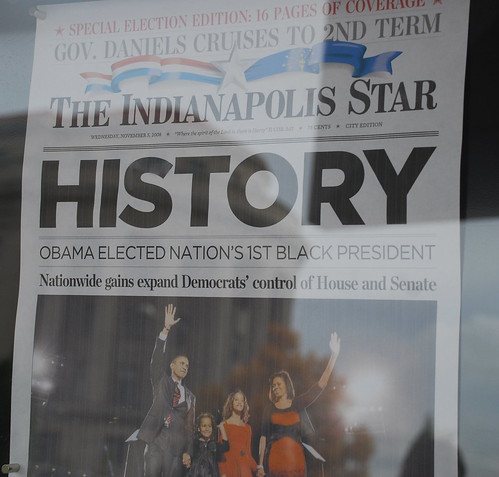
The Indianapolis Star from November 5, 2008

Over the past several years, I’ve seen how Gannett (owners of USA Today) have decimated the local reporting staff at the Indianapolis Star. They get rid of people who know how to report and write (and yes, there’s a difference). They get rid of well-known writers that bring regular readers to the paper in favor of a couple of recent college grads who — together — make up 75% of the salary of the original writer. They have bombed out the newsroom, eliminated business writers, booted popular columnists, and slashed the different culture and dining critics. To add insult to injury, the design work for the Indianapolis Star will soon be moved to Louisville. All we’re left with is a sterilized husk of what was once an awesome newspaper.

The Indianapolis Star, when it was run by the Pulliam family, actually won the Pulitzer Prize in 1975, for its outstanding reporting in exposing police corruption in 1974. (The Indianapolis Star, when it has been run by Gannett has, well, not.) I’ve been reading the book by Dick Cady, one of the reporters who helped break the police corruption story wide open, and I sometimes wonder if I’m reading about the same newspaper.

I’m reading a newspaper that wasn’t afraid to go up against local law enforcement for the sake of truth, justice, and the American way. Meanwhile, I’m left with a newspaper whose median years of newsroom experience is slowly drifting toward the single digits.

And yet Gannett can’t figure out why newspaper ad revenue is dropping like a rock. I’ll tell you why: no one wants to read the Indianapolis edition of USA Today. But that’s what we’ll be left with in less than five years (some former Indy Star readers and employees think five years is overly optimistic).

Blogging is not to blame for this. Blogging has not harmed the Indianapolis Star. Blogging did not make Gannett fire people like columnists Ruth Holladay or Lori Borgman, or business writers like John Ketzenberger. Blogging did not kill what was actually a profit-making online venture by replacing the editor with someone much younger.

Instead, blogging is picking up the pieces that Gannett and other big-city newspapers are dropping whenever they gut their newsrooms yet again.

There’s a great blog on the southeast side of Indianapolis called (what else?) Southeast Indianapolis Communities. It’s a simple little blog that has nothing but news for the southeast side of town. They’re covering the news and events that the Indy Star won’t and can’t cover. They’re doing the kind of reporting that the Star doesn’t have the staff, time, or even city knowledge to adequately write about.

Basically, Southeast Indianapolis Communities is filling the gap left by Gannett’s mishandling of the Indianapolis Star, and they’re doing a great job. In this case, SIC hasn’t hurt the Star. Rather, the growing crappiness of the Star is helping the SIC.

What about your newspaper in your city? Is your newspaper holding on, or are you seeing the same decimation and ruin that we’re seeing in Indianapolis? Tell us about your city’s newspaper and if you’re seeing any local blogs picking up the slack. (And tell us about those too.)

My book, Branding Yourself: How to Use Social Media to Invent or Reinvent Yourself (affiliate link), is available for pre-order on Amazon.com. I wrote it with my good friend, Kyle Lacy, who I also helped write Twitter Marketing For Dummies (another affiliate link).

Stephen, I can’t find the post where you commented with this great insight. If you’re out there, let me know who you are, so I can at least link to a Twitter page or your blog, or something.

Photo credit: afagen (Flickr)

Filed Under: Blogging, Broadcast Media, Print Media, Traditional Media Tagged With: blog writing, bloggers, citizen journalism, newspapers, traditional media

December 4, 2010 By Erik Deckers

Five Reasons Why We Use WordPress

We’re a WordPress house.

90% of our clients are on a WordPress site. The others are either Joomla or Compendium, a blogging platform made right here in Indianapolis.

Personally, I use Blogspot for my humor blog and Posterous for an experimental/personal blog I use for conferences and social media and crisis communicationsdemos.

Taking notes at Tammy Hart's WordPress Design session at WordCamp Louisville.

But when it comes to this blog, our clients’ blogs, and any consulting we do, we’re a WordPress house. In fact, I’m sitting at the Wordcamp Louisville conference right now, at Tammy Hart’s session on designing with WordPress. It’s informative, inspiring, and she’s done some amazing stuff. She’s also making me feel guilty for using pre-built themes (not enough to stop, but I’ll at least feel a twinge of guilt whenever I buy one).

So here are the five reasons we use WordPress, and why we think any corporate bloggers ought to use it too.

  • You can make it do just about anything you want. Tammy says WordPress won’t do your laundry, won’t fix the economy, won’t climb Mount Everest, and won’t explain the meaning of life.* But, you can create brochure sites, basic e-commerce sites, magazines, social communities, a knowledge base, even an invoicing and time tracking system. The important thing about WordPress design is to ask yourself, “How do I make WordPress do X, Y, and Z?” not “What can WordPress do?” So far, we’ve been able to make WordPress do anything our clients need.
  • It’s easy to optimize a site for search engines. We use a plugin called All In One SEO, which helps us creative keyword-rich WordPress meta tags very easily. In fact, I interrupted that last sentence to take 30 seconds to drop in my All In One SEO tags. You didn’t even notice I was gone, did you? There are a lot of companies who specialize in search engine optimization. And the one secret they don’t want me to tell you is that they use a plugin like this to make their lives so much easier. (To be fair, there’s a whoooole lot more they do offsite, and there’s no plugin for that.)
  • The developers make it so easy to use. Anyone with some technical know-how, or at least the patience to figure it out, can set up a blog with WordPress.org. (WordPress.com is easy-peasy. Just go to the site, start an account, choose your theme, and start blogging.) WordPress.org lets you download the software to your own server, where you control everything — updates, themes, plugins. Everything. Tammy says “WordPress.com is like renting, WordPress.org is like buying. If you rent, you can’t knock down walls, can’t paint, can’t change the carpet. Of course, if you rent, you don’t have to fix the toilet, don’t have to fix the water heater, don’t have to fix the refrigerator.” We like WordPress.org, because we can even design the site so it doesn’t look like a WordPress site.
  • It lets you own everything, including your content. No other site does that. Facebook, Twitter, even WordPress.com, owns the means of production and communication. If they go away, all your content is gone. If Facebook inadvertently deletes your account, all your stuff is gone. (They did that to a bunch of accounts when they rolled out Facebook Messaging a month ago, including my mom’s. They restored them all, but it showed how uncertain using someone else’s platform can be.) If Twitter goes under, all your tweets are gone. Even if Blogger (owned by Google) decides you violated their Terms of Service, they’ll delete your stuff, never to return again.But with WordPress.org, the software lives on your server, under your domain, with your content. The only thing that can make it die is you. Even if WordPress dies as a platform, you still own your copy of the software, so you can make it limp along for a couple of years until you find a suitable replacement. Why would you want to put your stuff’s safety and existence at the mercy of someone else’s whim?
  • It’s very easy to embed photos and videos. I’ve used some other blog platforms, and embedding video and photos can be a bit of a pain. WordPress makes it so easy to upload photos and videos, whether they’re from my computer (like these two are), or they’re hosted on YouTube and Vimeo, Flickr and Picasa. Just a couple of clicks, and my media is in place.

There are hundreds of reasons to use WordPress. These are just the five that make us big fans and grateful users. How about you? Why do you use it Or to turn it around, why do you hate it What is your favorite platform, and why?

* Actually, yes it will. It’s 42. And you heard it here on a WordPress blog.

Filed Under: Blogging, Tools, Writing Tagged With: blog writing, business blogging, WordPress

Primary Sidebar

Subscribe via RSS

Categories

Tags

advice bloggers blogging blog writing books book writing business blogging citizen journalism content marketing copywriting crisis communication digital marketing Ernest Hemingway Facebook freelance writing ghost blogging ghostwriting Google grammar Jason Falls journalism language Linkedin marketing media networking newspapers No Bullshit Social Media personal branding public relations public speaking punctuation ROI SEO Social Media social media experts social media marketing social networking storytelling traditional media Twitter video writers writing writing skills

Archives

Recent Posts

  • The Enshittification of Evernote and Why I Quit Them
  • 11 Tips for New Digital Nomads
  • 13 Things to Do or Not to Do When Connecting With Me for the First Time
  • Why You Need to Write Your Memoir
  • How to Give a 6-Minute Presentation at 1 Million Cups

Footer

BUY ERIK DECKERS’ LATEST BOOK

Erik Deckers' and Kyle Lacy's book - Branding Yourself now available at Amazon

Request a Quote – It’s easy

We write blog posts, manage social media campaigns, write online press releases, write monthly news letters and can write your website content.

Let's figure out the right package for you.

FREE 17 Advanced Secrets to Improve Your Writing ebook

Download our new ebook, 17 Advanced Secrets to Improve Your Writing

Erik recently presented at the Blogging For Business webinar, and shared his presentation "12 Content Marketing Secrets from the Giants of Fiction.

If you attended the event (or even if you didn't!), you can get a free copy of his new ebook on professional-level secrets to make your writing better than the competition.

You can download a copy of free ebook here.

© Copyright 2020 Professional Blog Service, LLC.

All rights reserved. Use of this site indicates your consent to our Privacy Policy and Terms of Use.

1485 Oviedo Mall Boulevard Oviedo, FL 32765
Call us at (317) 674-3745 Contact Us About